
Missing teeth can dramatically affect your confidence, ability to eat comfortably, and overall oral health. Research shows that tooth loss leads to jawbone deterioration, shifting of remaining teeth, and changes in facial structure. Replacing missing teeth quickly is essential for maintaining proper bite alignment, preserving bone density, and restoring full function.
Two primary solutions exist for tooth replacement: dental implants and dental bridges. Each option offers distinct advantages and limitations that patients in Nepal should understand before making their decision. This comprehensive guide explores both treatments in detail, helping you determine which solution best matches your specific dental needs, budget, and lifestyle.
Understanding Tooth Replacement Options: Implants vs. Bridges
Losing a tooth affects more than just your smile, proper chewing becomes difficult, speech may suffer, and remaining teeth begin shifting into empty spaces. Two primary solutions exist for tooth replacement: dental implants and dental bridges, each working through fundamentally different mechanisms.
Implants replace both root and crown by surgically placing titanium posts into jawbone, while bridges use neighboring teeth as anchors to hold artificial teeth in place. Understanding how each option functions, along with their distinct advantages and limitations, helps you make informed decisions about restoring your smile and oral health.
What are dental implants and how do they work?
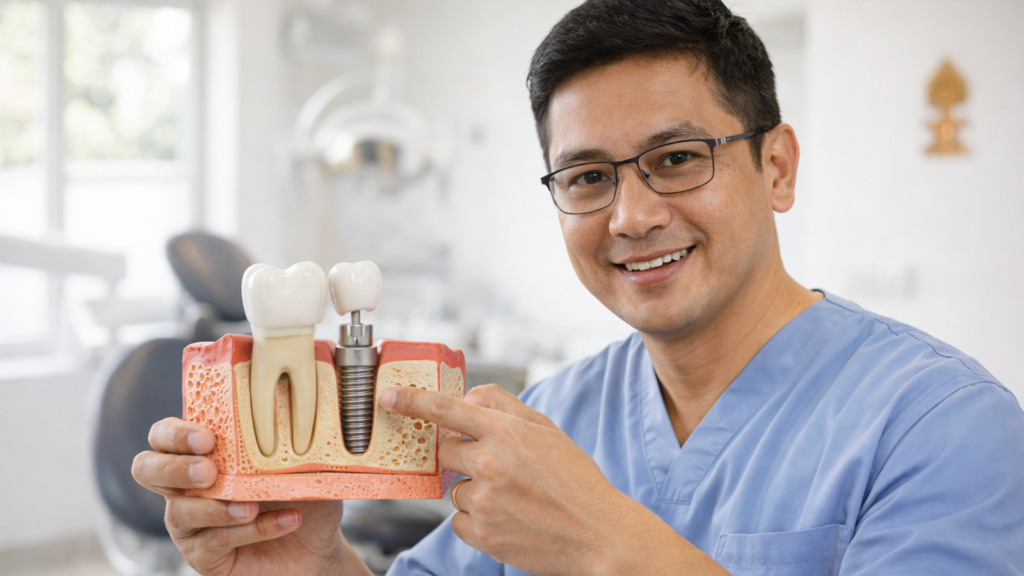
A dental implant is a biocompatible titanium post surgically inserted into the jawbone to replace a missing tooth’s root. Once placed, bone naturally grows around this post through a process called osseointegration, creating a stable foundation. Healing typically requires 3 to 6 months (90 to 180 days) before dentists attach an abutment connector and custom crown.
Implants function independently without relying on neighboring teeth for support. After complete osseointegration, the implant-supported crown looks, feels, and performs like a natural tooth. Unlike removable dentures, implants remain permanently fixed in your jaw, providing stability for chewing, speaking, and smiling.
The procedure involves multiple stages. First, oral surgeons evaluate your jawbone density using X-rays or Computed Tomography (CT) scans. Adequate bone volume is necessary for successful implant placement. Patients with insufficient bone may require grafting procedures before implant surgery, adding time and cost to treatment.
What are dental bridges and when are they used?
A dental bridge is a prosthetic restoration that literally “bridges” gaps created by missing teeth. Bridges consist of one or more false teeth (pontics) anchored by crowns on adjacent natural teeth or dental implants. Traditional bridges require preparing neighboring teeth by filing them down to accommodate supporting crowns.
What Types of Bridges exist?
There are three types of bridges exist;
- Traditional bridges represent the most common option. Crowns placed on teeth flanking the gap hold a pontic between them. Both neighboring teeth must be healthy enough to support crowns, and dentists permanently alter these teeth by removing enamel.
- Cantilever bridges use only one adjacent tooth as an anchor. Dentists typically recommend cantilever bridges for front teeth where chewing forces are minimal, as single-sided support may not withstand heavy biting pressure.
- Maryland bridges (also called resin-bonded bridges) preserve more natural tooth structure. Metal or porcelain frameworks bond onto the backs of neighboring teeth with minimal enamel removal. However, Maryland bridges work best for front teeth in low-stress areas and may show metal frameworks or cause staining over time.
Bridges restore chewing function and appearance within weeks, requiring only 2 to 3 dental visits. Unlike removable partial dentures, bridges stay permanently cemented in your mouth.
What are the Key differences between dental implants and bridges
Dental implants replace both root and crown, functioning as independent units. Bridges rely on adjacent teeth for structural support, permanently altering healthy teeth in the process. Understanding these fundamental differences helps patients make informed choices.
- Structural approach: Implants integrate with the jawbone, stimulating bone tissue and preventing deterioration. Bridges sit above the gumline, providing no stimulation to the underlying bone. Over years, bone loss beneath bridges can change facial contours and complicate future tooth replacements.
- Treatment timeline: Bridges offer faster results, completing treatment in several weeks. Implants require months for complete healing and final crown placement. Patients needing immediate restoration may prefer bridges for speed.
- Adjacent tooth impact: Implants preserve neighboring teeth completely. Bridges require grinding down healthy adjacent teeth for crown placement, increasing future cavity and fracture risks for those supporting teeth.
- Maintenance requirements: Implants clean like natural teeth with standard brushing and flossing. Bridges demand special flossing techniques under pontics where food particles accumulate, making daily hygiene more challenging.
Who typically needs tooth replacement treatment?
Anyone with one or more missing teeth should consider replacement options. Tooth loss occurs from various causes: severe decay, gum disease (Periodontitis), trauma, congenital absence, or failed root canals. Regardless of cause, leaving gaps untreated creates problems.
Adjacent teeth drift into empty spaces, creating bite misalignment and increased decay risk. Opposite teeth may over-erupt without opposing contact, destabilizing your entire bite. Jawbone beneath missing teeth gradually shrinks without root stimulation, potentially complicating future dental work.
Younger patients often benefit from implants’ longevity, avoiding multiple bridge replacements throughout life. Older patients with health conditions affecting healing may find bridges more suitable. Your dentist evaluates factors including age, overall health, bone density, oral hygiene habits, and budget when recommending treatment.
Patients with uncontrolled diabetes, heavy tobacco use, or immunocompromising conditions may face higher implant failure risks. Bridges offer alternatives when surgery poses unacceptable health risks.
Comparing Dental Implants vs. Bridges: Benefits and Limitations
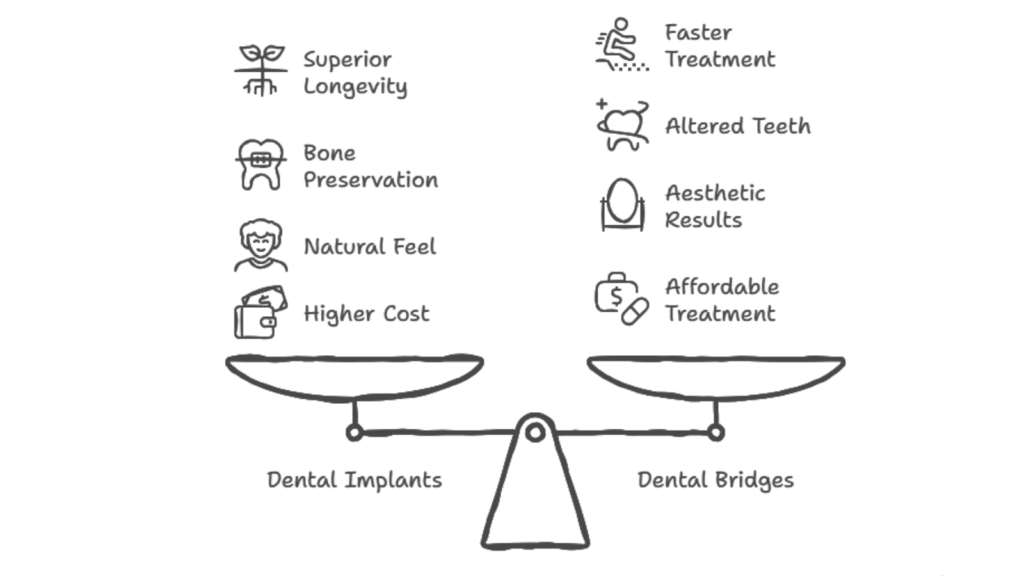
Dental implants offer superior longevity and bone preservation, typically lasting 20-plus years while stimulating the jawbone to prevent deterioration. Bridges provide faster, more affordable treatment requiring only several weeks to complete, though they permanently alter adjacent healthy teeth and need replacement every 8 to 12 years.
Both options achieve excellent aesthetic results, yet implants feel more natural because they’re anchored directly in bone rather than attached to neighboring teeth. Your choice between these treatments depends on factors including bone density, overall health, budget constraints, and willingness to undergo minor surgery versus faster non-surgical alternatives.
Dental implants: advantages, durability, and long-term value
Implants provide the most durable tooth replacement option available. With proper care, implants commonly last 20-plus years or even a lifetime. Success rates exceed 97% at 10 years, making implants highly predictable investments in oral health.
Key advantages include:
- Bone preservation: Implants stimulate jawbone just like natural tooth roots, preventing bone resorption that causes sunken facial appearance. The Food and Drug Administration (FDA) emphasizes that implants help maintain bone density long-term.
- Protecting adjacent teeth: Unlike bridges, implants require no alteration of neighboring teeth. Healthy teeth remain untouched, preserving their strength and integrity for decades.
- Natural appearance and function: Implant crowns emerge from gums like natural teeth, creating seamless aesthetics. Patients report implants feel indistinguishable from biological teeth when chewing, speaking, and smiling.
- No cavities: Implant crowns cannot develop decay, though gum tissue surrounding them requires diligent cleaning to prevent peri-implantitis (gum inflammation around implants).
- Independence: Each implant stands alone, so failure of one implant doesn’t affect neighboring restorations or natural teeth.
Despite these benefits, implants have limitations. Higher upfront costs (NPR 60,000 to 150,000 in Kathmandu) and extended treatment timelines require patient commitment. Surgical placement carries risks including infection, nerve damage, or sinus complications, though serious complications remain rare with experienced surgeons.
Dental bridges: benefits, limitations, and short-term outcomes
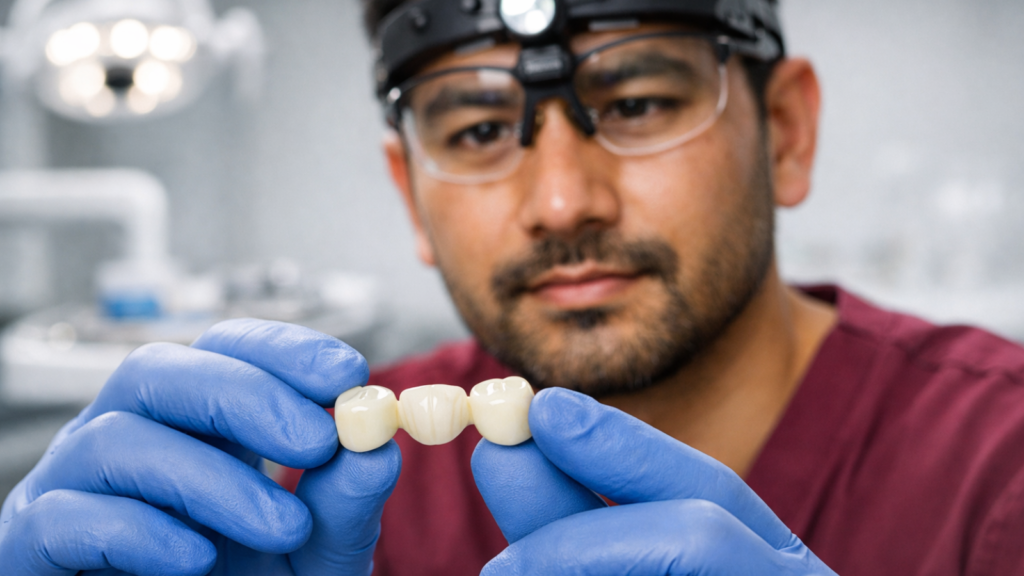
Bridges offer effective tooth replacement with distinct advantages for specific situations. Dentists complete bridge placement in 2 to 3 visits over several weeks, providing faster results than implants.
Dental bridges Primary benefits include:
- Quick treatment: Bridges restore appearance and function within weeks. Patients needing rapid tooth replacement for upcoming events or immediate functional needs appreciate this speed.
- Lower initial cost: A three-unit bridge in Nepal typically costs NPR 54,000 to 75,000, considerably less than single-tooth implant expenses upfront.
- No surgery required: Patients avoiding surgery due to health concerns, anxiety, or healing limitations find bridges attractive alternatives.
- Multiple tooth replacement: Bridges efficiently replace 2 to 3 adjacent missing teeth without requiring individual implants for each gap.
Bridges have significant limitations affecting long-term oral health:
- Shorter lifespan: Bridges typically last 5 to 7 years, though some extend to 10-plus years with excellent care. Replacement every decade means additional costs and dental visits over time.
- Altering healthy teeth: Preparing abutment teeth for crowns removes significant enamel permanently. Crowned teeth face increased cavity and sensitivity risks compared to untouched teeth.
- Difficult cleaning: Flossing beneath pontics requires threaders or water flossers. Inadequate cleaning leads to decay on abutment teeth and gum disease.
- Continued bone loss: Bridges provide no stimulation to the jawbone beneath pontics. Bone continues deteriorating, potentially affecting future dental work and facial structure.
- Stress on abutment teeth: Supporting teeth bear extra chewing forces, increasing fracture risks over years.
Dental implants vs. bridges: which looks and feels more natural?
Both options achieve excellent cosmetic results when properly designed and fabricated. Modern materials like zirconia and porcelain allow dentists to match color, shape, and translucency of surrounding teeth.
- Implants typically edge ahead in naturalness. Crown emergence from gum tissue mimics biological tooth anatomy precisely. Implant-supported restorations maintain gum contours long-term because bone preservation prevents tissue recession.
- Bridges also look natural initially, especially all-ceramic or zirconia varieties. Well-crafted bridges blend seamlessly with adjacent teeth. However, bone loss beneath pontics can create visible gaps between artificial teeth and gums over years. Metal frameworks in Maryland bridges occasionally show through or cause gum discoloration.
Regarding feel, implants win decisively. Patients report implants feel like natural teeth because they’re anchored directly in bone with no connection to neighbors. Bridges, while stable, sometimes feel slightly different due to their attachment to adjacent crowned teeth.
What’s the Impact on nearby teeth and jawbone health
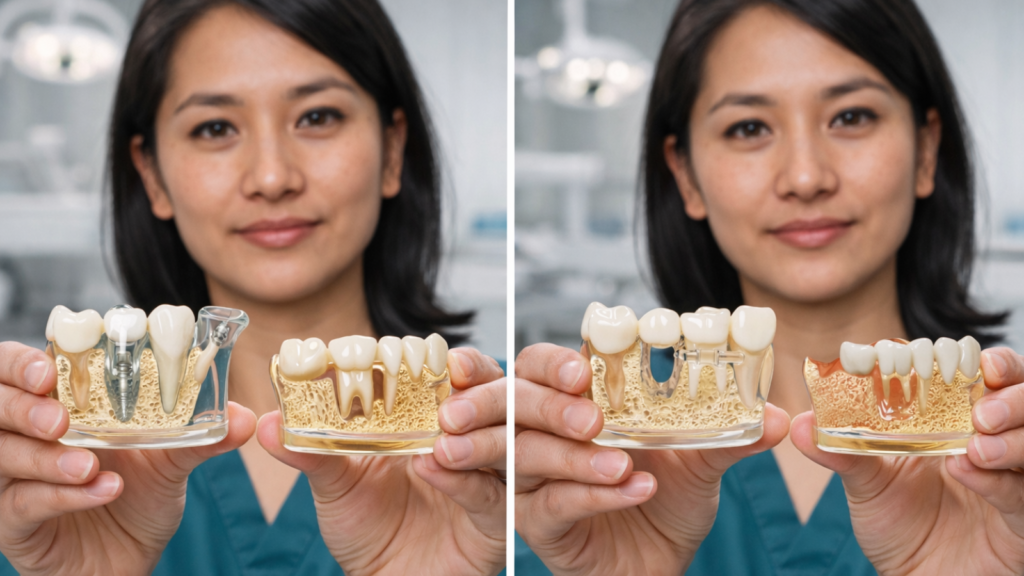
Tooth replacement choices significantly affect long-term oral health beyond the immediate restoration.
Implant effects on surrounding structures: Implants preserve neighboring teeth completely, requiring no modifications. Bone stimulation from implant posts maintains jaw structure, preventing the sunken facial appearance common after tooth loss. Studies show implants help stabilize adjacent teeth by maintaining proper spacing and bite forces.
Bridge effects on surrounding structures: Bridges permanently alter abutment teeth through enamel removal for crown placement. Crowned teeth face higher decay risks, especially at crown margins where cleaning proves difficult. Research indicates teeth supporting bridges develop cavities and require additional treatment more frequently than unaltered teeth.
Bridges accelerate bone loss beneath pontics because no root stimulation occurs. Over 10 to 15 years, significant bone resorption can compromise future implant placement or denture fit.
Abutment teeth bear increased chewing forces, sometimes causing cracks or fractures requiring extraction. Losing an abutment tooth means replacing the entire bridge with a longer span, cascading into more complex and expensive treatments.
Cost, Procedure, and Time Factors in Nepal

Dental implants in Kathmandu cost NPR 60,000 to 150,000 per tooth and require 4 to 8 months completion time including healing periods. Bridges range from NPR 54,000 to 75,000 for three-unit restorations and finish within 2 to 3 weeks from start to final placement.
Many Kathmandu clinics offer payment plans allowing staged payments throughout treatment, making both options more financially accessible for patients. Insurance coverage remains limited in Nepal, though some employer-sponsored plans provide partial dental benefits worth investigating before starting treatment.
Cost of dental implants in Nepal: what affects the price?
Dental implant costs in Kathmandu range from NPR 60,000 to 150,000 per tooth, including implant post, abutment, and crown. Several factors influence final pricing.
- Implant system brand: Premium European or American implant systems (Straumann, Nobel Biocare) cost more than Asian alternatives. Higher-priced systems often provide extensive research backing and longer warranty coverage.
- Crown material: Porcelain-fused-to-metal crowns cost less than all-ceramic or zirconia crowns. All-ceramic options provide superior aesthetics, especially for front teeth.
- Additional procedures: Bone grafting adds NPR 20,000 to 40,000. Sinus lifts for upper posterior teeth increase costs similarly. CT scans for surgical planning typically cost NPR 3,000 to 5,000.
- Clinic location and reputation: Established clinics in central Kathmandu charge premium rates reflecting overhead costs and experienced specialists. Newer or suburban clinics may offer lower pricing.
- Dentist experience: Implant placement requires surgical training and expertise. Experienced implantologists command higher fees but typically deliver more predictable outcomes with fewer complications.
Many Kathmandu clinics offer payment plans, allowing patients to stage payments over treatment duration. Firstly, initial consultation and diagnostics; secondly, surgical placement; thirdly, final crown placement.
Cost of dental bridges in Nepal: affordable options explained
Bridge costs in Nepal prove considerably more budget-friendly upfront. A typical three-unit bridge ranges from NPR 54,000 to 75,000, though prices vary based on materials and clinic.
Material selection impacts pricing:
Metal-ceramic bridges cost less, ranging NPR 15,000 to 25,000 per unit. Metal substructures provide strength but may show dark lines at gum margins.
All-ceramic bridges offer superior aesthetics at NPR 20,000 to 30,000 per unit. Ceramic material matches natural tooth translucency beautifully.
Zirconia bridges provide optimal strength and aesthetics, costing NPR 20,000 to 35,000 per unit. Zirconia resists staining and fracture exceptionally well.
Hidden costs considerations:
Bridge lifespan averages 8 to 12 years. Replacement every decade means repeating costs multiple times throughout life. When calculating long-term expenses, bridges may actually cost more than implants over 20 to 30 years.
Supporting teeth may develop problems requiring additional treatment. Cavity treatment, root canals, or even extraction of abutment teeth add unforeseen expenses.
Procedure timeline: how long implants vs. bridges take
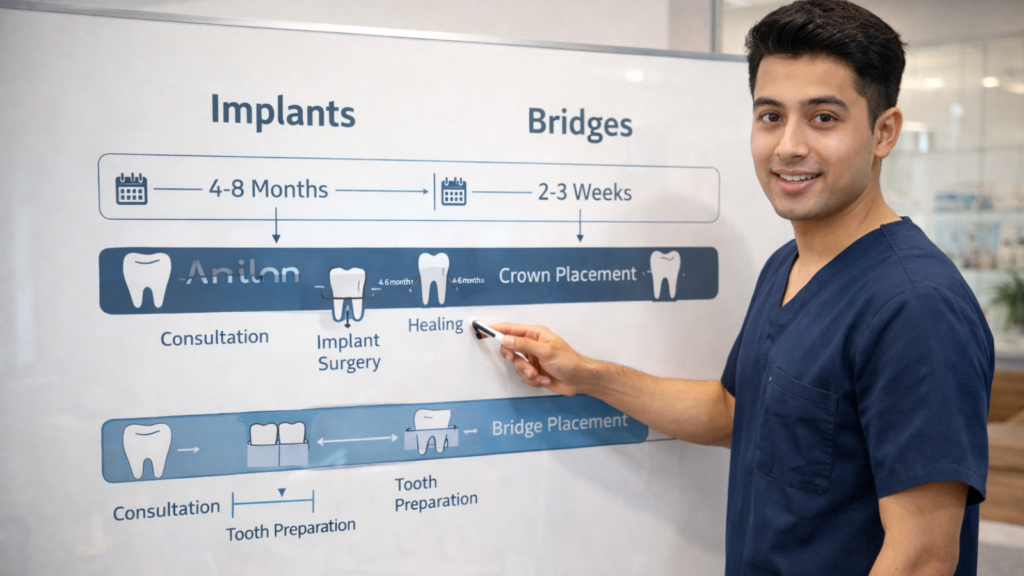
Dental implant timeline:
Initial consultation involves examination, X-rays, and treatment planning (one visit, approximately 1 hour). Surgical implant placement under local anaesthesia takes 1 to 2 hours per implant. Healing and osseointegration require 3 to 6 months before proceeding.
Abutment placement occurs after healing confirms successful integration (one visit, approximately 30 minutes). Crown fabrication requires impressions and laboratory work (one to two weeks). Final crown placement and bite adjustment complete treatment (one visit, approximately 1 hour).
The total timeline spans 4 to 8 months from start to finish. Patients requiring bone grafts add 3 to 6 additional months for graft healing before implant placement.
Dental bridge timeline:
Initial consultation includes examination and treatment planning (one visit, approximately 1 hour). Tooth preparation and impression-taking occur during the second appointment (one visit, approximately 1.5 to 2 hours). Temporary bridge placement protects prepared teeth while the laboratory fabricates final restoration.
Laboratory work requires 1 to 2 weeks. Final bridge placement, adjustment, and cementation complete treatment (one visit, approximately 1 hour).
The total timeline spans 2 to 3 weeks from start to finish. Bridges provide significantly faster completion, appealing to patients needing quick results.
Is dental insurance or financing available in Nepal?
Dental insurance coverage in Nepal remains limited compared to Western countries. Most insurance policies provide minimal dental benefits, typically covering only basic extractions and fillings. Implants and bridges usually fall outside standard coverage.
Some employers offer enhanced health plans including partial dental coverage. Government employees and military personnel may access better dental benefits through state programs. Always verify your specific policy details before assuming coverage.
Major private clinics in Kathmandu increasingly offer in-house financing plans. Payment options include:
Staged payments: Pay for each treatment phase separately rather than the entire cost upfront. Firstly, diagnostic fees; secondly, surgical fees; thirdly, final restoration fees.
Instalment plans: Spread total cost over 6 to 12 months with interest-free or low-interest terms.
Credit arrangements: Partner financing companies provide dental loans with competitive interest rates.
Discussing financial concerns openly with your dentist helps identify affordable solutions. Many clinics work within patient budgets while maintaining quality standards.
How to Choose the Right Option for Your Dental Needs?
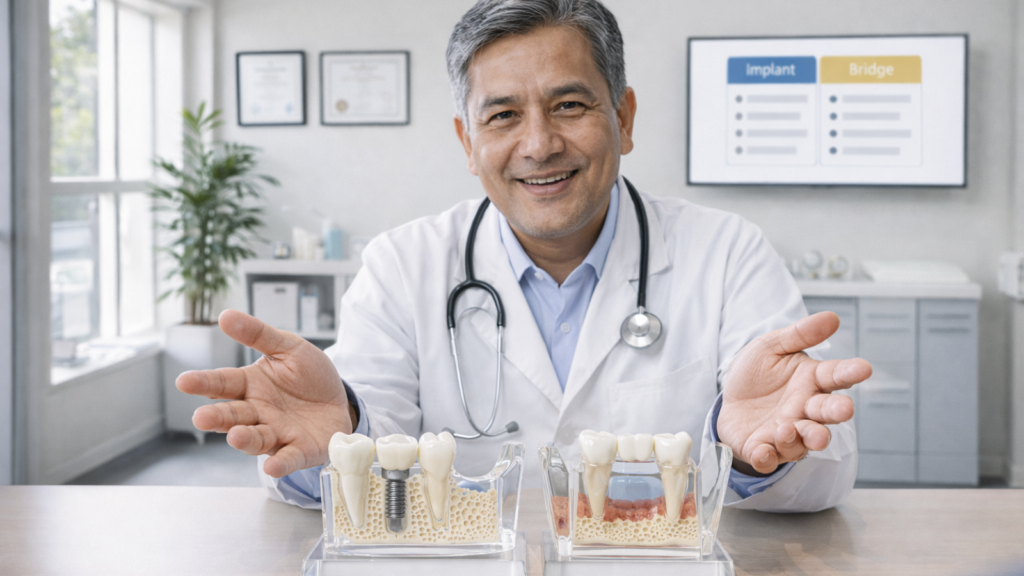
Selecting between implants and bridges requires evaluating your jawbone density, overall health status, budget limitations, and timeline expectations for treatment completion. Implants work best for patients with adequate bone, good general health, and desire for longest-lasting solutions protecting adjacent teeth.
Bridges suit patients needing faster results, those unable to undergo surgery, or situations where multiple consecutive teeth require replacement simultaneously. Consulting experienced dentists in Nepal ensures comprehensive evaluation of your specific circumstances, leading to personalized treatment recommendations matching your oral health goals and financial capabilities.
Dental implants vs. bridges for beginners: decision checklist
Selecting between implants and bridges requires evaluating multiple personal factors. Use this checklist to guide your decision:
Health considerations:
- Do you have adequate jawbone density? (Implants require sufficient bone)
- Are you in good general health without conditions affecting healing? (Diabetes, smoking, immune disorders impact implant success)
- Can you undergo minor oral surgery safely? (Some health conditions contraindicate surgery)
Financial factors:
- Can you afford higher upfront costs for implants?
- Do you prefer lower initial expenses with bridges, accepting future replacement costs?
- Does your insurance provide any coverage for either option?
Time availability:
- Can you wait several months for complete implant treatment?
- Do you need immediate tooth replacement within weeks?
Long-term priorities:
- Do you want the longest-lasting solution available?
- Are you willing to sacrifice longevity for quicker, cheaper treatment?
Oral health goals:
- Do you want to preserve adjacent healthy teeth?
- Is preventing bone loss important to you?
Maintenance preferences:
- Are you comfortable with standard oral hygiene routines?
- Can you commit to special cleaning techniques required for bridges?
Honest answers to these questions illuminate which option better matches your circumstances.
Best option for missing front teeth vs. back teeth
Tooth location influences optimal replacement choice. Front teeth (incisors and canines) demand superior aesthetics because they’re visible when smiling and speaking. Back teeth (premolars and molars) require exceptional strength for heavy chewing forces.
Front tooth replacement:
Implants excel for front teeth replacement. Single-tooth implants create natural-looking results without dark gum lines or visible metal. Bone preservation maintains facial contours and prevents sunken appearance around lips.
Maryland bridges provide reasonable front tooth alternatives when implants aren’t feasible. Conservative preparation preserves tooth structure on adjacent teeth. However, metal frameworks sometimes show through translucent front teeth.
Traditional bridges work well cosmetically but permanently alter neighboring teeth. All-ceramic bridges provide excellent aesthetics for front tooth spans.
Back tooth replacement:
Both options work effectively for back teeth. Implants provide superior longevity and protect adjacent teeth. Single-unit molars experience tremendous chewing forces, making implants’ bone-anchored stability advantageous.
Bridges economically replace multiple adjacent back teeth. A bridge spanning two or three missing molars costs significantly less than placing individual implants for each tooth. However, bridges transfer chewing forces to abutment teeth, potentially causing problems over time.
Patients grinding teeth (bruxism) should consider implants’ superior stability. Bridges on bruxers may fracture or debond under excessive forces.
Choosing based on age, bone health, and oral condition
Age considerations:
- Young adults (18 to 25 years) may still have developing jawbones. Dentists typically delay implant placement until jaw growth completes, making bridges temporary solutions for this age group.
- Middle-aged adults (25 to 60 years) generally make ideal implant candidates with stable bone and good healing capacity. Implants’ longevity provides excellent value throughout the remaining lifetime.
- Seniors (60-plus years) benefit from both options. Healthy seniors make excellent implant candidates. Those with health concerns or medications affecting healing may prefer bridges’ non-surgical approach.
Bone health:
- Strong, dense jawbone supports implants successfully. Dentists assess bone quality using CT scans. Adequate bone height and width prove essential for implant stability.
- Moderate bone loss can be addressed with grafting procedures before implant placement. Grafts use natural or synthetic bone materials to rebuild sufficient volume, though adding 3 to 6 months healing time.
- Severe bone loss may make implants impractical or prohibitively expensive. Multiple grafting surgeries and extended treatment times discourage some patients. Bridges provide effective alternatives when bone deficiency prevents implants.
Existing oral conditions:
- Active gum disease (gingivitis or periodontitis) requires treatment before any tooth replacement. Uncontrolled gum infection causes implant failure and bridge complications.
- Patients with multiple missing teeth face complex decisions. Strategic implant placement can support fixed bridgework, combining both approaches for optimal results and cost-effectiveness.
- Heavy tobacco users experience higher implant failure rates. Smoking impairs healing and bone integration. Dentists may refuse implant treatment for heavy smokers or require smoking cessation before surgery. Bridges work better for patients unwilling to quit tobacco.
What dentists in Nepal recommend for long-term results?
Dental professionals in Kathmandu consistently recommend implants for optimal long-term outcomes when patients meet candidacy criteria. Implants preserve bone, protect adjacent teeth, and provide superior durability compared to bridges.
Leading clinics emphasize patient education, ensuring understanding of both options’ advantages and limitations. Comprehensive consultations include:
- Detailed examination of oral health, bone density, and overall medical condition
- Digital imaging (X-rays, CT scans) to assess bone volume and plan treatment
- Discussion of costs, timelines, and expected outcomes for both options
- Customized treatment plans matching individual needs and priorities
Most dentists acknowledge bridges serve important roles when health conditions, insufficient bone, or budget constraints preclude implants. Well-made bridges effectively restore function and appearance, especially for patients unable or unwilling to undergo surgery.
Experienced clinicians stress realistic expectations. No restoration lasts forever, requiring maintenance and potential replacement eventually. Regular dental checkups, excellent oral hygiene, and addressing problems promptly maximize longevity for both implants and bridges.
Implants and Bridges Common Questions, Problems, and Next Steps

Both implants and bridges occasionally develop complications requiring professional attention, including infection, loosening, or damage to surrounding teeth and gums. Proper daily care, brushing twice daily, flossing carefully around restorations, and attending regular dental checkups, prevents most problems and maximizes treatment longevity.
Pain levels remain manageable for both procedures through modern anaesthesia and post-treatment medications, with most patients returning to normal activities within days. Schedule consultation at a reputable Kathmandu dental clinic immediately after tooth loss or when learning extraction becomes necessary, as early replacement prevents bone deterioration and tooth shifting that complicate future treatment options.
Are dental implants painful compared to bridges?
Dental implant surgery involves less discomfort than many patients expect. Dentists perform implant placement under local anaesthesia, numbing the surgical area completely. Most patients report feeling pressure during surgery but no pain.
Post-surgical discomfort typically remains mild to moderate, managing well with over-the-counter pain medication. Swelling and bruising may occur for several days. Most patients return to normal activities within 24 to 48 hours.
Bridge preparation causes minimal discomfort because tooth reduction occurs under local anaesthesia. Temporary sensitivity on prepared teeth may persist until final bridge placement. Some patients experience brief sensitivity to hot or cold temperatures initially.
Overall, neither procedure causes unbearable pain. Modern anaesthesia and pain management techniques ensure comfortable experiences for both treatments.
What problems can occur with implants or bridges?
Implant complications:
- Infection at surgical sites occurs occasionally, requiring antibiotics. Proper post-operative care and oral hygiene minimize infection risks.
- Implant failure (lack of osseointegration) happens in approximately 2 to 3% of cases. Failed implants must be removed, allowing bone healing before replacement attempts.
- Nerve damage during surgery can cause numbness or tingling in lips, tongue, or chin. Careful surgical planning using CT scans reduces nerve injury risks significantly.
- Sinus complications may arise when placing upper back implants near maxillary sinuses. Sinus lifts address this issue but add complexity.
- Peri-implantitis (gum inflammation around implants) develops from inadequate cleaning. Regular dental visits and meticulous home care prevent this condition.
Bridge complications:
- Decay on abutment teeth represents the most common bridge problem. Difficulty cleaning beneath pontics allows plaque accumulation and cavity formation.
- Abutment tooth fracture occurs when supporting teeth cannot withstand increased chewing forces. Fractured abutment teeth may require extraction, necessitating longer bridge spans or alternative treatments.
- Bridge loosening or debonding happens occasionally. Cement failures require professional recementation.
- Gum disease around bridge margins develops when cleaning proves inadequate. Inflamed gums recede, exposing crown margins and creating aesthetic concerns.
- Pontic wear or staining occurs over years, necessitating bridge replacement for cosmetic reasons.
How to care for dental implants and bridges after treatment
Implant care:
- Brush implant crowns exactly like natural teeth twice daily using soft-bristled toothbrushes. Electric toothbrushes work excellently for thorough cleaning.
- Floss around implant crowns daily, removing plaque between teeth and below gumline. Standard floss or water flossers both work effectively.
- Visit your dentist every 6 months (six months) for professional cleanings and examinations. Dentists check implant stability and surrounding tissue health during checkups and cleaning.
- Avoid extremely hard foods (ice, hard candy) that might damage implant crowns. While strong, porcelain crowns can chip under excessive force.
Bridge care:
- Brush bridge crowns and pontics twice daily like natural teeth. Pay special attention to areas where pontics meet gums.
- Use floss threaders or special bridge floss to clean beneath pontics daily. Threading floss under pontics removes trapped food particles and plaque.
- Water flossers effectively clean hard-to-reach areas around bridges. Directed water streams dislodge debris efficiently.
- Regular dental visits every 6 months allow professional cleaning under bridges and monitoring of abutment tooth health.
- Report any looseness, sensitivity, or unusual sensations immediately. Early intervention prevents small problems from becoming major complications.
When should you consult a dental clinic in Nepal?
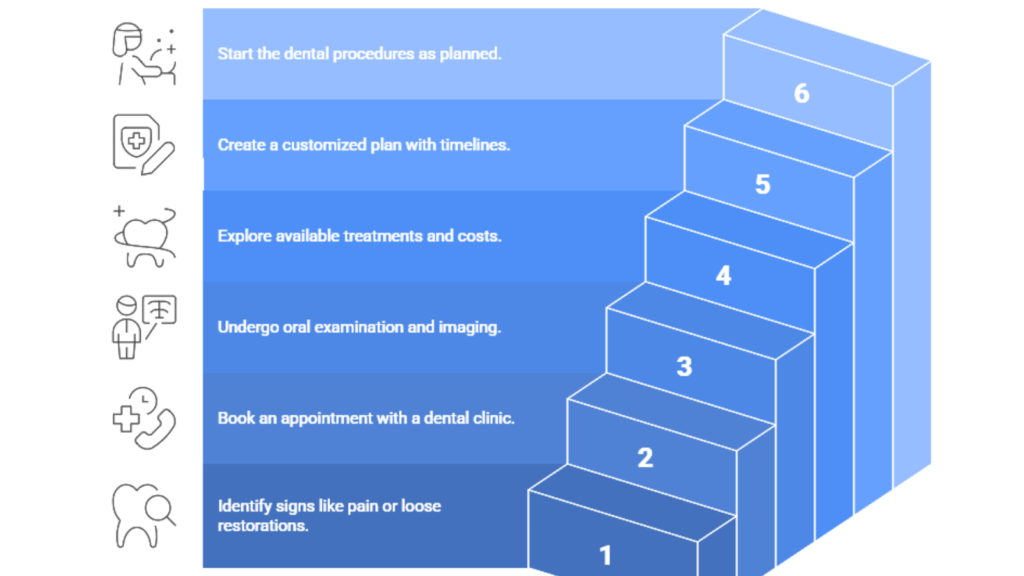
Schedule consultation promptly after losing a tooth or discovering you need extraction. Early tooth replacement prevents bone loss and tooth shifting that complicate future treatment.
Warning signs requiring immediate dental attention include:
- Pain, swelling, or bleeding around implants or bridges
- Loose implants or bridges (movement when touching with tongue)
- Bad taste or odour coming from restorations
- Visible decay around bridge margins
- Difficulty chewing or biting properly
- Changes in how upper and lower teeth meet
During your consultation, expect comprehensive evaluation including:
- Complete oral examination assessing tooth and gum health
- Digital X-rays or CT scans revealing bone density and anatomical structures
- Discussion of medical history and medications affecting treatment
- Detailed explanation of treatment options with associated costs and timelines
- Customized treatment plan addressing your specific needs and goals
Our dental clinics in Kathmandu offer transparent pricing, experienced specialists, modern equipment, and patient-centred care. Don’t hesitate to seek second opinions or ask detailed questions until you feel confident in your treatment decision. For Crowns and bridges consultation, contact BrightSmile Dental Clinic.
Can dental implants fail years after placement?
Yes, implants occasionally fail years later, though long-term failure rates remain low (under 5% at 15 years). Peri-implantitis from poor oral hygiene represents the primary cause of late failures. Smoking, uncontrolled diabetes, and excessive bite forces also contribute. Regular dental checkups and excellent home care minimize late failure risks significantly.
Will bridges damage my healthy teeth permanently?
Bridge placement requires removing enamel from supporting teeth, which cannot regenerate. Crowned teeth face higher cavity risks and may eventually need root canals or extraction. However, many bridge abutment teeth remain healthy for decades with proper care and maintenance.
How many teeth can one dental bridge replace?
Traditional bridges effectively replace 1 to 3 consecutive missing teeth. Longer spans become less stable and put excessive stress on abutment teeth. For larger gaps, dentists often recommend implant-supported bridges or individual implants for better stability.
Can smokers get dental implants successfully?
Smokers can receive implants but face higher failure rates (10 to 15% vs. 2 to 3% for non-smokers). Tobacco impairs healing and bone integration. Many dentists require smoking cessation several weeks before surgery and throughout healing for optimal success.
Do dental implants set off metal detectors?
No, dental implants do not trigger airport metal detectors or security scanners. Titanium implants contain insufficient metal mass to activate detection systems. Patients travel freely without concerns about dental implants causing security issues.
Can bridges be converted to implants later?
Yes, bridges can be removed and replaced with implants later. However, bone loss beneath old bridge pontics may necessitate grafting before implant placement. Converting requires additional time and expense beyond original implant costs.
What happens during the healing period after implant surgery?
During healing, bone gradually grows around and integrates with implant posts (osseointegration). Patients typically experience minimal discomfort after the first few days. Most people continue normal activities with slight dietary modifications, avoiding very hard foods near surgical sites until fully healed.
Are all-on-4 dental implants available in Nepal?
Yes, many advanced dental clinics in Kathmandu offer All-on-4 implant solutions for complete arch replacement. All-on-4 uses four strategically placed implants to support full-arch prosthetics, providing fixed teeth in one day at lower cost than individual implants per tooth.
How do dentists determine if bone grafting is necessary?
Dentists evaluate bone volume using CT scans showing three-dimensional jaw anatomy. Measurements reveal bone height, width, and density at proposed implant sites. Bone grafting becomes necessary when insufficient bone exists to surround and stabilize implant posts completely (typically needing 1 to 2 millimetres of bone around all implant surfaces).
Can dental bridges cause bad breath?
Bridges may contribute to bad breath when food particles and bacteria accumulate beneath pontics. Inadequate cleaning allows bacterial growth producing odours. Proper daily flossing under bridges and regular professional cleanings prevent bad breath associated with bridges.