
A toothache rarely announces itself politely. One moment you’re fine, the next you’re wondering whether you need a dentist today or if you can wait until morning. The difference between a minor irritation and a dental emergency often comes down to recognizing specific warning signs within the first few minutes. Most toothaches in Kathmandu patients fall into predictable patterns, and identifying yours quickly determines whether you book urgent care or manage symptoms safely at home.
This guide walks you through a practical triage system used by dentists at BrightSmile Dental Clinic and across Nepal. You’ll learn to match your exact symptoms to likely causes, understand what each pain type reveals about the underlying problem, and know precisely when waiting becomes risky. The goal is simple: give you the clarity to make the right decision fast.
Quick Toothache Triage: Identify the Problem in 2 Minutes
The first 2 minutes after tooth pain strikes determine whether you need emergency care, a next-day appointment, or safe home management. Facial swelling spreading to your eye or neck, fever above 101°F (38.3°C), or difficulty breathing signals a dental emergency requiring immediate medical attention, not a scheduled appointment. By pinpointing which tooth hurts, what triggers the pain (cold, hot, sweet, or biting), and how long each episode lasts (seconds versus minutes versus constant), you gather the exact information dentists need to diagnose your problem before you even sit in the chair.
Dental emergency red flags (face/eye/neck swelling, fever, trouble breathing/swallowing, uncontrolled bleeding)

Certain symptoms require immediate medical attention, not next-day dental booking. Facial swelling that closes your eye, spreads to your neck, or feels firm and hot signals a spreading infection that can obstruct airways or enter the bloodstream. Fever above 101°F (38.3°C) combined with tooth pain suggests your body is fighting a significant infection that antibiotics alone won’t resolve without dental intervention.
Difficulty breathing, swallowing, or opening your mouth (trismus) means the infection has progressed beyond the tooth socket into surrounding tissue planes. Uncontrolled bleeding that soaks gauze within minutes and doesn’t slow after 20 minutes of pressure often indicates a complication that needs professional control. You should head to the emergency department or call your dentist for after-hours instructions if you notice any of these signs.
The 60-second self-check: exact tooth, trigger (cold/hot/sweet/biting), and timing (seconds vs minutes vs constant)
Pinpointing the problem tooth and what provokes pain gives you 80% of the diagnostic picture. Stand in front of a mirror with good light. Gently tap each tooth with a fingernail or spoon handle, the painful one will announce itself. Note whether cold water, hot tea, sweet foods, or biting pressure triggers discomfort. This trigger reveals whether the problem sits in the enamel, nerve, or surrounding ligament.
Timing matters as much as intensity. Pain that vanishes within 5 seconds after removing the trigger usually means sensitivity or early decay. Discomfort lasting 30 seconds to several minutes after the stimulus ends points toward inflamed nerve tissue. Constant throbbing that persists regardless of triggers typically signals infection or an abscess forming at the root tip.
Record these 3 details before calling a dentist: which tooth hurts, what makes it worse, and how long each episode lasts. You’ll notice that dentists in Kathmandu consistently ask these exact questions because they narrow the diagnosis before you sit in the chair.
Can a toothache go away on its own? How long is “safe to wait” (24 to 48 hours vs 2+ days)
Minor sensitivity or irritation from food trapped between teeth can resolve within 24 hours with gentle cleaning. Pain triggered only by cold that fades within seconds and doesn’t worsen overnight often settles as enamel remineralizes or minor inflammation subsides. Wait-and-see is reasonable if you can identify a clear cause (new filling, aggressive brushing, acidic meal) and the discomfort trends downward each day.
You cross into risky territory when pain persists beyond 48 hours, intensifies despite home care, or disrupts sleep. A toothache that starts mild and escalates to throbbing signals progression, decay reaching the nerve, or a crack deepening. Waiting more than 2 to 3 days with worsening symptoms allows reversible problems to become irreversible. A tooth that could have been saved with a filling may need root canal treatment (RCT) or extraction if you delay too long.
The safe window is 24 to 48 hours for mild, stable discomfort with a known trigger and improving trend. Beyond that, book an exam at BrightSmile Dental Clinic or another Putalisadak dentist to prevent complications that cost more time and money later.
Toothache symptom-checker table: pain type, trigger & location → most likely causes
| Pain Type | Trigger | Duration | Location | Most Likely Cause |
| Sharp, fleeting | Cold, sweet | Seconds | Single tooth | Sensitivity, enamel wear, early decay |
| Dull, lingering | Hot, cold | 30 sec to minutes | Single tooth | Inflamed nerve (pulpitis) |
| Sharp on pressure | Biting, chewing | Immediate | Single tooth | Crack, loose filling, high restoration |
| Throbbing, constant | Spontaneous | Hours, worse at night | Single tooth, jaw | Abscess, advanced infection |
| Pressure, diffuse | Bending, lying down | Intermittent | Upper back teeth | Sinus congestion |
| Dull, radiating | Morning, jaw movement | Varies | Multiple teeth, jaw | TMJ disorder, bruxism |
Use this table as a first-pass filter. Match your symptoms across columns to identify the most probable cause, then read the corresponding section below for confirmation and next steps.
Match Your Symptoms to Likely Causes
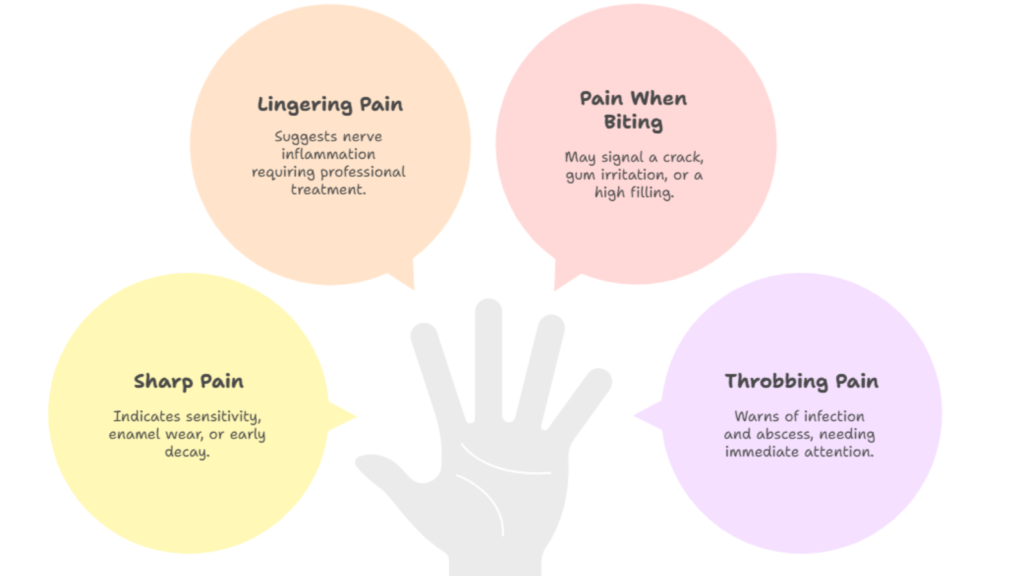
Each type of dental pain follows a distinct pattern that reveals what’s happening inside or around your tooth. Sharp pain appearing and disappearing instantly with cold drinks or sweets points to sensitivity or early decay, while pain lingering 30 seconds to several minutes after temperature changes signals nerve inflammation requiring professional treatment. Throbbing pain that wakes you at night, especially with a bad taste or gum swelling, warns of an active infection spreading from the tooth root into surrounding bone, a situation where antibiotics alone cannot resolve the problem without root canal treatment or extraction.
1. Sharp pain with cold or sweets: sensitivity, enamel wear, or early decay?
Sharp, electric-like pain that appears and disappears with cold drinks or sugary foods points to exposed dentin or a small cavity breaching the enamel. Healthy enamel insulates the nerve from temperature and chemical changes. Thinning enamel from aggressive brushing, acidic erosion, or gum recession uncovers microscopic tubules that connect directly to the nerve. Cold or sugar molecules rush through these channels and trigger instant pain that vanishes when the stimulus leaves.
Early decay behaves similarly but with a crucial difference: the pain often localizes to a specific spot you can feel with your tongue, a rough patch or subtle pit. Sensitive teeth causes and treatments tend to affect a broader area along the gum line or an entire tooth surface. You might notice sensitivity after switching to a whitening toothpaste or consuming acidic foods regularly, while decay-related pain often starts without an obvious lifestyle change.
The distinction matters because sensitivity responds well to desensitizing toothpaste and fluoride application within 2 to 4 weeks. Early decay requires a filling to stop progression. Waiting to see if it resolves on its own works for sensitivity but allows decay to advance toward the nerve.
2. Lingering pain after hot/cold: signs the nerve (pulp) may be inflamed
Pain that persists for 30 seconds to several minutes after you remove hot or cold stimuli signals inflammation inside the pulp chamber. The dental pulp contains nerves and blood vessels within the tooth’s core. Inflammation there behaves differently than surface-level irritation. Deep decay, repeated dental work, or a crack allows bacteria or irritants to reach the pulp, triggering an immune response that swells the tissue inside a rigid chamber with nowhere to expand.
You’ll notice the pain lingers even after you spit out the cold water or finish the hot soup. Some patients describe a dull ache that radiates toward the ear or jaw. The tooth may feel slightly tender when you tap it. Lying flat at night often worsens the discomfort because blood pressure increases in the head, amplifying inflammation.
This pattern indicates reversible or irreversible pulpitis. Reversible means the pulp can heal if the irritant (decay, loose filling) is removed promptly. Irreversible means the nerve tissue is dying and requires root canal treatment to save the tooth. The timing tells you which: pain fading over days suggests reversible inflammation, while escalating or spontaneous pain points toward irreversible damage. If you’re unsure whether your tooth is heading toward a root canal, read about the top 5 signs you need a root canal to compare your symptoms before your appointment.
3. Pain when biting or chewing: crack, gum ligament irritation, or a “high” filling
Sharp pain specifically when you bite down or release pressure suggests a problem with the tooth structure or its attachment to the bone. Cracked tooth syndrome produces a distinctive pattern: pain when biting on a specific cusp, especially when chewing sticky or hard foods, but often no discomfort at rest. The crack opens slightly under pressure, flexing the tooth and irritating the nerve. You may struggle to identify which tooth hurts because the pain disappears once you stop chewing.
A “high” filling, one that sits slightly taller than the surrounding tooth surface, causes a similar biting pain. Your jaw naturally avoids that spot, but when you forget and chew directly on it, the excess contact bruises the periodontal ligament that cushions the tooth in its socket. This ligament irritation (periodontal ligament syndrome) can persist for days after the initial trauma, feeling like a dull ache that flares with pressure.
Recent dental work makes a high filling likely. A crack is more probable if you recall biting something hard (ice, unpopped popcorn kernel, bone fragment) or if you grind your teeth at night. Cracked teeth rarely show on X-rays until the fracture deepens, so diagnosis often relies on symptom pattern and a special bite test where you chew on a rubber wedge to reproduce the pain.
4. Throbbing/night pain and bad taste or swelling: infection and abscess warning pattern

Throbbing pain that wakes you at night, accompanied by a foul taste, gum swelling, or a pimple-like bump on your gum signals an active infection at the tooth root. Abscesses form when bacteria invade the pulp, kill the nerve, and colonize the space inside the tooth. Understanding the full range of tooth abscess symptoms, danger signs, and when to seek urgent treatment helps you act before the infection spreads. Pressure builds as pus accumulates, causing intense, rhythmic pain that often worsens when lying flat. You may notice facial swelling on the affected side, difficulty fully closing your jaw, or a persistent bad taste from pus draining into your mouth.
Some patients experience sudden pain relief when the abscess ruptures through the gum, the “pimple” drains, pressure drops, and discomfort fades temporarily. This misleads people into thinking the problem resolved itself. The infection remains active inside the bone, and the cycle repeats. Untreated abscesses spread into surrounding tissue, form facial cellulitis, or seed bacteria into the bloodstream.
Antibiotics reduce swelling and buy time, but they cannot sterilize the inside of the tooth. The infected pulp tissue and bacteria remain sealed inside. Definitive treatment requires either root canal therapy to clean and seal the tooth or extraction to remove the infection source entirely. Kathmandu dentists typically prescribe 5 to 7 days of antibiotics (amoxicillin or metronidazole) alongside scheduling RCT within 7 to 10 days. Delaying beyond that risks the infection flaring again or the tooth becoming unrestorable.
Tooth-Related Causes You Can Often Spot
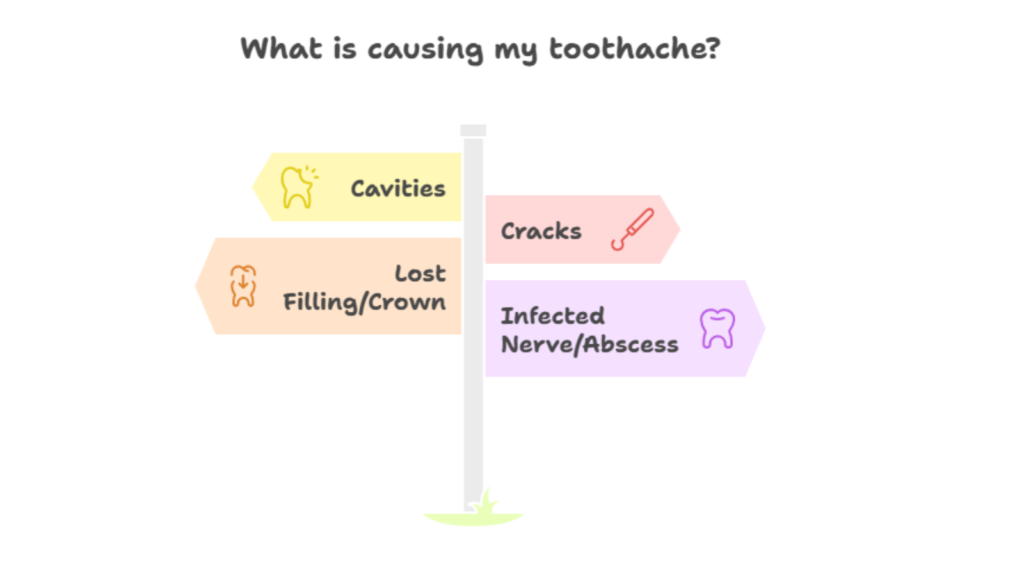
Most toothaches originate from predictable tooth problems you can learn to identify through specific symptoms and visual clues. Cavities progress through stages from rough white spots with no pain to deep decay causing lingering aches and spontaneous throbbing, while cracks produce distinctive sharp pain when biting that disappears when you release pressure. Lost fillings or crowns create instant sensitivity because they suddenly expose the inner tooth structure, and infected nerves generate relentless throbbing pain that temporarily stops when the nerve dies, then returns worse as an abscess forms at the root tip.
1. Cavities and tooth decay stages: what early vs deep decay feels like
Cavities progress through predictable stages, each producing distinct sensations you can learn to recognize. Initial enamel decay creates a rough spot or white chalky area with no pain, you might catch a thread of floss repeatedly or notice staining that won’t brush away. As decay breaches the enamel and reaches the dentin layer, cold and sweet sensitivity appears because dentin tubules connect to the nerve. Pain remains brief and stimulus-dependent at this stage.
Deep decay advancing toward the pulp produces lingering pain after temperature changes and spontaneous aching, especially at night. You may feel food packing into the cavity or notice a sharp edge where enamel collapsed. Some patients describe a constant dull throb or pressure sensation as the pulp struggles with inflammation. The final stage occurs when decay reaches the nerve, intense pain suddenly stops as the nerve dies, leaving a bad taste and swelling as infection takes hold.
The progression from early to advanced decay typically takes 6 to 18 months for most Kathmandu patients, though it accelerates in children or people with dry mouth, frequent sugar exposure, or poor hygiene. Catching decay at the dentin stage means a straightforward filling for NPR 2,000 to NPR 4,000. Understanding your cavity symptoms and tooth filling options before your appointment helps you ask the right questions and choose the best filling material. Waiting until pulp involvement requires RCT (NPR 9,800 to NPR 16,000) plus a crown. Early detection through regular checkups at BrightSmile Dental Clinic or other Putalisadak practices saves both discomfort and cost.
2. Cracks, chipped teeth, and fractures: clues you’ll notice when chewing or with temperature changes
Cracked teeth often hide in plain sight because fractures start microscopically and widen slowly under chewing forces. You might notice sharp pain when biting on a particular spot that disappears once you release pressure, this “release pain” distinguishes cracks from other causes. Temperature sensitivity, especially to cold, flares when fluid in the crack expands and contracts, flexing the tooth and irritating the nerve. Some patients describe an electric shock sensation or a fleeting jolt that makes them wince.
Visible chips usually announce themselves, a piece breaks off while eating, leaving a rough edge you can’t stop touching with your tongue. Small chips confined to enamel rarely hurt unless they create a sharp point irritating your cheek or trap food. Larger fractures extending into dentin cause immediate sensitivity because you’ve exposed the inner tooth structure. Fractures that reach the pulp bleed initially and quickly escalate to severe pain as the nerve becomes inflamed.
Vertical cracks running from the chewing surface toward the root pose the biggest threat. They allow bacteria to penetrate deep into the tooth and often split it into segments that can’t be saved. These cracks typically result from chronic grinding, chewing ice, or biting hard objects repeatedly. If you suspect a crack, especially if biting pain persists without visible damage, request a thorough exam with transillumination (bright light) or a dye test that reveals hidden fracture lines.
Learn more about Chipped vs Cracked vs Broken Tooth
3. Lost filling or loose crown: why it suddenly hurts and what symptoms point to it
A filling or crown that falls out creates instant sensitivity because you’ve suddenly exposed dentin or the prepared tooth structure underneath. Most patients notice the moment it happens, a metallic taste, something loose in your mouth while chewing, or a sudden awareness that your tongue finds a hole where smooth tooth surface existed minutes before. The exposed area immediately reacts to temperature, air, and food contact. Sweet or acidic foods produce sharp, fleeting pain as they reach the dentin tubules.
Loose crowns that haven’t fully dislodged cause a different problem. The crown rocks slightly with each bite, creating a gap where bacteria and food debris accumulate. You may feel the crown shift or notice a bad taste from decay forming underneath. Some crowns loosen because the cement dissolved over time, while others came loose because decay weakened the underlying tooth structure. The distinction matters: recementation works for the first scenario, but the second requires treating the new decay before making a new crown.
Lost fillings often result from recurrent decay around the filling margin or breakdown of the filling material itself. Amalgam (silver) fillings can fracture after years of service, while composite (tooth-colored) fillings sometimes shrink slightly or debond from the tooth. Temporary relief comes from dental wax or sugar-free gum pressed gently into the space to block sensitivity, but this doesn’t seal the tooth against bacteria. Schedule a repair appointment within 3 to 5 days to prevent bacteria colonizing the exposed dentin and advancing toward the pulp.
4. Infected nerve or abscess: what it feels like, why it worsens, and why “antibiotics only” isn’t the full fix
An infected nerve creates relentless, throbbing pain that follows a predictable escalation pattern. Early infection produces intermittent aching that responds temporarily to pain relievers. As bacteria multiply inside the pulp chamber, pressure builds because the rigid tooth structure can’t expand. Pain becomes constant, often described as pulsating in sync with your heartbeat. Lying flat redistributes blood flow and intensifies the sensation, disrupting sleep. You may notice the tooth feels “longer” or more prominent than neighboring teeth because inflammation swells the periodontal ligament.
The infection eventually kills the nerve, and pain suddenly stops, many patients misinterpret this as healing. Hours to days later, bacteria breach the tooth apex and colonize the surrounding bone, forming an abscess. Pressure rebuilds, this time in bone rather than inside the tooth, causing deep, gnawing pain. A gum boil (parulis) may appear, a soft, pus-filled swelling that drains intermittently. Some abscesses track through tissue planes, creating facial swelling or spreading toward the eye, neck, or throat. This is when dental infections become life-threatening.
Antibiotics reduce bacterial load and control spreading infection but cannot penetrate the sealed pulp chamber where bacteria hide. The standard 5-day course of amoxicillin or metronidazole prescribed by Kathmandu dentists provides temporary relief, but infection recurs within weeks unless you complete root canal therapy or extract the tooth. RCT mechanically removes infected tissue and bacteria, then seals the canal system to prevent reinfection. Antibiotics alone leave the infection source intact, imagine treating an infected splinter by taking medicine without removing the splinter itself. The only reliable fix combines medication with removing or sterilizing the infection site.
Gum, Jaw, and Referred Pain (Not Always the Tooth)
Pain in or around teeth doesn’t always originate from the teeth themselves, gum disease, sinus pressure, jaw joint problems, and grinding habits create convincing tooth pain patterns. Gum infections cause bleeding, tenderness, and one-spot soreness that improves with flossing, while sinus congestion creates dull pressure across multiple upper back teeth that worsens when bending forward and improves with decongestants. TMJ disorders and nighttime grinding produce morning jaw aches, headaches, and sensitivity across several teeth simultaneously, symptoms that fade throughout the day rather than escalating like true dental infections.
Gum disease, gum infection, and trapped food: bleeding gums, tenderness, and one-spot soreness
Gum inflammation and infection often masquerade as tooth pain because nerve endings in gum tissue sit close to those in teeth. Bleeding gums and gum disease progress from gingivitis (mild inflammation causing bleeding when brushing or flossing) to periodontitis (advanced gum disease), which produces deeper aching as bacteria destroy bone supporting the teeth. You might notice gum recession, loose teeth, or spaces forming between teeth where food traps easily.
Acute gum infections (periodontal abscesses) create intense, localized pain at one spot along the gum line. The area swells, feels hot, and may ooze pus when pressed. This differs from tooth abscesses, which originate inside the tooth, gum abscesses start in the gum pocket around the tooth. Food debris or a popcorn hull trapped deep in the gum pocket often triggers these infections. Patients describe a constant ache that worsens with chewing and doesn’t respond well to pain medication until the abscess drains or gets treated.
One-spot soreness between two teeth typically signals food impaction. Meat fibers or fibrous vegetables wedge between teeth and press into the gum tissue, causing inflammation and discomfort that intensifies over 12 to 24 hours. Gently flossing usually dislodges the trapped material and brings immediate relief. Recurring food traps in the same location suggest a problem, an open contact between teeth, a poorly contoured filling, or bone loss from gum disease creating a vulnerable space. Addressing the underlying cause at BrightSmile Dental Clinic or another Kathmandu practice prevents repeated episodes.
Sinus-related tooth pain: upper molar pressure vs true tooth infection
Your upper back teeth (molars and premolars) sit directly beneath the maxillary sinus, and sinus congestion often mimics tooth pain. Sinus infections or allergies increase pressure inside the sinus cavity, which presses down on the roots of upper teeth. You’ll notice a dull ache or pressure sensation across several upper back teeth on one side, rather than pinpoint pain in a single tooth. Bending forward, lying down, or jumping up and down typically worsens the discomfort as fluid shifts in the sinus.
Key differences help distinguish sinus pain from dental infection: sinus-related discomfort affects multiple teeth simultaneously, improves when congestion clears, and often accompanies nasal symptoms (runny nose, facial pressure, loss of smell). Dental infections produce sharp, localized pain in one tooth, persist regardless of sinus drainage, and don’t improve with decongestants. Tapping upper teeth gently with a spoon handle reproduces pain from dental infections but usually doesn’t worsen sinus-related pressure.
Sinus pain typically peaks 2 to 4 days into a cold or allergy flare, then improves as inflammation resolves. Dental pain escalates steadily without treatment. Dentists in Kathmandu see increased sinus-related tooth pain during monsoon season (June to September) when mold and humidity trigger allergies. Trying over-the-counter decongestants or steam inhalation for 24 to 48 hours makes sense if multiple upper teeth ache during a cold. Persistent or worsening pain confined to one tooth requires a dental exam to rule out infection masquerading as sinus trouble.
TMJ problems and teeth grinding (bruxism): morning jaw ache, headache, and “multiple teeth hurt”
Temporomandibular joint (TMJ) disorders and nighttime teeth grinding create diffuse dental pain that confuses patients and sometimes dentists. Jaw pain, clicking, and TMJ causes and treatments are worth reviewing if your symptoms include clicking or popping when opening your mouth, limited jaw opening, or pain radiating from the jaw joint toward the ear and temple. Grinding (bruxism) generates tremendous force, up to 250 pounds per square inch, that fatigues jaw muscles and traumatizes multiple teeth simultaneously. You wake with a dull headache, sore jaw muscles, and generalized tooth sensitivity across several teeth. The discomfort typically improves throughout the day as muscles relax, distinguishing it from dental infections that worsen as the day progresses.
TMJ dysfunction produces clicking or popping when opening your mouth, limited jaw opening, or pain radiating from the jaw joint toward the ear and temple. Some patients experience tooth pain referred from the jaw joint, where it feels like several lower back teeth ache despite all teeth being healthy. Stress, jaw clenching, and misaligned bites often trigger TMJ symptoms. The pain pattern tends to fluctuate, bad days and good days, whereas dental infections follow a steady upward trajectory.
Clues pointing toward grinding or TMJ rather than tooth disease include: waking with symptoms that fade by afternoon, multiple teeth hurting simultaneously, flat, worn chewing surfaces visible on back teeth, or tongue indentations (scalloping) along the sides from pressing against teeth. Bite changes from new dental work sometimes trigger these patterns. Dentists at BrightSmile Dental Clinic or other Putalisadak practices typically recommend a night guard in Kathmandu (NPR 8,000 to NPR 15,000) to protect teeth and muscles from grinding forces. The guard doesn’t cure TMJ disorders but prevents further damage while addressing underlying causes through physical therapy, stress management, or bite adjustment.
Braces/orthodontic pain vs harmful pain: what’s normal and what needs a check
Orthodontic treatment produces predictable discomfort patterns you can distinguish from problems requiring urgent attention. Normal braces pain starts 2 to 6 hours after an adjustment appointment, peaks at 24 to 48 hours, then fades over 3 to 5 days. The sensation feels like pressure or soreness across all teeth being moved, dull, achy, worse when biting but manageable with soft foods and over-the-counter pain relief. This reflects teeth shifting through bone, a controlled inflammation process that’s essential for movement.
Abnormal pain demands attention: sharp, stabbing pain in one tooth (possible root damage), a bracket or wire cutting into your cheek or gum (needs wax or wire adjustment), or swelling and pus around a tooth (infection from trapped food or damaged gum). A tooth that suddenly feels loose beyond the expected mobility during treatment may signal excessive force or root resorption. Any of these warrant contacting your orthodontist before your next scheduled visit.
Aligner-related pain (Invisalign or clear aligners) follows similar timing but feels more like tight pressure than soreness. You switch to a new aligner every 1 to 2 weeks, and discomfort peaks on day one then subsides. Persistent pain beyond 3 days or pain preventing you from wearing the aligner full-time suggests the aligner doesn’t fit properly or the treatment plan needs adjustment. Kathmandu patients undergoing orthodontic treatment at BrightSmile Dental Clinic or other practices should expect temporary discomfort after each adjustment but report pain that doesn’t follow the typical pattern or interferes with daily function.
Safe At-Home Relief (Tonight): What to Avoid
Managing tooth pain safely at home requires knowing which remedies help, which provide false relief, and which actions risk making problems worse. For a comprehensive look at your options before and after a dental visit, see this guide on toothache relief: home remedies vs emergency dental care. Warm saltwater rinses, gentle cleaning, elevated sleeping position, and staggered doses of ibuprofen with paracetamol reduce pain and inflammation effectively for 24 to 48 hours while you arrange dental care. Never apply heat to facial swelling (use cold packs instead), avoid placing aspirin directly on gums (it causes chemical burns), and don’t ignore worsening symptoms hoping they resolve on their own, infections that spread beyond teeth become life-threatening emergencies.
Do/Don’t checklist: brushing, flossing, foods, smoking, and sleeping position
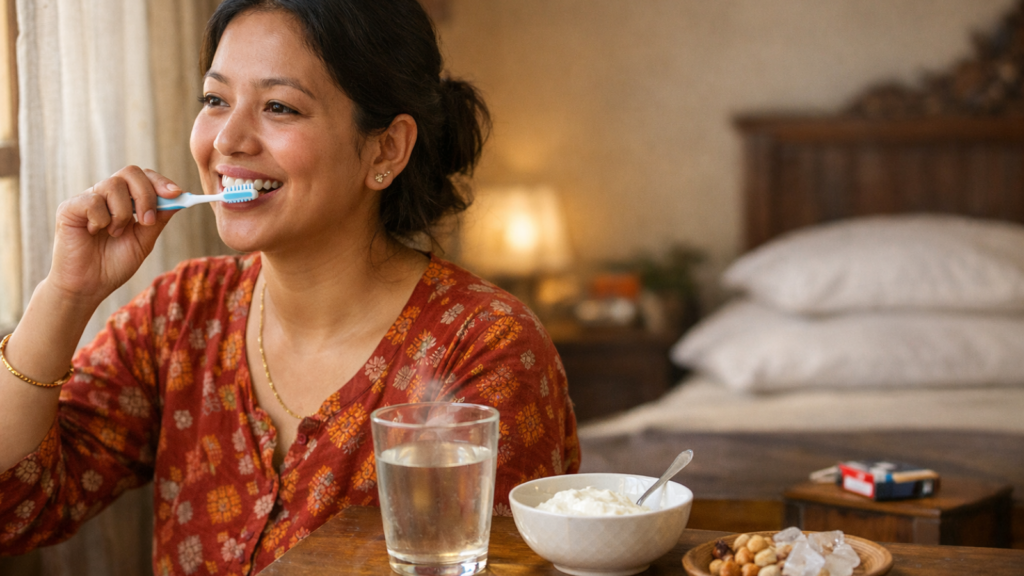
DO: Brush gently twice daily with soft-bristled brush and fluoride toothpaste, even around the painful tooth, plaque removal reduces inflammation. Floss carefully to remove trapped food; angle floss to curve around each tooth rather than snapping it forcefully into gums. Rinse with warm saltwater (1/2 teaspoon salt in 8 ounces of warm water) after meals to reduce bacteria and soothe inflammation. Sleep with your head elevated on 2 pillows to minimize blood pressure in your head and reduce nighttime throbbing. Stick to soft, lukewarm foods that require minimal chewing, yogurt, soup, mashed potatoes, smoothies.
DON’T: Avoid extremely hot or cold foods and beverages; temperature extremes amplify pain by shocking inflamed nerves. Skip hard, crunchy, sticky, or chewy foods that stress the painful tooth (nuts, ice, caramel, tough meat). Avoid smoking or chewing tobacco, nicotine constricts blood vessels, slows healing, and increases infection risk. Don’t apply aspirin or pain medication directly to gums; this creates chemical burns without providing meaningful relief. Avoid alcohol, which can interfere with medications and dehydrate tissues. Don’t ignore worsening symptoms, hoping pain resolves while infection spreads risks serious complications.
Sleeping position matters more than most patients realize. Lying flat increases intracranial pressure and blood flow to your head, amplifying pain from inflammation or infection. Prop yourself at a 30- to 45-degree angle. Some patients find sleeping on the opposite side from the painful tooth reduces pressure sensation.
Saltwater rinse step-by-step: Gentle cleaning: how to reduce irritation safely
A properly prepared saltwater rinse creates an osmotic environment that draws fluid from inflamed tissues and reduces bacterial load. Dissolve 1/2 teaspoon of table salt or sea salt in 8 ounces (approximately 240 ml) of warm, not hot, water. Stir until the salt fully dissolves. Take a mouthful and swish gently for 30 seconds, focusing on the painful area without aggressive swishing that could irritate tissues further. Spit the solution out; don’t swallow. Repeat 3 to 4 times daily, especially after meals and before bed.
Gentle cleaning around a painful tooth requires adjusting your technique. Hold your toothbrush at a 45-degree angle to the gum line and use small, circular motions rather than aggressive back-and-forth scrubbing. Focus on the area but don’t press hard, you’re removing soft plaque, not scrubbing a pan. Use waxed floss and guide it down each side of the tooth carefully; if you encounter resistance, don’t force it. The goal is cleaning without traumatizing already inflamed tissue.
Some patients benefit from an antimicrobial rinse (chlorhexidine 0.12% or 0.2%, available at Kathmandu pharmacies for NPR 200 to NPR 400) if saltwater alone doesn’t control inflammation. Use chlorhexidine for 7 days maximum because prolonged use stains teeth. Rinse twice daily, morning and bedtime, swishing for 30 seconds then spitting out. Avoid eating or drinking for 30 minutes after letting the medication work.
OTC pain relief basics: common options, who should be careful, and what not to mix
Over-the-counter pain relievers manage dental pain through different mechanisms, and combining them strategically often works better than taking one alone. Ibuprofen (400 to 600 mg every 6 to 8 hours, not exceeding 2,400 mg daily) reduces both pain and inflammation, it’s usually most effective for dental pain because it targets the swelling component. Paracetamol/acetaminophen (500 to 1,000 mg every 4 to 6 hours, not exceeding 4,000 mg daily) works through the central nervous system and provides pure pain relief without anti-inflammatory effect.
Combining ibuprofen and paracetamol creates additive pain control stronger than either alone. Take them on a staggered schedule, ibuprofen at 8 AM and 2 PM, paracetamol at 11 AM and 5 PM, for example. This provides more consistent relief than taking both together. DO NOT combine ibuprofen with aspirin, they compete for the same binding sites and reduce each other’s effectiveness. DO NOT exceed recommended doses; paracetamol overdose causes liver damage, and ibuprofen overdose causes stomach ulcers and kidney stress.
Who should be careful: People with stomach ulcers, kidney disease, or asthma should consult a doctor before taking ibuprofen. Those with liver disease or who drink alcohol regularly should minimize paracetamol. Pregnant women should discuss options with their doctor, paracetamol is generally considered safer than ibuprofen during pregnancy. Elderly patients and those on blood thinners (warfarin, aspirin) need dose adjustments. Kathmandu pharmacies stock both generic and branded versions; generic works equally well and costs less (NPR 50 to NPR 150 for 10 tablets of ibuprofen 400 mg).
If a tooth is broken/knocked out: immediate steps (plus what to avoid: heat on swelling, “aspirin on tooth,” risky numbing gels)
A knocked-out permanent tooth has the best chance of survival if you act within 30 minutes. Pick up the tooth by the crown (chewing surface) only, never touch the root. Rinse it gently with clean water or milk if visibly dirty, but don’t scrub or remove any attached tissue. The best storage is back in the socket: try to gently reinsert the tooth, holding it in place with your finger or by biting on clean gauze. If you can’t reposition it, store the tooth in a container of cold milk, saline solution, or your own saliva. DO NOT use tap water for storage, it damages root surface cells. Get to a dentist within 30 to 60 minutes; success rates drop significantly after 2 hours.
For broken teeth, rinse your mouth with warm saltwater and save any fragments you can find, occasionally they can be bonded back. Cover the broken tooth with dental wax or sugar-free gum if sharp edges cut your tongue. Apply a cold compress to the outside of your face if swelling develops. Avoid chewing on that side. Contact a dentist the same day for fractures exposing the inner tooth or causing significant pain.
Learn more about Chipped vs Cracked vs Broken Tooth
What to avoid: Never apply heat to facial swelling from dental problems, heat increases blood flow, accelerates bacterial spread, and worsens inflammation. Use cold packs (15 minutes on, 15 minutes off) instead. Don’t place aspirin directly against your gum near the painful tooth; this old home remedy causes chemical burns called aspirin necrosis without providing real relief. Be cautious with topical numbing gels containing benzocaine, they provide 20 to 30 minutes of surface numbness but can trigger allergic reactions or, if used excessively, a rare blood disorder (methemoglobinemia). Use them sparingly for temporary relief before dental appointments, not as ongoing treatment.
What a Dentist Will Do in Kathmandu (Diagnosis → Treatment → Prevention)
Kathmandu dentists follow systematic protocols combining visual examination, X-rays, and provocation tests to pinpoint your pain source, then match treatment precisely to the underlying cause. The diagnostic process takes 15 to 25 minutes and includes cold testing to assess nerve health, percussion to detect inflamed ligaments or abscesses, bite tests for cracks, and gum probing to measure infection depth, resulting in specific recommendations before you leave the chair. Treatment ranges from simple fillings (NPR 2,000 to NPR 4,000) for early decay to root canal therapy (NPR 9,800 to NPR 16,000) for infected nerves, with prevention plans addressing grinding, diet, hygiene habits, and systemic factors like diabetes that increase your risk of repeat problems.
Same-day vs next-day care in Kathmandu: when to book urgent dental treatment
Kathmandu dental clinics including BrightSmile Dental Clinic in Putalisadak typically reserve same-day urgent slots for specific scenarios. Book same-day or emergency care (within 4 to 6 hours) for: facial or neck swelling, knocked-out permanent tooth, uncontrolled bleeding, severe pain unresponsive to OTC medication, visible abscess with fever, or trauma causing loose teeth or jaw fractures. Call ahead, most clinics triage phone inquiries and hold urgent slots until noon, releasing them to scheduled appointments if unused.
Next-day appointments work for: moderate pain controlled by ibuprofen, broken tooth without nerve exposure, lost filling or crown causing sensitivity but no severe pain, gum infection without systemic symptoms. Most Putalisadak dental practices (BrightSmile, Oral & Dental Clinic, Dental Planet) offer morning slots starting 9 AM to 10 AM and afternoon availability from 2 PM to 5 PM. Sunday hours vary, some clinics close, others operate reduced schedules; confirm by phone.
During monsoon season (June to September) and major festivals (Dashain, Tihar in October to November), appointment availability tightens as dentists take leave and patient volume spikes before holidays. Book 2 to 3 days ahead during these periods unless symptoms escalate to urgent criteria. WhatsApp booking (+977-9748343015 for BrightSmile) often gets faster response than phone calls during busy hours. Provide your symptom summary and preferred time slot in your first message to speed scheduling.
How dentists pinpoint the cause: exam, X-ray, cold test, bite test & gum checks
Dental diagnosis follows a systematic protocol combining visual exam, imaging, and provocation tests to confirm the pain source. Firstly, the dentist reviews your symptom timeline, when it started, what triggers pain, how long episodes last, then examines the tooth and surrounding tissues visually under bright light and magnification. Secondly, they check for visible decay, cracks, swelling, gum pockets, and bite alignment. Thirdly, X-rays (bitewing or periapical films) reveal hidden decay between teeth, bone loss around roots, abscesses at root tips, and the extent of existing fillings or crowns.
Cold testing isolates which tooth has a problematic nerve. The dentist applies refrigerant spray or an ice stick to each suspect tooth individually and compares your response. A normal tooth produces brief, mild cold sensitivity that fades within 5 seconds. Teeth with inflamed nerves create prolonged pain lasting 15 to 30 seconds after the cold stimulus leaves. Dead or infected teeth produce no response, they’ve lost sensation entirely. The percussion test involves tapping each tooth gently with a mirror handle; inflamed periodontal ligaments or abscesses make this exquisitely painful on the affected tooth.
Bite tests use a specialized tool (Tooth Slooth or similar) that isolates pressure on individual cusps of back teeth. This reproduces pain from cracked teeth that regular biting doesn’t always trigger. Gum probing measures pocket depths around each tooth with a calibrated probe; depths over 4 millimeters suggest gum disease or infection. The entire exam takes 15 to 25 minutes at BrightSmile Dental Clinic and similar Kathmandu practices, resulting in a specific diagnosis and treatment recommendation before you leave the chair.
Treatment matched to the cause: filling, root canal,gum treatment, wisdom tooth care, extraction
Treatment flows directly from diagnosis, prioritizing tooth preservation when structurally and financially feasible. Early to moderate decay receives a filling (NPR 2,000 to NPR 4,000 for composite resin in Kathmandu clinics). The dentist removes decayed tissue, disinfects the cavity, and bonds filling material layer by layer. The procedure takes 30 to 45 minutes per tooth, requires local anesthesia, and restores function immediately. Some practices use rubber dam isolation at BrightSmile Dental Clinic to keep the area dry and prevent saliva contamination during bonding.
Deep decay reaching the pulp or irreversible pulpitis requires root canal treatment (RCT). Kathmandu pricing ranges from NPR 9,800 to NPR 16,000 per tooth depending on location, front teeth cost less than molars because they have fewer canals. RCT removes infected nerve tissue, shapes and disinfects the canal space, then seals it with gutta-percha rubber and sealer cement. The tooth becomes brittle without its internal blood supply, so most dentists recommend a crown (NPR 8,000 to NPR 18,000) within 3 to 6 months to prevent fracture. RCT typically spans 2 to 3 appointments: initial cleaning and medication, final sealing, then crown preparation.
Gum infections require scaling and root planing to remove bacterial deposits from below the gum line, sometimes combined with antibiotics. Severe gum disease may need minor surgery to reshape infected gum pockets. Wisdom tooth removal may be necessary for teeth causing recurrent infections or crowding neighboring teeth (NPR 3,000 to NPR 8,000 depending on impaction severity). Simple extractions take 10 to 20 minutes; surgical extractions removing impacted wisdom teeth take 45 to 60 minutes and require stitches that dissolve in 7 to 10 days.
Extractions become necessary when teeth fracture below the gum line, have root tips too damaged to support RCT, or when infection has destroyed over 50% of supporting bone. The procedure uses local anesthesia, takes 20 to 40 minutes, and heals in 7 to 14 days. Most Kathmandu dentists discuss replacement options (implant, bridge, partial denture) during the extraction consultation because leaving gaps causes neighboring teeth to drift and opposing teeth to overerupt.
Special situations and prevention plan: kids (toothache vs teething), pregnancy, diabetes, and how to stop repeat pain
Children’s toothaches require distinguishing between teething (normal) and cavities or infections (needs treatment). Teething affects children under 3 years as primary teeth erupt, gums swell, drool increases, and mild fussiness appears. Pain is brief, relieved by cold teething toys, and doesn’t cause fever above 100.4°F (38°C). Toothaches in children over 3 years typically signal decay, baby teeth have thinner enamel and decay progresses faster than adult teeth. Look for visible brown or black spots, sensitivity to sweet foods, or complaints about specific teeth hurting. For a detailed look at what to watch for, see our guide to common childhood dental problems including cavities and trauma. Don’t dismiss baby tooth cavities as unimportant; infections spread to permanent tooth buds developing underneath.
Pregnancy complicates dental care timing but not safety. The second trimester (weeks 14 to 27) is ideal for routine dental work; first and third trimesters tolerate only emergency treatment. Pregnant women experience increased gum inflammation (pregnancy gingivitis) from hormonal changes, making regular cleaning essential. Local anesthesia, X-rays with lead aprons, and antibiotics (amoxicillin, penicillin) are safe during pregnancy when needed. Inform your Putalisadak dentist about pregnancy status, they’ll modify treatment positions and avoid medications like tetracycline that cross the placenta.
Diabetic patients face higher infection risk and slower healing but benefit enormously from resolving dental infections that spike blood sugar. Schedule dental appointments when blood glucose is well controlled (fasting below 126 mg/dL). Bring your glucometer; some dentists check levels before procedures. Eat normally before appointments to prevent hypoglycemia. Infections drain energy reserves and elevate A1C levels, so addressing dental problems quickly helps stabilize diabetes control. BrightSmile Dental Clinic and other Kathmandu practices typically prescribe slightly longer antibiotic courses (7 to 10 days vs 5 to 7 days) for diabetic patients.
Conclusion
Most toothaches reveal their cause within the first 2 minutes if you know which symptoms to check, the exact tooth, what triggers pain, and how long discomfort lasts after the trigger disappears. This information determines whether you need emergency care tonight, a next-day appointment, or 24 to 48 hours of safe home management while monitoring for improvement. Understanding these pain patterns empowers you to make informed decisions quickly, communicate effectively with your dentist, and avoid the costly complications that arise when reversible problems progress into infections requiring root canals or extractions.
Our dental in Kathmandu provides transparent pricing, comfort-focused protocols, and bilingual service to help Kathmandu patients navigate dental problems with clarity and confidence. Whether you’re dealing with sudden pain tonight or planning to address chronic sensitivity, understanding what your symptoms mean gives you control over your dental health decisions.
Ready to identify your toothache cause? For Toothache treatment services, Message BrightSmile Dental Clinic on WhatsApp at +977-9748343015 or call for same-day urgent slots and next-day appointments. Include your symptom pattern (which tooth, what triggers pain, how long it lasts) when booking to help us reserve the appropriate time and specialist.
Can a toothache go away without treatment?
Minor sensitivity from food stuck between teeth or temporary gum irritation can resolve within 24 to 48 hours with saltwater rinses and gentle cleaning. Pain that persists beyond 2 days, worsens at night, or causes swelling indicates a problem requiring dental treatment. Waiting too long allows reversible issues like early decay to progress into infections needing root canal treatment or extraction.
How do I know if my toothache is an emergency?
Seek immediate care if you experience facial or neck swelling, fever above 101°F (38.3°C), difficulty breathing or swallowing, or uncontrolled bleeding. A knocked-out permanent tooth requires treatment within 30 to 60 minutes for the best chance of survival. Severe, throbbing pain unresponsive to over-the-counter medication also warrants same-day dental attention.
Why does my toothache get worse at night?
Lying flat increases blood pressure in your head, which amplifies inflammation and pain from infections or inflamed nerves. Fewer distractions at night make you more aware of discomfort you might ignore during busy daytime hours. Sleeping with your head elevated on 2 pillows reduces nighttime throbbing significantly.
What’s the difference between tooth sensitivity and a cavity?
Sensitivity causes brief, sharp pain with cold or sweet foods that disappears within 5 seconds once the trigger is removed, often affecting a broad tooth surface. Cavities produce lingering pain that lasts 30 seconds or more after the stimulus ends and typically localize to a specific rough spot you can feel with your tongue. Sensitivity responds to desensitizing toothpaste within 2 to 4 weeks, while cavities require fillings to stop progression.
Can sinus problems cause tooth pain?
Upper back teeth sit directly beneath the maxillary sinus, so sinus congestion from colds or allergies often creates pressure across multiple upper teeth simultaneously. Sinus-related pain improves when you take decongestants and worsens when bending forward or lying down. Dental infections cause sharp pain in a single tooth that persists regardless of sinus drainage and doesn’t respond to cold medication.
Is it safe to take ibuprofen and paracetamol together for tooth pain?
Taking ibuprofen and paracetamol on a staggered schedule provides stronger pain relief than either medication alone because they work through different mechanisms. Take them 2 to 3 hours apart, for example, ibuprofen at 8 AM and paracetamol at 11 AM, rather than simultaneously. Never exceed recommended daily doses: 2,400 mg for ibuprofen and 4,000 mg for paracetamol, and avoid this combination if you have liver, kidney, or stomach problems without consulting a doctor.
Why does my tooth hurt when I bite down but not at other times?
Pain specifically when biting indicates a cracked tooth, a loose filling sitting too high, or irritation of the periodontal ligament cushioning the tooth in its socket. Cracked teeth produce distinctive “release pain” that appears when you stop biting and the crack closes. Recent dental work makes a high filling likely, while a history of biting hard objects or grinding teeth points toward a crack requiring examination with specialized tests.
Will antibiotics cure my tooth infection?
Antibiotics reduce swelling and control spreading infection but cannot eliminate bacteria sealed inside the tooth’s pulp chamber or root canals. The infection returns within weeks after antibiotics end unless you complete root canal treatment to remove infected tissue or extract the tooth entirely. Dentists prescribe 5 to 7 days of antibiotics alongside scheduling definitive treatment within 7 to 10 days.
What should I do if a filling falls out?
Rinse your mouth with warm saltwater and avoid chewing on that side until you see a dentist. Press dental wax or sugar-free gum gently into the space to block sensitivity from temperature changes and food contact. Schedule a repair appointment within 3 to 5 days to prevent bacteria from colonizing the exposed tooth structure and advancing toward the nerve.
How much does toothache treatment cost in Kathmandu?
Simple fillings range from NPR 2,000 to NPR 4,000, while root canal treatment costs NPR 9,800 to NPR 16,000 depending on tooth location. Dental crowns range from NPR 8,000 to NPR 18,000, and extractions cost NPR 3,000 to NPR 8,000 based on complexity. For a full breakdown of what to budget, see the complete guide to dental treatment costs in Kathmandu. BrightSmile Dental Clinic and other Putalisadak practices offer transparent pricing with treatment bundles that include exams, X-rays, and follow-up care.