
Finding transparent dental pricing in Kathmandu can feel overwhelming when you’re trying to budget for treatment or compare clinics. You want clear numbers, not vague estimates that triple at checkout. This guide breaks down actual treatment costs across Kathmandu’s private clinics and teaching hospitals, explains how pricing structures work, and shows you exactly what to ask before committing to any procedure.
Every price range in this guide reflects real rates from clinics across the valley. You’ll learn how to compare quotes properly, spot hidden fees before they appear, and choose the right clinic type for your budget and timeline.
Dental Treatment Cost in Kathmandu: Quick Price Chart and How Pricing Works
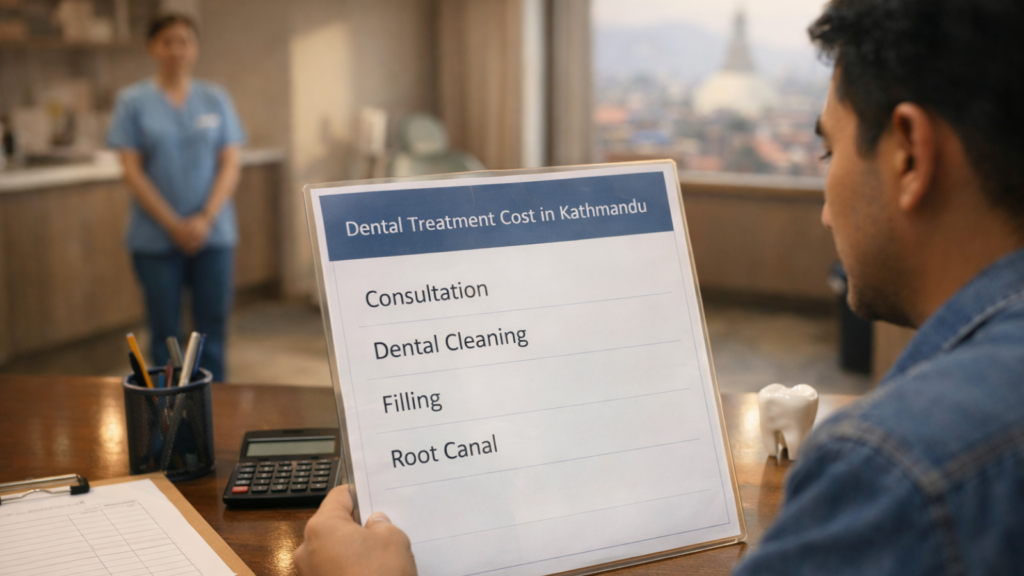
Dental treatment costs in Kathmandu range from NPR 500 for a basic consultation to NPR 130,000 for a single dental implant, depending on the procedure complexity, clinic type, and materials used. Most patients pay between NPR 2,000 and NPR 25,000 for routine treatments like cleanings, fillings, and root canals.
Quick price chart (NPR): the most searched treatments at a glance
Here are the current price bands you’ll encounter across Kathmandu clinics as of January 2026:
- Consultation/Registration: NPR 500–1,500
- Teeth Cleaning (Scaling): NPR 2,000–3,000
- Composite Filling (per surface): NPR 1,500–2,500
- Root Canal Treatment: NPR 9,800–16,000 (varies by tooth type)
- Tooth Extraction (simple): NPR 1,500–3,000
- Wisdom Tooth Removal (surgical): NPR 5,000–12,000
- Teeth Whitening: NPR 12,000–25,000
- Porcelain Crown (PFM/Zirconia): NPR 8,000–18,000 per tooth
- Dental Implant (complete): NPR 60,000–130,000 per tooth
- Metal Braces (full treatment): NPR 60,000–90,000
- Complete Denture: NPR 15,000–35,000 per arch
These ranges account for differences in clinic location, dentist experience, equipment quality, and material brands. A Putalisadak clinic using imported composite resin will charge more than a teaching hospital using local materials.
How clinics charge: per tooth vs per arch vs per visit (and how to compare)
Pricing structures vary significantly between treatments, which makes comparing quotes tricky. Understanding these 3 models helps you evaluate estimates properly:
- Per-tooth pricing applies to fillings, extractions, root canals, crowns, and implants. A quote for “3 fillings” should specify whether each filling is single-surface (NPR 1,500) or multi-surface (NPR 2,000–2,500). Root canal pricing changes by tooth: front teeth cost NPR 9,800–12,000, while molars run NPR 13,000–16,000 because they have more canals.
- Per-arch pricing covers dentures, full-mouth cleanings, and orthodontic work. “Complete denture” means one arch (upper or lower), so replacing both arches doubles the cost. Some clinics quote braces “per arch” at NPR 30,000–45,000, while others give a total treatment price of NPR 60,000–90,000 that includes both arches, monthly adjustments, and retainers.
- Per-visit pricing appears in deep cleaning (periodontal scaling) and orthodontic adjustments. Deep cleaning often requires 2–4 visits at NPR 2,500–4,000 each, with the total determined by gum pocket depth. Braces patients pay NPR 1,000–2,000 per monthly adjustment visit, which adds up to NPR 24,000–48,000 over 2 years.
The comparison mistake most people make is accepting a low per-tooth quote without confirming what’s included. A NPR 8,000 crown seems cheap until you discover it excludes the NPR 12,000 root canal, NPR 1,500 post buildup, and NPR 800 temporary crown.
Private clinic vs teaching hospital: cost difference, waiting time, and expectations
Private clinics in areas like Putalisadak, Kamalpokhari, and Lazimpat charge 40–70% more than teaching hospitals but offer immediate appointments and faster treatment completion. Teaching hospitals (Tribhuvan University Teaching Hospital, Kantipur Dental College) provide the same technical quality at lower prices because they’re subsidized and serve as training facilities.
- Cost difference examples: A root canal costs NPR 9,800–16,000 at private clinics versus NPR 5,000–8,000 at teaching hospitals. Dental implants run NPR 60,000–130,000 privately versus NPR 35,000–70,000 at teaching facilities. Routine scaling is NPR 2,000–3,000 privately versus NPR 800–1,500 at teaching hospitals.
- Waiting time trade-off: Private clinics schedule you within 1–3 days and complete multi-visit treatments in 2–4 weeks. Teaching hospitals have 1–3 week waiting lists for initial exams and 4–8 week treatment timelines because student dentists work under faculty supervision, which extends appointment length. Emergency cases get priority, but elective cosmetic work faces the longest delays.
- Experience expectations: Private clinics assign one dentist to your case from start to finish, maintain stricter appointment schedules, and offer amenities like individual operatories and music. Teaching hospitals rotate students across your visits (though the same faculty supervisor often oversees your case), operate in open clinic floors with less privacy, and sometimes reschedule appointments due to academic calendars.
Teaching hospitals make sense when you’re budget-conscious, have flexible scheduling, and need technically sound work without time pressure. Private clinics suit patients who value speed, convenience, consistent provider relationships, and are willing to pay premium rates for those benefits.
How to get an itemized estimate before treatment (what it must include)
A legitimate estimate should list every procedure code, material, and visit required, not a single lump sum. You avoid surprise charges by requesting this breakdown during your consultation.
Essential estimate components: The estimate must specify the procedure name (not just “tooth repair”), tooth numbers being treated, number of surfaces for fillings, material type (composite vs GIC, PFM vs zirconia), number of visits required, per-visit costs if applicable, and validity period (most quotes hold for 30–60 days).
Example of a complete estimate: “Root canal treatment on tooth #36 (lower right first molar) – NPR 14,000. Includes: access opening NPR 2,000, canal cleaning and shaping NPR 8,000, obturation NPR 4,000. Requires 3 visits over 2 weeks. Post and core buildup – NPR 1,500. Zirconia crown – NPR 15,000. Total: NPR 30,500. Estimate valid until March 15, 2026.”
What triggers additional costs: X-rays ordered after the exam (IOPA NPR 300–500, OPG NPR 1,200–1,800), unexpected findings like extra root canals or bone loss requiring grafts, material upgrades you approve mid-treatment, and emergency visits between scheduled appointments.
Ask 3 specific questions before accepting any estimate: “Does this include all X-rays and tests?”, “What could change this price once you start?”, and “Do follow-up visits cost extra?” Clinics that hesitate to answer or provide only verbal estimates create billing disputes later.
Checkup & Diagnosis Fees in Kathmandu Clinics
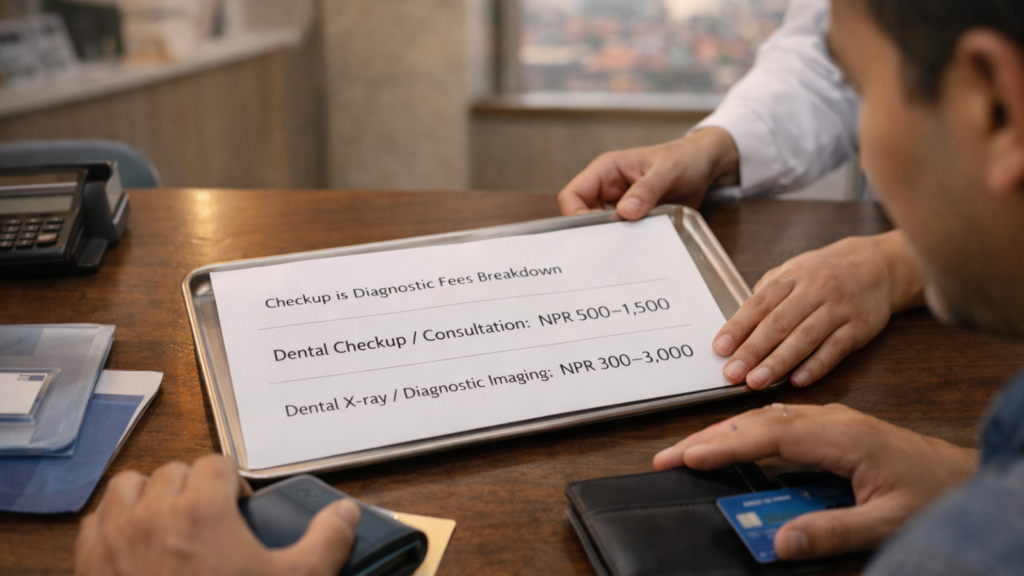
A basic dental checkup in Kathmandu costs NPR 500–1,500 for the consultation and visual examination, with additional diagnostic imaging adding NPR 300–3,000 depending on the type of X-ray required. First visits often combine multiple services, so understanding the fee structure prevents unexpected charges.
Consultation/registration fees: what’s included in the first visit
The consultation fee covers your dental history review, visual examination, basic diagnosis, and treatment plan discussion. Most clinics charge NPR 500–1,000 for general dentists and NPR 1,000–1,500 for specialists (orthodontists, periodontists, oral surgeons).
Standard first-visit inclusions: The dentist examines your teeth and gums, asks about pain locations and medical conditions, performs percussion and mobility tests, and explains recommended treatments with approximate costs. Some clinics include a basic mirror-and-explorer exam, while others add intraoral camera photos at no extra charge.
What’s NOT included: X-rays, cleaning, temporary fillings, and diagnostic models cost extra. Clinics that advertise “free consultation” usually waive the exam fee only if you proceed with treatment the same day. Emergency consultations after hours or weekends sometimes carry a NPR 500 surcharge.
Registration vs consultation distinction: The registration fee (NPR 200–500) creates your patient file and applies to your first visit only. The consultation fee (NPR 500–1,500) applies each time you see the dentist for a new issue. Returning patients pay only the consultation fee unless they’ve been absent for over a year.
Many clinics deduct the consultation fee from your treatment cost if you begin work within 7–14 days. Ask about this policy during checkout.
X-rays pricing basics: IOPA vs OPG (when you need each)
Intraoral Periapical X-rays (IOPA) and Orthopantomogram scans (OPG) serve different diagnostic purposes, which determines which your dentist orders.
- IOPA costs and uses: Single periapical X-rays run NPR 300–500 each. Dentists order IOPAs to examine one or two specific teeth, check root canal work, assess bone levels around a problem tooth, or diagnose abscesses. A root canal case might require 2–3 IOPAs: one before treatment, one mid-treatment to verify canal length, and one post-treatment to confirm filling quality. Expect to pay NPR 900–1,500 total for a complete RCT X-ray series.
- OPG costs and uses: Panoramic X-rays cost NPR 1,200–1,800 and capture all your teeth, jaws, sinuses, and TMJ in one image. Dentists order OPGs for orthodontic planning, wisdom tooth evaluation, implant placement planning, full-mouth rehabilitation cases, and initial exams when you have multiple problem areas. An OPG reveals impacted teeth, bone loss patterns, and jaw pathology that individual IOPAs miss.
Decision rule for patients: You need an IOPA when you have a specific toothache or are mid-treatment on one tooth. You need an OPG when starting braces, planning implants, extracting wisdom teeth, or getting a comprehensive exam after years without dental care. Clinics that push for both without clear justification are padding costs.
Some modern clinics offer digital X-rays, which reduce radiation exposure by 60–80% compared to film but cost the same or NPR 100–200 more per image.
CBCT/3D scans and other tests that increase the total cost
Cone Beam Computed Tomography (CBCT) scans provide 3D imaging of your jaw, teeth, and surrounding structures, which is essential for complex cases but adds NPR 5,000–8,000 to your bill.
When CBCT is necessary: Implant planning requires CBCT to measure bone height, width, and density, and to map nerve locations. Impacted wisdom teeth near nerves need CBCT to prevent nerve damage during extraction. Root canal retreatments sometimes require CBCT to locate missed canals or fractures. Jaw pathology (cysts, tumors) demands 3D imaging before surgery.
When CBCT is optional: Routine fillings, simple extractions, and standard braces cases do not need CBCT. Some clinics offer CBCT for every implant case even when clinical examination and OPG provide sufficient information. Ask, “What will the CBCT show that the OPG doesn’t?” before agreeing.
Other diagnostic add-ons: Vitality tests (hot/cold stimulus) are usually free. Study models for braces cost NPR 2,000–3,500. Photographs for smile design run NPR 500–1,000. Salivary pH or bacterial tests are uncommon in Kathmandu but cost NPR 2,000–4,000 when ordered.
CBCT scans are non-negotiable for implants and impacted wisdom teeth. For other treatments, a second opinion can confirm whether you actually need the scan or if the dentist is over-diagnosing.
First-visit cost scenarios: checkup only vs checkup and cleaning vs emergency visit
Your total first-visit cost depends on what services you combine. Here are 3 common scenarios with real 2026 pricing:
Scenario 1: Checkup only
You want an evaluation with no treatment. Cost: NPR 500–1,500 consultation + NPR 300–1,800 for X-rays if needed = NPR 800–3,300 total. You leave with a diagnosis and treatment plan. Some clinics apply this fee toward treatment if you return within 2 weeks.
Scenario 2: Checkup and cleaning
You book a routine exam and scaling. Cost: NPR 500–1,500 consultation + NPR 2,000–3,000 scaling + NPR 500 (optional polishing) + NPR 1,200–1,800 OPG (if first visit in over a year) = NPR 4,200–6,800 total. This is the most common preventive visit and takes 45–60 minutes.
Scenario 3: Emergency visit
You arrive with severe pain. Cost: NPR 1,000–1,500 consultation (some clinics charge emergency surcharge) + NPR 300–500 IOPA + NPR 500–1,000 temporary filling or drainage = NPR 1,800–3,000 total. The dentist stabilizes the problem and schedules definitive treatment (RCT, extraction) for a later visit.
Hidden cost trap: Clinics that quote “NPR 500 checkup” often add X-rays, registration fees, and treatment planning charges at checkout. Ask for an all-inclusive first-visit price during phone booking to avoid this.
Emergency visits cost 30–50% more after 6 PM or on weekends at most private clinics. Teaching hospitals charge standard rates 24/7 but have longer wait times.
Routine & Urgent Treatments: Cleaning, Fillings, Extractions
Routine dental treatments in Kathmandu: cleanings, fillings, and extractions, range from NPR 2,000 for basic scaling to NPR 12,000 for surgical wisdom tooth removal, with most procedures falling in the NPR 1,500–5,000 range. These are the treatments most patients need annually or when problems arise.
Teeth cleaning cost: scaling vs scaling and polishing vs second sitting
Teeth cleaning pricing depends on the extent of tartar buildup, staining, and whether you need one or multiple visits.
- Basic scaling (NPR 2,000–3,000): This removes hard tartar deposits above the gumline using ultrasonic scalers and hand instruments. A routine 6-month cleaning for someone with minimal buildup costs NPR 2,000–2,500 and takes 20–30 minutes. If you want to know exactly what the dentist does during each step, what happens during a professional teeth cleaning explains the full sequence from scaling to polishing. Heavy smokers or people who haven’t cleaned in years may pay NPR 2,500–3,000 because the dentist spends 40–50 minutes removing thick calculus.
- Scaling and polishing (NPR 2,500–3,500): This adds a polishing step using a rubber cup and prophylaxis paste after scaling. Polishing removes surface stains from tea, coffee, and tobacco, and creates smoother tooth surfaces that resist plaque buildup. Most clinics bundle scaling and polishing as their standard cleaning package. The NPR 500–800 polishing upgrade is worth it if you have visible staining.
- Second-sitting cleanings (NPR 1,500–2,500 per visit): You need multiple visits when you have heavy tartar extending below the gumline or sensitive teeth that require anesthesia. The dentist splits the work across 2–4 quadrants, charging NPR 1,500–2,500 per quadrant. Total cost for severe cases can reach NPR 6,000–10,000 over 2–3 weeks.
What determines visit frequency: Patients with good home care need scaling every 6–12 months. Those with gum disease, diabetes, or heavy tartar formation should clean every 3–4 months. The dentist will tell you at checkout when to return, which directly affects your annual dental budget.
Gum disease costs: deep cleaning (often per tooth) and common periodontal add-ons
Gum disease treatment costs significantly more than routine cleaning because it involves deep scaling below the gumline, root planing, and sometimes surgical procedures. Understanding the stages of bleeding gums and gum disease causes and treatment helps you anticipate whether your case will need basic deep cleaning or surgical intervention.
- Deep cleaning (scaling and root planing): This costs NPR 2,500–4,000 per quadrant or NPR 500–800 per tooth. The dentist numbs the area, scales beneath the gums to remove tartar from root surfaces, and smooths the roots to help gums reattach. A full-mouth deep cleaning (all 4 quadrants) runs NPR 10,000–16,000 and requires 2–4 visits spaced 1–2 weeks apart.
- Periodontal add-ons that increase costs: Antibiotic placement in deep pockets costs NPR 300–500 per site. Laser-assisted periodontal therapy adds NPR 5,000–8,000 to the total. Gingival flap surgery for severe cases runs NPR 8,000–15,000 per quadrant. Bone grafting for lost bone costs NPR 12,000–25,000 depending on graft material.
Maintenance phase costs: After initial deep cleaning, you’ll need supportive periodontal therapy every 3–4 months at NPR 2,500–3,500 per visit to prevent disease recurrence. This ongoing cost is what many patients underestimate when they delay gum treatment.
The cost difference between catching gum disease early (NPR 10,000–16,000 for deep cleaning) versus late (NPR 40,000–80,000 for surgery, grafts, and tooth loss replacement) is why dentists push scaling referrals aggressively.
Filling costs: per surface pricing, composite vs GIC, and temporary fillings
Filling costs vary by the number of tooth surfaces involved, the material used, and whether the filling is temporary or permanent.
- Per-surface pricing structure: Dentists classify cavities by surfaces affected: single-surface (NPR 1,500–2,000), two-surface (NPR 2,000–2,500), or three-surface (NPR 2,500–3,500). A cavity on the chewing surface only is single-surface. A cavity extending between two teeth is two-surface. Complex cavities involving the chewing surface and both sides are three-surface. Most patients need two-surface fillings.
- Composite vs GIC material costs: Composite resin (tooth-colored) costs NPR 1,500–2,500 per surface and lasts 5–10 years with good care. Glass Ionomer Cement (GIC) costs NPR 800–1,500 per surface, bonds to teeth without etching, and releases fluoride but wears faster (3–5 years). Composite is standard for visible front teeth; GIC suits children’s baby teeth and areas below the gumline. For a deeper look at which material suits different cavity sizes and locations, cavity symptoms and tooth filling options covers the full decision guide.
- Temporary filling costs: Emergency visits or root canal appointments use temporary fillings (NPR 500–1,000) to seal the tooth between visits. These last 2–4 weeks and must be replaced with permanent fillings. Budget NPR 2,000–3,000 total for temporary filling plus permanent composite replacement.
Hidden cost factors: Large cavities near the nerve sometimes need a protective liner (NPR 300–500 extra). Fillings on wisdom teeth cost NPR 500–1,000 more because of difficult access. Replacing old amalgam with composite costs the same as new fillings but requires 10–15 minutes extra to remove metal safely.
The pricing mistake is comparing single-surface quotes between clinics when your cavity actually needs two or three surfaces. Always confirm surface count in writing.
Extractions and wisdom teeth: simple vs surgical, stitches, and aftercare visits
Extraction costs scale with tooth type, position, and surgical complexity.
- Simple extractions (NPR 1,500–3,000): Fully erupted teeth that are loose or decayed cost NPR 1,500–2,000 for front teeth and NPR 2,000–3,000 for molars. The dentist numbs the area, loosens the tooth with an elevator, and removes it with forceps in 10–20 minutes. No stitches are required; you bite on gauze for 30 minutes.
- Surgical extractions (NPR 4,000–12,000): Impacted wisdom teeth, broken roots, or teeth fused to bone require surgical removal. Partially erupted wisdom teeth cost NPR 4,000–7,000. Fully impacted wisdom teeth embedded in bone cost NPR 8,000–12,000. Before booking surgery, read about wisdom tooth removal: symptoms, surgery, and recovery to understand what the procedure involves and how many days to set aside. The surgeon makes an incision, removes bone around the tooth, sections the tooth into pieces, and closes with stitches. Procedure time runs 30–60 minutes.
Stitch and aftercare costs: Stitches (NPR 500–1,000) dissolve in 7–10 days or require removal at a follow-up visit. Most clinics include one post-op checkup in the extraction fee, but additional visits for dry socket treatment or infection cost NPR 500–1,000 each.
Common extraction add-ons: Pre-extraction CBCT for impacted teeth costs NPR 5,000–8,000 extra. Sedation (oral sedative pills) adds NPR 2,000–3,000. Bone grafting to preserve the socket for future implants costs NPR 8,000–15,000. Post-op antibiotics and pain medication run NPR 1,500–2,500.
Wisdom teeth often come in sets of four. Removing all four impacted wisdom teeth costs NPR 32,000–48,000 total if you do them in one surgical session, which is 20–30% cheaper than four separate visits but requires 2–3 hours of surgery and stronger sedation.
Root Canal and Crown Costs: Saving a Tooth
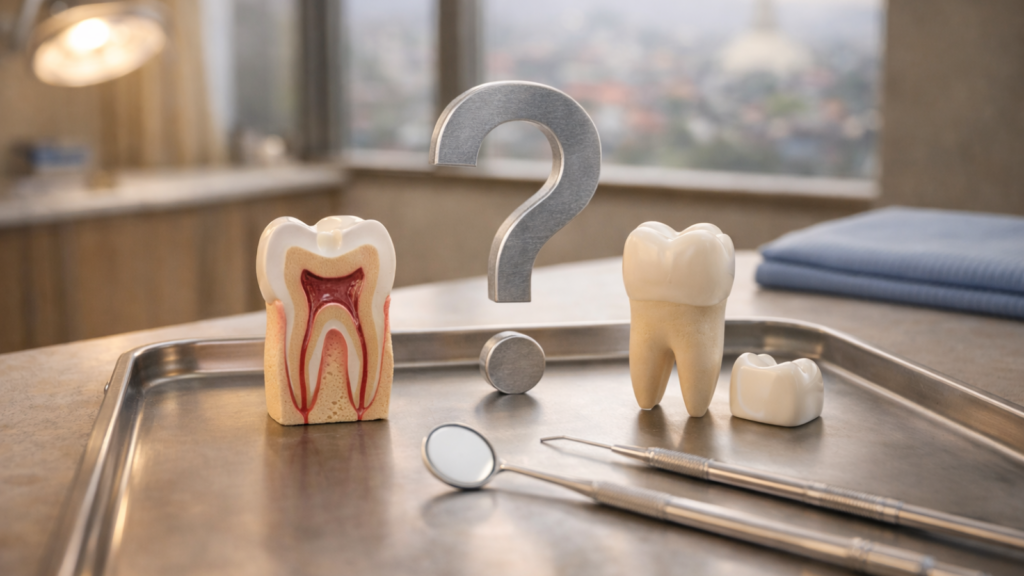
Root canal treatment in Kathmandu costs NPR 9,800–16,000 depending on tooth type and technique, with crowns adding another NPR 8,000–18,000 to protect the treated tooth. If you’re unsure whether you actually need one, the top 5 signs you need a root canal lists the clinical indicators that make RCT unavoidable versus symptoms that resolve with simpler treatment. The combined cost of saving a tooth through RCT and crown restoration runs NPR 18,000–34,000, which is less than implant replacement but requires multiple visits over 2–4 weeks.
Root canal cost by tooth type: front vs premolar vs molar
Root canal pricing increases with the number of root canals inside the tooth.
- Front teeth (incisors and canines): These cost NPR 9,800–12,000 because they have a single straight canal that’s easy to access and clean. Treatment takes 2–3 visits over 1–2 weeks. Front tooth RCT is the most predictable and has the highest success rate (95%+).
- Premolars (NPR 11,000–14,000): These have one or two canals, with the second canal sometimes splitting or curved. The additional canal increases cleaning time and difficulty. Treatment requires 2–3 visits.
- Molars (NPR 13,000–16,000): Upper molars have 3–4 canals; lower molars have 2–4 canals. Curved or narrow canals, calcified areas, and difficult access (especially on wisdom teeth) add complexity. Molar RCT takes 3–4 visits and has a slightly lower success rate (85–90%) than front teeth due to anatomy challenges.
Extra canal fees: Some clinics charge NPR 2,000–3,000 per additional canal beyond the expected number. A lower molar with four canals instead of three might cost NPR 15,000–18,000. This should be discussed when the dentist discovers extra canals mid-treatment, not at final billing.
The tooth-type pricing difference exists because molars require 60–90 minutes of chair time per visit versus 30–45 minutes for front teeth, and the risk of complications (missed canals, file separation) is higher.
Technique-based pricing: manual vs endomotor/rotary vs “laser” RCT
Root canal technique affects both cost and treatment time.
- Manual (hand-file) RCT (NPR 9,800–13,000): The dentist uses stainless steel hand files to clean and shape canals. This is the most common method in teaching hospitals and budget clinics. Treatment is thorough but takes longer (60–90 minutes per visit for molars). Success rates are equivalent to rotary when performed by experienced dentists.
- Rotary/Endomotor RCT (NPR 12,000–16,000): Nickel-titanium rotary files powered by an endomotor clean canals faster (30–50 minutes per visit) and navigate curves more easily. Most private clinics use rotary systems. The NPR 2,000–3,000 upcharge reflects equipment costs and reduced chair time. Outcomes match manual RCT, but treatment finishes 1–2 weeks faster.
- Laser-assisted RCT (NPR 15,000–20,000): Laser disinfection supplements traditional cleaning methods but doesn’t replace filing and shaping. Some clinics market laser RCT as superior, but research shows minimal outcome differences. The NPR 3,000–7,000 premium is primarily for marketing, not evidence-based advantage. Laser may help in cases with persistent infection.
- Microscope-enhanced RCT (NPR 18,000–25,000): Dental operating microscopes improve visualization of canal anatomy, missed canals, and cracks. This technique is standard for endodontic specialists but rare in general dental clinics in Kathmandu. You pay for specialist training and equipment, which is justified for complex cases (calcified canals, retreatments, unusual anatomy) but unnecessary for straightforward RCT.
The technique matters less than the dentist’s experience and case selection judgment. A skilled general dentist using hand files often achieves better results than an inexperienced dentist with expensive equipment.
Common RCT add-ons: opening/dressing, re-RCT, post/core buildup
Root canal treatment involves multiple procedures beyond the core canal cleaning and filling.
Access opening and dressing (NPR 1,500–2,500 per visit): The first visit includes drilling through the tooth to access canals and placing medication (calcium hydroxide) inside. Some clinics itemize this separately; others bundle it into the total RCT fee. Expect 2–3 dressing changes in multi-visit RCT.
Re-treatment (previous RCT that failed): Re-RCT costs NPR 13,000–20,000, which is 30–50% more than initial treatment. The dentist must remove old filling material, locate missed canals, and re-clean the system. Success rates drop to 70–80% because retreatment cases often have complex anatomy or persistent infection. Some specialists recommend extraction and implant instead when retreatment prognosis is poor.
Post and core buildup (NPR 1,500–3,000): Teeth with large cavities or previous fillings need structural reinforcement before crown placement. Fiber posts cost NPR 1,500–2,000; metal posts run NPR 2,000–3,000. The core buildup (composite reconstruction) adds NPR 1,000–1,500. This step is essential for molars and broken teeth but optional for front teeth with minimal damage.
Temporary crown (NPR 800–1,500): You need a temporary crown between RCT completion and permanent crown delivery (1–2 weeks). Some clinics include this; others charge separately.
The itemized RCT bill for a molar with post and temporary crown might read: RCT NPR 14,000 + post/core NPR 2,500 + temporary crown NPR 1,000 = NPR 17,500, with the permanent crown (NPR 12,000–18,000) billed separately after delivery.
Crown and bridge prices: PFM vs zirconia vs eMax and lab-quality factors
Crown costs vary by material, laboratory quality, and dentist experience.
- Porcelain-fused-to-metal (PFM) crowns (NPR 8,000–12,000): Metal substructure with porcelain overlay provides strength and acceptable aesthetics. PFM suits back teeth where chewing forces are high. The dark metal edge sometimes shows near the gumline, which is why PFM is less popular for front teeth. Average lifespan is 10–15 years.
- Zirconia crowns (NPR 12,000–18,000): Solid zirconia or layered zirconia offers superior strength and no metal show-through. Zirconia works for both front and back teeth, resists chipping better than PFM, and lasts 15+ years. For a full breakdown of crown types, placement criteria, and average lifespan by material, dental crowns: when you need one, types, and lifespan covers each scenario in detail. The NPR 4,000–6,000 premium over PFM reflects material cost and lab fabrication complexity.
- eMax (lithium disilicate) crowns (NPR 15,000–22,000): These all-ceramic crowns provide the best aesthetics (translucency matches natural teeth) but are less strong than zirconia. eMax is ideal for front teeth and premolars, not molars. Lifespan is 10–15 years. The premium price reflects imported material and precision lab work.
- Lab quality factors: Local labs charge NPR 3,000–5,000 per crown; international labs (South Korea, China) charge NPR 6,000–10,000 per crown. Better labs provide superior color matching, marginal fit, and anatomical shaping. Clinics using cheap labs may have fit issues requiring remakes, which delay treatment and frustrate patients.
Bridge pricing (per unit): Three-unit bridges (replacing one missing tooth) cost 3× the single crown price: PFM bridge NPR 24,000–36,000, zirconia bridge NPR 36,000–54,000. You pay for two abutment crowns plus one pontic (false tooth).
Crown choice depends on your priorities. Back molars need strength (zirconia or PFM). Front teeth need aesthetics (eMax or layered zirconia). Budget-conscious patients choose PFM and accept the metal margin. The dentist should show you photos of actual cases done with each material.
Replacing Missing Teeth: Implants, Bridges, and Dentures
Dental implant costs in Kathmandu range from NPR 60,000 to NPR 130,000 per tooth, while bridges run NPR 24,000–54,000 for three units and complete dentures cost NPR 15,000–35,000 per arch. Your choice depends on budget, number of missing teeth, bone condition, and long-term maintenance preferences.
Implant price breakdown: surgery and crown and number of implants
Implant pricing has three components that are sometimes bundled, sometimes itemized.
Implant surgery (placement of titanium fixture): This costs NPR 35,000–75,000 depending on the implant brand. Korean systems (Osstem, Dentium) run NPR 35,000–50,000. European/American systems (Straumann, Nobel Biocare) cost NPR 60,000–75,000. Not everyone qualifies for a standard implant procedure; who is a candidate for dental implants explains the bone density, health, and age criteria that determine eligibility before you commit to this cost. The surgery includes anesthesia, fixture placement, and healing cap. You wait 3–6 months for osseointegration (bone fusion).
Abutment and crown (final tooth restoration): This adds NPR 25,000–55,000. Standard abutments cost NPR 8,000–15,000; custom abutments run NPR 15,000–25,000. Zirconia crowns on implants cost NPR 15,000–25,000; eMax crowns cost NPR 20,000–30,000. The crown is fabricated after the implant integrates.
Complete single-tooth implant (NPR 60,000–130,000): Budget clinics using Korean implants charge NPR 60,000–80,000 total. Premium clinics with European systems charge NPR 100,000–130,000. The higher price reflects implant longevity (premium systems have 20+ years of research), better warranty (10-year vs lifetime), and surface treatment quality.
Multiple implant discounts: Four implants for an implant-supported denture cost NPR 200,000–350,000 (NPR 50,000–87,500 per implant) because labs give bulk discounts and the dentist schedules one long surgery instead of four separate appointments. Full-arch rehabilitation (6–8 implants + fixed bridge) runs NPR 450,000–800,000.
The number of implants you need depends on how many teeth are missing and their distribution. Three adjacent missing teeth sometimes need only two implants with a three-unit bridge, reducing cost by one-third.
Implant add-ons that change quotes: bone graft, GBR/membrane, sinus lift
Bone quality and quantity determine whether you need surgical add-ons that double or triple the base implant cost.
Bone grafting (NPR 12,000–25,000 per site): You need grafts when bone width or height is insufficient to stabilize an implant. Synthetic grafts cost NPR 12,000–18,000; bovine/cadaver grafts run NPR 18,000–25,000. The graft material is placed during implant surgery or 3–6 months before implant placement, depending on defect size.
Guided bone regeneration with membrane (NPR 15,000–30,000): GBR adds a collagen or synthetic membrane over the graft to prevent soft tissue invasion while bone regenerates. Resorbable membranes cost NPR 15,000–22,000; non-resorbable membranes requiring removal run NPR 22,000–30,000. This is essential for larger defects.
Sinus lift (NPR 25,000–50,000): Upper back teeth often lack bone height because the sinus cavity extends downward after tooth loss. Direct sinus lift (lateral window approach) costs NPR 35,000–50,000 and adds 6–9 months to treatment. Indirect sinus lift (through implant site) costs NPR 25,000–35,000 and can sometimes be done simultaneously with implant placement.
CBCT scan for planning (NPR 5,000–8,000): This is non-negotiable for implants and should be factored into your budget from the start. The scan measures bone density, identifies nerve locations, and determines whether you need grafts.
Example quote comparison:
Simple implant (adequate bone): NPR 60,000–80,000 total.
Implant with bone graft and membrane: NPR 87,000–135,000 total.
Implant with sinus lift and graft: NPR 110,000–180,000 total.
Most implant failures occur when bone quality is poor but the dentist skips grafting to keep costs low. Proper case planning prevents this, which is why you want a CBCT evaluation before committing to any implant quote.
Denture costs in Kathmandu: complete vs partial vs flexible vs cast (per arch/per tooth)
Dentures remain the most affordable tooth replacement option, especially for multiple missing teeth.
Complete dentures (NPR 15,000–35,000 per arch): Acrylic dentures replacing all teeth in one arch cost NPR 15,000–22,000 in budget clinics, NPR 25,000–35,000 in premium clinics. Higher-priced dentures use better acrylic (less porous, more stain-resistant), premium teeth (imported vs local), and more try-in appointments for fit refinement. Treatment takes 3–5 visits over 3–4 weeks.
Partial dentures (NPR 8,000–25,000): Acrylic partial dentures (replacing 1–6 teeth) cost NPR 8,000–15,000. Cast metal framework partials run NPR 18,000–25,000 and distribute chewing forces better, but they’re heavier and more visible. Flexible partials (Valplast) cost NPR 18,000–28,000, offer better aesthetics (no metal clasps), and are lighter but harder to adjust.
Per-tooth pricing for partials: Some labs charge NPR 1,500–3,000 per replacement tooth plus NPR 8,000–12,000 for the framework. A 4-tooth flexible partial might cost NPR 8,000 (framework) + NPR 8,000 (4 teeth × NPR 2,000) = NPR 16,000 total.
Implant-supported dentures (NPR 250,000–450,000): Four implants with a snap-on overdenture cost NPR 250,000–350,000. Fixed implant-supported bridges (All-on-4 or All-on-6) run NPR 400,000–600,000. These provide far better chewing efficiency and comfort than traditional dentures but require adequate bone.
Maintenance costs: Dentures need relining every 2–3 years (NPR 5,000–8,000) as gums shrink. Repairs for broken dentures cost NPR 3,000–6,000. Adding teeth to existing dentures runs NPR 2,000–4,000 per tooth. Budget an extra NPR 5,000–10,000 over the denture’s 5–7 year lifespan for these services.
The denture decision depends on how many teeth you’re replacing. One missing tooth is best replaced with an implant or bridge. Three to six missing teeth suit a partial denture. Full-arch tooth loss requires complete dentures or implant-supported options.
Bridge vs implant vs denture: cost comparison by lifespan and maintenance
Each tooth replacement option has different upfront costs, longevity, and long-term expenses.
Cost comparison for replacing one missing molar:
- 3-unit bridge: NPR 24,000–54,000 upfront. Requires grinding down two healthy adjacent teeth. Lasts 10–15 years. Eventual replacement costs another NPR 30,000–60,000. Total 30-year cost: NPR 60,000–120,000 (2 bridge replacements).
- Single implant: NPR 60,000–130,000 upfront. Preserves adjacent teeth. Lasts 20–25 years with good care. Crown replacement after 15–20 years costs NPR 18,000–25,000. Total 30-year cost: NPR 78,000–155,000 (one implant + one crown replacement).
- Partial denture: NPR 10,000–18,000 upfront. Requires relining every 2–3 years (NPR 5,000–8,000). Replacement every 5–7 years (NPR 12,000–20,000). Total 30-year cost: NPR 60,000–100,000 (4 denture replacements + 8 relines).
Maintenance time and effort:
- Bridges: Floss with threaders daily (adds 2–3 minutes). Regular checkups. No removal.
- Implants: Brush and floss normally. Annual checkups. Most hands-off long-term.
- Dentures: Remove and clean daily (5–10 minutes). Adhesive needed for retention. Relining appointments every 2–3 years.
Chewing efficiency and comfort:
- Implants: 90–95% of natural tooth function. No movement. No diet restrictions.
- Bridges: 80–85% of natural function. Fixed in place. Normal diet after adjustment.
- Dentures: 25–40% of natural function (complete dentures); 50–70% for partials. Movement during eating. Avoid very hard or sticky foods.
The lifetime cost analysis shows implants and bridges are comparable over 30 years, with implants pulling ahead if you avoid grafting costs and maintain good oral hygiene. Dentures have the lowest upfront cost but highest maintenance burden and poorest function. Patients who cannot afford implants often choose bridges for single-tooth replacement and dentures for multiple missing teeth. For patients traveling specifically for restorative work, dental in Kathmandu covers what the city’s clinics offer across every major treatment category.
Cosmetic Dentistry & Braces Costs and How to Budget Smart
Cosmetic dental treatments in Kathmandu range from NPR 12,000 for professional teeth whitening to NPR 90,000 for full orthodontic treatment, with most smile makeovers falling in the NPR 40,000–150,000 range depending on the combination of procedures, our professional whitening pricing and package breakdown explains what affects the final cost. These elective treatments require careful budgeting because they’re rarely covered by insurance.
Teeth whitening in Kathmandu: in-office vs take-home trays vs laser
Professional whitening costs vary by method, with each offering different speed, intensity, and longevity.
- In-office chemical whitening (NPR 12,000–18,000): The dentist applies high-concentration hydrogen peroxide gel (25–40%) to your teeth for 3–4 cycles of 15 minutes each. Total chair time is 60–90 minutes. Results appear immediately (3–8 shades lighter) and last 1–3 years with good maintenance. Some clinics include a sensitivity kit (desensitizing toothpaste and fluoride treatment).
- Take-home whitening trays (NPR 8,000–15,000): The dentist makes custom trays and provides lower-concentration gel (10–20% carbamide peroxide). You wear trays 2–4 hours daily or overnight for 2–3 weeks. Results are gradual (2–6 shades lighter) and similar in longevity to in-office treatment. This costs less because it uses less dentist time, but requires patient compliance.
- Laser-activated whitening (NPR 18,000–25,000): A laser or LED light activates the whitening gel during in-office treatment. Clinics market this as faster and stronger, but research shows light activation adds minimal benefit beyond gel alone. The NPR 6,000–10,000 premium mostly pays for marketing and equipment costs rather than superior results.
Sensitivity management: 40–60% of patients experience temporary tooth sensitivity during whitening. Budget NPR 1,500–2,500 for desensitizing toothpaste, fluoride varnish application, and lower-concentration gel if standard formulas cause pain.
Maintenance costs: Whitening fades over 1–3 years depending on diet (tea, coffee, red wine accelerate staining). Touch-up treatments cost NPR 5,000–8,000 for in-office or NPR 3,000–5,000 for take-home gel refills. Annual touch-ups keep results consistent.
Whitening only works on natural teeth, not on crowns, veneers, or fillings. You may need to replace visible restorations after whitening to match the new shade, which adds NPR 2,000–3,500 per filling or NPR 12,000–18,000 per crown.
Veneers and bonding: direct composite vs porcelain (eMax/zirconia) and case limits
Veneers and bonding reshape and recolor teeth to create more uniform smiles.
Direct composite bonding (NPR 3,000–6,000 per tooth): The dentist sculpts tooth-colored composite resin directly on your tooth to close gaps, repair chips, or reshape irregular teeth. Treatment is done in one visit (30–45 minutes per tooth) with minimal or no tooth grinding. Results last 5–7 years before staining or chipping requires replacement. Composite bonding suits minor cosmetic issues (small chips, narrow gaps, slight discoloration) and tight budgets.
Porcelain veneers (NPR 18,000–35,000 per tooth): Lab-fabricated ceramic shells are bonded to the front of teeth after removing 0.3–0.7 mm of enamel. eMax veneers cost NPR 18,000–28,000 per tooth; ultra-thin (minimal-prep) veneers run NPR 25,000–35,000. Treatment takes 2–3 visits over 2 weeks. Veneers last 10–15 years, resist staining better than composite, and create the most natural translucency. They work for moderate to severe cosmetic issues (severe discoloration, worn edges, large gaps, uneven tooth sizes).
Full smile makeover costs (6–8 front teeth): Composite bonding for 8 teeth costs NPR 24,000–48,000 total. Porcelain veneers for 8 teeth run NPR 144,000–280,000. Most patients treat 6–10 teeth to create a balanced smile.
Case limits (when veneers won’t work): Severe misalignment needs braces first; veneers cannot correct rotated or crowded teeth. Heavy grinding (bruxism) causes veneers to chip or debond; you need a nightguard (NPR 8,000–15,000) for protection. Large cavities or weakened teeth need crowns, not veneers. Deep intrinsic staining (tetracycline) sometimes requires multiple veneer layers or alternative treatments.
Reversibility consideration: Composite bonding can be removed and replaced without permanent tooth damage. Porcelain veneers require enamel removal, making them irreversible; you’ll always need veneers or crowns on those teeth. Choose carefully.
The dentist should show you before-and-after photos of similar cases, offer a wax-up or digital mockup (NPR 3,000–8,000) so you can preview results, and explain maintenance requirements before you commit to veneers.
Braces and clear aligners: full cost, follow-ups, and retainer fees
Orthodontic treatment is the most time-intensive cosmetic procedure, with costs spread over 18–36 months.
Metal braces (NPR 60,000–90,000 total): Traditional stainless steel brackets and wires cost NPR 60,000–75,000 for mild to moderate cases (18–24 months treatment). Severe crowding or bite issues run NPR 75,000–90,000 (24–36 months). The quoted price usually includes initial bracket placement, monthly adjustments, and first set of retainers.
Ceramic/tooth-colored braces (NPR 80,000–110,000 total): Ceramic brackets blend with tooth color for better aesthetics. Treatment time matches metal braces, but the NPR 20,000–30,000 premium reflects material cost and higher breakage rates (ceramic is more fragile than metal).
Clear aligners (NPR 120,000–200,000 total): Brands like Invisalign or local alternatives (ClearPath, K-Aligners) use sequential clear trays to move teeth. Mild cases cost NPR 120,000–150,000 (12–18 months, 15–25 aligner sets). Complex cases run NPR 150,000–200,000 (20–30 months, 30–50 aligner sets). Aligners are removable, nearly invisible, and allow normal eating, but they cost 50–100% more than braces and require strict compliance (22 hours/day wear).
Monthly adjustment fees: Most clinics include adjustments in the total price. Clinics that charge separately bill NPR 1,000–2,000 per visit × 24 months = NPR 24,000–48,000 extra. Confirm this before starting treatment to avoid budget surprises.
Retainer costs (NPR 8,000–18,000): After braces removal, you wear retainers to prevent relapse. Fixed lingual retainers (bonded behind front teeth) cost NPR 8,000–12,000 and last 5–10 years. Removable retainers (Hawley or clear) cost NPR 5,000–8,000 per arch and need replacement every 2–3 years. Budget NPR 10,000–15,000 for retainers over the first 5 years post-treatment.
Hidden costs in orthodontics: Broken brackets or lost aligners cost NPR 1,000–3,000 each to replace. Teeth whitening after braces costs NPR 12,000–18,000 (many patients want this to match bracket-covered areas to exposed enamel). Wisdom tooth extraction before braces runs NPR 8,000–12,000 per tooth if they threaten treatment outcomes.
Orthodontic treatment requires commitment beyond the initial payment. You’ll spend 90–120 minutes total in the clinic over 24 months just for adjustments, plus emergency visits for broken brackets or discomfort, so review braces cost in Kathmandu by type (metal, ceramic, Damon, clear aligners) before choosing a plan.
Budget checklist: hidden costs, payment plans/EMI, insurance, and quality red flags
Smart budgeting prevents treatment surprises and financial stress.
Hidden costs to ask about upfront:
- X-rays and diagnostic records (CBCT, photos, models): NPR 3,000–8,000
- Temporary restorations between appointments: NPR 500–1,500 each
- Anesthesia or sedation for anxious patients: NPR 2,000–5,000
- Post-treatment medications (antibiotics, painkillers): NPR 1,500–2,500
- Follow-up visits beyond the initial treatment plan: NPR 500–1,500 each
- Lab remakes due to fit or shade issues (should be free, but confirm): NPR 0
- Emergency visits for pain or complications: NPR 1,000–2,000 per visit
Payment plan and EMI options: Many private clinics offer zero-interest installment plans for treatments over NPR 30,000. You pay 30–50% upfront and the balance in 2–6 monthly installments. Some clinics partner with banks for longer EMI terms (6–12 months) with 12–18% annual interest. Teaching hospitals rarely offer payment plans; you pay the full amount before or immediately after treatment.
Dental insurance reality in Nepal: Most health insurance policies exclude dental care or limit coverage to NPR 10,000–20,000 annually for accidents only. Employer-provided insurance sometimes covers cleanings and basic fillings but excludes cosmetic work, braces, and implants. Read your policy’s dental section carefully before assuming any treatment is covered.
Quality red flags to avoid:
- Quotes significantly below market rates (30%+ cheaper) often use inferior materials or cut corners on sterilization
- Clinics that cannot name their implant brand or lab partner
- Dentists who skip X-rays or rush diagnosis in under 10 minutes
- Treatment plans that recommend multiple crowns or root canals without clear justification
- Pressure to start treatment immediately without time to consider or seek second opinions
- Unclear itemization (lump-sum quotes with no procedure breakdown)
- No written treatment plan or consent forms
Budget allocation strategy for major dental work: Set aside 15–20% above the quoted treatment cost for unexpected findings or optional upgrades (better crown material, additional X-rays, post-op care). Save another NPR 10,000–20,000 as a buffer for next year’s maintenance (cleanings, adjustments, repairs). This prevents emergency borrowing mid-treatment.
How much does a dental checkup cost in Kathmandu?
A dental checkup in Kathmandu typically costs between NPR 500 and NPR 1,000. The price may increase if X-rays, scans, or emergency evaluations are required. Some clinics adjust the consultation fee if treatment begins the same day, so always confirm what’s included upfront.
Why do two clinics give very different prices for the same treatment?
Why do two clinics give very different prices for the same treatment? Dental treatment prices vary due to differences in dentist experience, equipment quality, material standards, and lab work, especially for visitors, so read what to expect with dental tourism in Kathmandu (safety, follow-ups, and timeline). One clinic may include extras like X-rays or follow-ups, while another charges separately. Always compare itemized estimates for accurate cost comparison.
Is dental cleaning priced per visit or per sitting?
Basic dental cleaning is usually priced per visit, but deep cleaning for gum disease may be charged per tooth or quadrant. Severe buildup or bleeding may require multiple sittings. Always confirm whether polishing and fluoride are included.
Are fillings charged per tooth or per surface?
Fillings are often charged per tooth, but larger or complex cavities may be priced per surface. Composite fillings cost more than GIC or temporary ones. Depth of decay and use of liners or bases also affect the final cost.
What usually increases the cost of a root canal?
Root canal costs increase for molars due to more canals and longer procedures. Price rises with infection, retreatment, or multiple visits. Post/core buildup and the crown are separate charges, so ask for a complete estimate.
Does an implant price include the crown?
Implant prices don’t always include the crown. Some quotes cover only surgery, while others include the abutment and crown. Costs increase with bone grafts, sinus lifts, or membranes. Always request a breakdown of all steps.
Is it cheaper to get a bridge than an implant in Kathmandu?
Bridges usually cost less upfront than implants because they don’t involve surgery. However, bridges may require trimming healthy teeth and may need replacement sooner. Consider long-term value, durability, and tooth preservation when comparing.
Are braces and aligners quoted as a full package?
Braces and aligners are sometimes quoted as a full package, but some clinics separate X-rays, monthly visits, and retainers. Aligners often include a fixed number of refinement trays; extras may add cost. Always confirm what’s included.
What are the most common “hidden costs” patients miss?
Common hidden dental costs include imaging (OPG/CBCT), medications, temporary restorations, and follow-up visits. Extractions may add costs for sutures or complications. Crown and implant work may cost more with lab upgrades or material changes.
How can I budget and avoid overpaying for dental treatment?
Avoid overpaying by requesting an itemized estimate and checking for included services like imaging, anesthesia, and follow-ups. Compare quotes from 2–3 clinics using the same treatment plan. Prioritize quality for long-term treatments like crowns and implants.
Schedule a consultation at BrightSmile Dental Clinic to discuss your specific case and receive a detailed treatment plan with transparent pricing.