
Night guards are one of the most cost-effective ways to protect teeth from grinding and clenching, especially when morning jaw pain, headaches, or chipped edges start showing up. In Kathmandu, prices vary widely depending on whether you choose a basic guard, a lab-made custom splint, or a more durable stabilization design for heavy bruxism and TMJ symptoms.
This guide breaks down night guard cost in Kathmandu, the main types (soft, hard, dual-laminate, OTC), the step-by-step fitting process, and how long each option typically lasts. You’ll also learn what’s usually included in the quoted price, what “extra costs” can appear (consultation, scans, adjustments), and how to choose a clinic that delivers a comfortable fit that won’t create bite problems.
Night Guard Cost in Kathmandu (NPR): Price Ranges & What’s Included
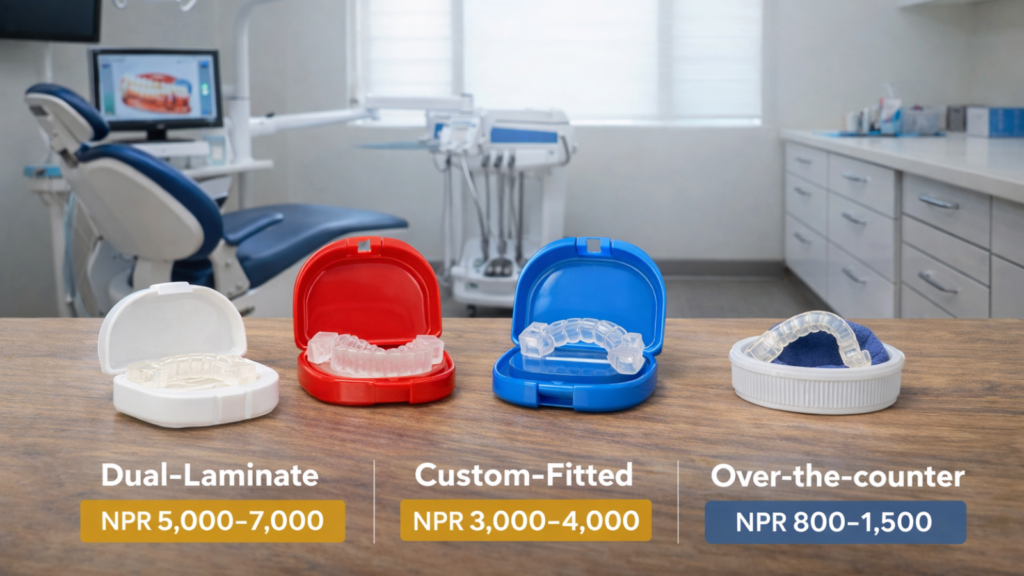
Night guard cost in Kathmandu usually depends on whether you choose a simple protective guard or a dentist-made custom splint designed to balance your bite. A basic guard may look affordable upfront, but the total can change if consultation, scanning/impressions, follow-up adjustments, or remakes are billed separately. The smartest way to compare prices is to ask what’s included and whether the clinic offers a fit-check and adjustment after you start wearing it.
Typical Kathmandu Price Range (Custom vs Basic Guards)
- Custom-fitted night guards in Kathmandu typically cost NPR 3,000 to NPR 4,000 for standard acrylic models.
- Premium materials or specialized designs (dual-laminate guards for severe grinding) can reach NPR 5,000 to NPR 7,000.
- Over-the-counter (OTC) guards sold in pharmacies range from NPR 800 to NPR 1,500, but these lack the precision fit that prevents shifting teeth or jaw discomfort.
The price difference reflects material quality, fabrication precision, and clinical oversight. Custom guards use dental-grade acrylic molded to your exact bite, while OTC guards rely on boil-and-bite thermoplastic that softens in hot water. Clinics in central Kathmandu (Putalisadak, Dhobidhara, Kamaladi) and newer facilities like BrightSmile Dental Clinic align their pricing within the NPR 3,000 to NPR 4,000 band for standard hard acrylic guards, positioning them as accessible yet professionally fitted.
What’s Included vs What’s Extra (Check-Up, X-Ray, Models, Follow-Ups)
A standard night guard package in Kathmandu usually includes 3 core components:
- Firstly, the initial consultation and bite assessment (checking for wear patterns and jaw alignment);
- Secondly, dental impressions or digital scans to create a working model;
- Thirdly, the fabricated guard itself. Many clinics provide one follow-up adjustment visit within 2 to 4 weeks to refine the fit.
What often costs extra:
- Full-mouth X-rays (panoramic or bitewing): NPR 800 to NPR 1,500. Some dentists order these to rule out fractures or TMJ bone changes before fabricating the guard.
- Additional adjustment visits beyond the first: NPR 500 to NPR 1,000 per session if multiple refinements are needed.
- Deep cleaning or scaling before impressions: NPR 2,000 to NPR 3,000. Dentists may recommend this if calculus deposits would distort the mold.
- Replacement guards: Full price or discounted (NPR 2,000 to NPR 2,500) if you return within 6 to 12 months and still have your archived model on file.
Ask for an itemized breakdown during your consultation. Clinics that advertise “all-inclusive” packages typically absorb the first adjustment and digital scan fees, making the upfront quote more transparent.
Cost Drivers That Change Your Quote (Complex Bite, Restorations, TMJ Symptoms)
Your final price can shift based on clinical complexity. Patients with severe TMJ disorders may need a thicker stabilization splint (3 millimeters to 4 millimeters or 0.12 inches to 0.16 inches instead of the standard 2 millimeters or 0.08 inches), which requires more material and lab time, pushing costs toward NPR 5,000 to NPR 7,000. You will pay extra if your dentist adjusts the guard’s occlusal surface multiple times to balance jaw muscle activity.
Recent crowns, bridges, or dental implants also complicate fabrication. The lab must ensure the guard does not place stress on ceramic restorations or implant abutments. This precision work can add NPR 1,000 to NPR 2,000 to the base price. Missing teeth create gaps that require selective relief zones in the guard, again extending lab hours.
Edge cases include patients undergoing orthodontic treatment. You cannot wear a standard hard guard over braces; instead, your orthodontist may issue a temporary soft guard for NPR 2,500 to NPR 3,500, then fabricate a final guard after your braces are removed. Patients using clear aligners (such as Invisalign-style systems) should consult their provider, some aligner trays double as mild grinding protection, eliminating the need for a separate night guard.
How to Avoid Overpaying (Warranty/Remake Policy, Adjustment Visits, Lab Quality)
Three factors protect you from hidden costs: firstly, a clear warranty or remake policy; secondly, included adjustment visits; thirdly, verified lab quality.
- Warranty and remake policy: Reputable clinics offer a 6-month to 12-month remake guarantee if the guard cracks under normal use or becomes loose due to tooth movement. Confirm this in writing before you pay. Some clinics charge NPR 1,500 to NPR 2,000 for a remake if you lose the guard or damage it through neglect (such as exposure to hot water), but waive fees for manufacturing defects.
- Adjustment visits: Your guard should feel snug without rocking or pressure points. The first adjustment is usually free; beyond that, fees range from NPR 500 to NPR 1,000 per visit. Choose a clinic that schedules at least one follow-up within the first month, as bite changes during sleep can reveal fit issues not apparent during the initial try-in.
- Lab quality: Ask where the guard is fabricated. In-house labs (such as those at larger Kathmandu clinics like Shangrila or DentaLife) typically deliver faster turnaround (3 to 5 days) and tighter quality control. Outsourced labs may take 7 to 10 days and occasionally produce guards with uneven thickness. Verify the material, dental-grade polymethyl methacrylate (PMMA) or ethylene-vinyl acetate (EVA) is standard. Avoid clinics that use generic plastics without material certification.
Ask whether the clinic keeps your dental model on file. Archived models allow cheaper, faster remakes (NPR 2,000 to NPR 2,500) without new impressions if you need a replacement within 12 to 24 months.
Do You Need a Night Guard? Bruxism Signs, Causes, and Damage Prevention
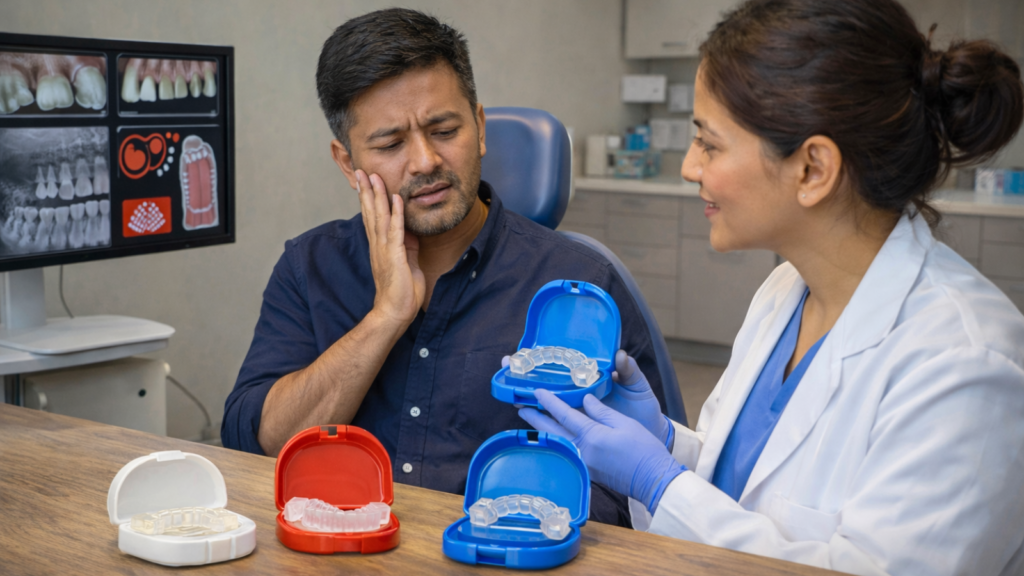
Many people don’t realize they grind or clench until they notice worn edges, sensitivity, jaw tightness, or morning headaches. A night guard doesn’t “cure” bruxism, but it protects your teeth and reduces strain on the jaw joint while you work on triggers like stress, sleep quality, and bite overload. If you have frequent jaw pain, tooth cracks, or TMJ clicking with discomfort, getting evaluated early can prevent more expensive dental repairs later.
What Bruxism Is and How Dentists Confirm It
Teeth grinding and bruxism, medically called bruxism, is the habitual grinding or clenching of teeth, most commonly during sleep (nocturnal bruxism). Dentists confirm it through clinical examination and patient history. During an exam, your dentist inspects tooth surfaces for wear facets, smooth, shiny areas where enamel has been abraded. Severe cases show flattening of cusps (the pointed parts of molars) or microfractures along the chewing edges.
Your dentist may also palpate the masseter and temporalis muscles (the large jaw muscles on the sides of your face). Hypertrophy (enlargement) or tenderness in these muscles suggests chronic clenching. Some clinics use diagnostic tools like the BiteStrip, a disposable sensor you wear overnight that records jaw muscle activity through electromyography (EMG). Elevated readings confirm grinding episodes.
Self-reporting is unreliable since you are asleep during most bruxism events. A bed partner who hears grinding sounds provides strong anecdotal evidence, but clinical signs (tooth wear, muscle tenderness, morning jaw stiffness) are the definitive markers.
Common Causes/Triggers (Stress, Sleep Habits, etc)
Bruxism arises from psychological, physiological, and lifestyle factors. Kathmandu dental clinics commonly observe 4 triggers: firstly, chronic stress and anxiety (exam periods, work deadlines, family pressures); secondly, sleep disorders such as obstructive sleep apnea (OSA) or insomnia; thirdly, stimulant use (caffeine, nicotine, recreational drugs); fourthly, malocclusion (misaligned bite) or missing teeth that create uneven pressure.
Stress-induced bruxism follows a feedback loop, tension raises cortisol levels, which activate the sympathetic nervous system, leading to involuntary jaw muscle contractions during sleep. Patients experiencing high stress in Kathmandu’s academic or professional environments (students preparing for entrance exams, professionals in high-pressure sectors) often present with moderate to severe grinding.
Sleep apnea patients clench their jaws as a reflex to reopen the airway after an obstruction. You may experience brief awakenings (micro-arousals) accompanied by grinding. Treating the underlying sleep disorder often reduces bruxism intensity. Stimulants like caffeine consumed after 4 PM extend wakefulness and disrupt REM sleep, when most grinding occurs. Alcohol relaxes muscles but fragments sleep architecture, paradoxically increasing bruxism episodes.
Malocclusion or missing posterior teeth force the jaw to find a new resting position, often triggering compensatory grinding. Patients who recently lost a molar or have an uneven bite should address the structural issue alongside night guard use.
7 Signs You’re Grinding/Clenching (Flattening, Chipped Teeth, Morning Headache, Jaw Pain)
You may have bruxism if you notice these 7 indicators:
- Flattened or worn tooth surfaces: Molars lose their natural peaks, appearing flat and shiny. Front teeth may show horizontal wear lines.
- Chipped or fractured enamel: Small chips along the biting edges of incisors or cracks in molar cusps. Severe cases expose the underlying dentin (yellowish layer beneath enamel).
- Increased tooth sensitivity: Worn enamel exposes dentin tubules, causing sharp pain when consuming hot, cold, or sweet foods. If this sensation is already present, it is worth reading about sensitive teeth causes and treatment options before it worsens.
- Morning headache: Dull, bilateral headache upon waking, often centered at the temples or back of the head. This reflects muscle fatigue from sustained jaw clenching.
- Jaw pain or stiffness: Difficulty opening your mouth fully in the morning or a locked sensation when chewing. The masseter muscles feel sore to touch.
- Enlarged jaw muscles: Visibly bulkier masseter muscles create a square jawline. This hypertrophy results from chronic overuse.
- Tongue indentations or cheek ridges: Pressing your tongue or cheeks against your teeth during clenching leaves scalloped impressions along the edges.
These signs worsen over months to years. Early detection (such as minor enamel wear) allows simpler interventions, while advanced damage (fractures, TMJ arthritis) requires comprehensive treatment beyond a night guard alone.
What Happens If You Don’t Treat Grinding (Fractures, Sensitivity, TMJ Issues)
Untreated bruxism causes progressive dental and joint damage. Enamel, the hardest substance in the human body, erodes under repeated grinding forces (up to 250 pounds per square inch or 1,724 kilopascals during severe clenching). You will experience hypersensitivity as dentin becomes exposed. Advanced wear may require full-coverage dental crowns (NPR 15,000 to NPR 25,000 per tooth in Kathmandu) to restore function and aesthetics.
Fractures extend beyond the enamel into the tooth’s pulp chamber, necessitating Root Canal Treatment (RCT). RCT in Kathmandu costs NPR 9,800 to NPR 16,000 per tooth. Multiple fractured teeth dramatically increase treatment expenses and chair time.
TMJ disorders develop when the disc (cartilage cushion) inside the jaw joint becomes displaced or the joint surfaces degenerate. Symptoms include clicking or popping sounds during jaw movement, persistent pain radiating to the ear or neck, and limited mouth opening (less than 35 millimeters or 1.38 inches between upper and lower incisors). Severe TMJ arthritis may require surgical intervention, which is rare but costly.
Chronic clenching also triggers tension headaches and disrupts sleep quality, creating a cycle of fatigue and increased stress, which, in turn, worsens bruxism. Addressing the issue early with a night guard and stress management prevents this escalation.
When a Guard Isn’t Enough (Jaw Locking, Severe Pain, Airway/Sleep Issues → Evaluation)
A night guard protects teeth but does not treat underlying pathology. You need further evaluation if you experience jaw locking (inability to open or close your mouth fully), severe pain unrelieved by over-the-counter analgesics, or signs of sleep apnea (loud snoring, gasping for air, excessive daytime sleepiness).
Jaw locking suggests a displaced TMJ disc or muscle spasm requiring physical therapy, muscle relaxants, or in rare cases, arthrocentesis (joint lavage). If you are experiencing jaw pain, clicking, or TMJ disorder symptoms, a specialist evaluation is needed before treatment, severe pain with swelling or restricted jaw movement warrants imaging (MRI or cone-beam computed tomography scans) to rule out joint degeneration or infection.
Sleep apnea patients must address airway obstruction before grinding improves. A night guard alone may worsen apnea by altering jaw positioning. Your dentist should refer you to a sleep medicine specialist for polysomnography (sleep study). Treatments include Continuous Positive Airway Pressure (CPAP) devices or oral appliances that advance the lower jaw, which differ from standard bruxism guards.
Patients with anxiety disorders or chronic stress benefit from cognitive-behavioral therapy (CBT) or relaxation techniques alongside dental treatment. Bruxism often reflects deeper psychological patterns that a guard cannot resolve on its own.
Types of Night Guards (Soft vs Hard vs Dual) and Upper vs Lower
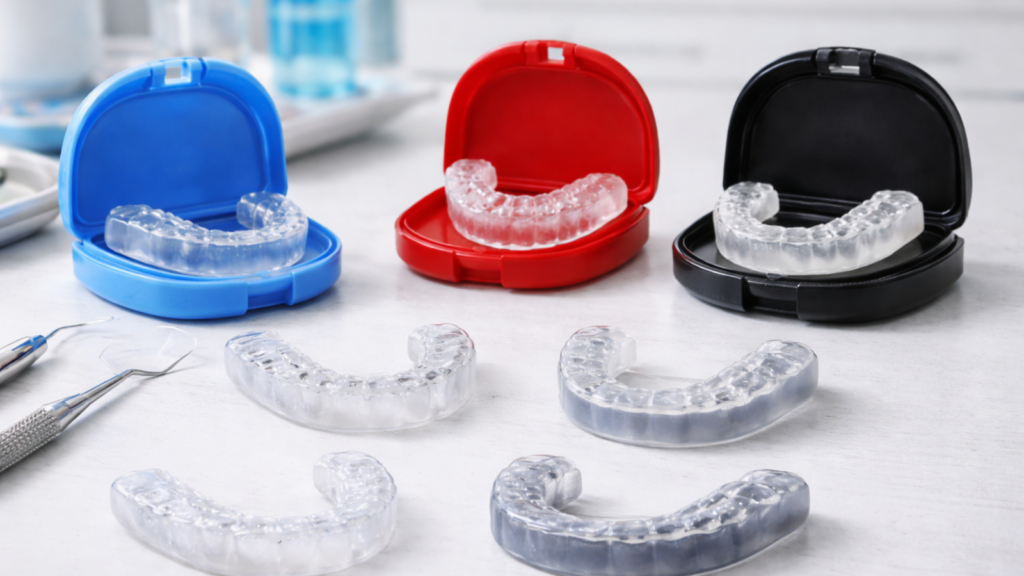
Soft guards are typically more comfortable for mild clenching, while hard acrylic stabilization splints are more durable for heavy grinding and can be better for TMJ-related strain. Dual-laminate designs combine a soft inner layer with a tougher outer surface, giving a balance of comfort and wear resistance. Upper vs lower selection depends on your bite, restorations, and jaw comfort, so choosing based only on price can lead to fit problems.
1. Soft Night Guards: Best for Mild Clenching (Pros/Cons)
Soft night guards use flexible thermoplastic materials (typically 1.5 millimeters to 2 millimeters or 0.06 inches to 0.08 inches thick) suited for patients with mild, occasional clenching. The material compresses under bite forces, cushioning teeth without creating hard resistance. Dentists recommend soft guards when tooth wear is minimal and the patient has no TMJ symptoms.
Pros: Comfortable to wear, easy adaptation (most patients tolerate soft guards immediately without adjustment visits), and affordable (NPR 2,800 to NPR 3,500 in Kathmandu). The pliable material does not irritate gums or feel bulky.
Cons: Soft guards paradoxically encourage chewing behavior in some patients, the cushiony feel mimics gum or food, triggering more jaw activity during sleep. This can worsen bruxism over time. The material wears out faster (6 to 12 months) compared to hard acrylic (2 to 5 years). Soft guards also absorb saliva and bacteria, developing odor if not cleaned rigorously.
Avoid soft guards if you have moderate to severe grinding or TMJ pain. The material compresses excessively under high forces, offering limited protection against enamel wear.
2. Hard Acrylic Stabilization Guards: Heavy Grinding & TMJ Support
Hard acrylic guards (2 millimeters to 3 millimeters or 0.08 inches to 0.12 inches thick) provide the strongest protection for moderate to severe bruxism and TMJ disorders. Fabricated from rigid polymethyl methacrylate (PMMA), these guards create a smooth, even surface that distributes bite forces uniformly across all teeth. The hardness prevents penetration by grinding forces, preserving both the guard and your enamel.
Stabilization splints (a type of hard guard) are designed to reposition the jaw into a relaxed, centered position (centric relation). Dentists adjust the occlusal surface so upper and lower teeth contact evenly, reducing muscle strain. Patients with TMJ clicking, limited opening, or muscle hypertrophy see significant symptom reduction within 4 to 6 weeks.
Pros: Maximum durability (2 to 5 years with proper care), effective for heavy grinders, and supports TMJ therapy by stabilizing the joint. Hard guards resist bacterial growth better than soft materials.
Cons: Initial discomfort, patients often report a bulky feel and increased salivation during the first week. Some people gag on thicker guards. Adjustment visits are typically required to smooth rough edges or rebalance the bite surface. Hard guards cost more upfront (NPR 3,500 to NPR 5,000 in Kathmandu).
Hard acrylic is the standard choice for long-term bruxism management and is preferred by most Kathmandu dentists for patients with visible tooth wear.
3. Dual-Laminate: Comfort and Strength Balance
Dual-laminate guards combine a hard outer acrylic shell (1 millimeter to 1.5 millimeters or 0.04 inches to 0.06 inches) with a soft inner layer (0.5 millimeters to 1 millimeter or 0.02 inches to 0.04 inches). This hybrid design delivers the durability of hard guards while offering the initial comfort of soft materials. The soft inner cushions against gums and teeth, reducing adaptation time, while the hard outer resists grinding forces.
Dentists prescribe dual-laminate guards for patients who find hard acrylic too uncomfortable but need more protection than soft guards provide. They are also suitable for transitioning patients, starting with dual-laminate builds tolerance before moving to a full hard guard if needed.
Pros: Comfortable fit with minimal adjustment period, durable outer shell protects against heavy grinding, and reduced gagging compared to thick hard guards.
Cons: More expensive (NPR 4,500 to NPR 7,000 in Kathmandu), and the soft inner layer can delaminate (separate from the hard shell) over time, especially if exposed to hot water. Lifespan is intermediate, typically 1 to 3 years.
Dual-laminate guards represent the premium option for patients prioritizing comfort without sacrificing protection.
Upper vs Lower Night Guard: Who Gets Which and Why
Upper guards (maxillary splints) are the default choice for 85 to 90 percent of bruxism patients. The upper jaw is more stable, and an upper guard is less likely to dislodge during sleep. It provides easier speech and swallowing, and patients report better tolerance.
Lower guards (mandibular splints) are used when upper teeth have extensive restorations (crowns, bridges) that would complicate fitting, or when the patient has a strong gag reflex triggered by upper guards. Some TMJ protocols specifically require lower guards to reposition the jaw forward, which is easier to achieve from the mandible.
Your dentist determines the best option during the consultation. Upper guards are fabricated more frequently in Kathmandu clinics due to their proven comfort and stability. Lower guards are a specialized solution for specific clinical scenarios.
Night Guard vs Retainer vs Sports Mouthguard (Don’t Mix Them Up)
Night guards, retainers, and sports mouthguards serve distinct purposes and are not interchangeable.
Night guards protect teeth from grinding forces and stabilize the jaw. They are thick (1.5 millimeters to 3 millimeters or 0.06 inches to 0.12 inches), cover all teeth, and are designed for nocturnal wear.
Retainers maintain tooth position after orthodontic treatment. They are thin (0.5 millimeters to 1 millimeter or 0.02 inches to 0.04 inches), made from flexible plastic or wire, and do not withstand grinding forces. Wearing a retainer at night instead of a night guard can crack the retainer and fail to protect enamel.
Sports mouthguards absorb impact forces during contact sports. They are bulky (3 millimeters to 5 millimeters or 0.12 inches to 0.20 inches), extend over the gums, and are constructed from shock-absorbent ethylene-vinyl acetate (EVA). Using a sports guard at night creates excessive bulk and breathing difficulty.
You should use the appliance prescribed for the specific condition. Patients undergoing orthodontic retention and experiencing bruxism need both a retainer and a night guard, worn on alternate nights or as directed by their orthodontist.
Fitting Process in Kathmandu: From Assessment to Final Delivery
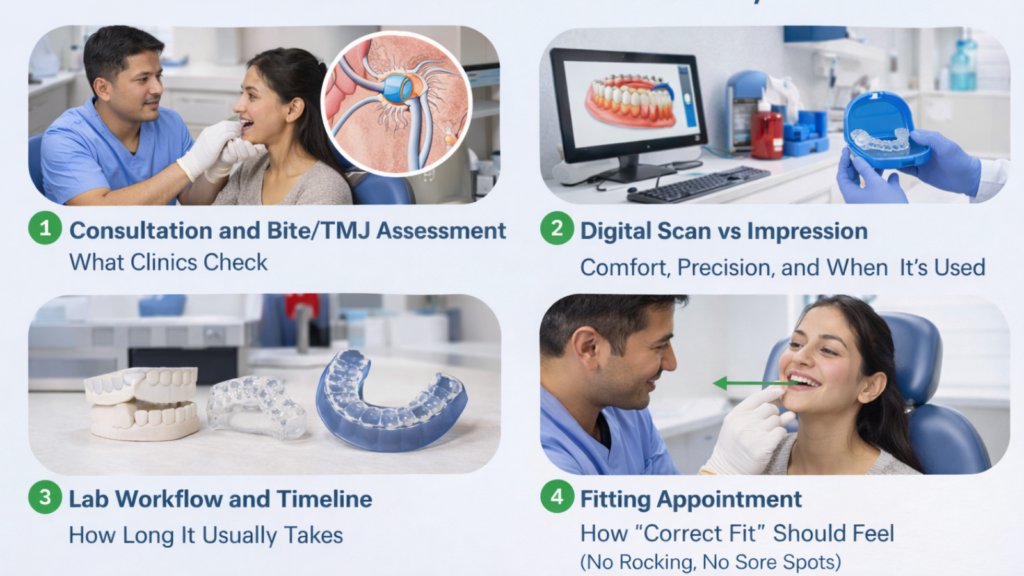
A proper night guard starts with a bite and TMJ check, then a digital scan or impression to capture your teeth accurately. The lab fabricates the guard to fit your arch and bite pattern, and the delivery appointment fine-tunes comfort so it doesn’t feel “high” or cause sore spots. A short follow-up adjustment is often what separates a guard that sits comfortably from one that gets abandoned in a drawer.
1. Consultation and Bite/TMJ Assessment: What Clinics Check
Your first visit involves a comprehensive examination. The dentist reviews your dental history, asking about jaw pain, headaches, tooth sensitivity, and sleep quality. They inspect your teeth for wear patterns, fractures, and enamel loss. Palpation of the masseter and temporalis muscles reveals tenderness or hypertrophy.
TMJ assessment includes measuring maximum mouth opening (normal is 40 millimeters to 50 millimeters or 1.57 inches to 1.97 inches between incisors) and listening for clicking or popping sounds with a stethoscope placed over the joint. The dentist asks you to move your jaw side-to-side and forward to assess mobility. Deviation or limited range of motion indicates joint dysfunction.
Bite evaluation checks for premature contacts, spots where teeth hit unevenly when you close your mouth. The dentist uses articulating paper (thin colored sheets) that marks high spots. An uneven bite increases grinding forces on specific teeth, which the night guard must address.
Some clinics photograph your teeth and gums for before-and-after documentation. This record helps track wear progression and justify the need for future treatments.
2. Digital Scan vs Impression: Comfort, Precision, and When It’s Used
Kathmandu clinics use 2 methods to capture your dental anatomy: traditional putty impressions or digital intraoral scans.
Traditional impressions involve placing a tray filled with alginate putty in your mouth for 2 to 3 minutes while the material sets. The process can trigger gagging in sensitive patients. Impressions are accurate when taken correctly but can distort if the putty moves before setting or if saliva contaminates the mold. Cost is lower, and most labs accept alginate models.
Digital scans use an intraoral scanner (a wand-shaped camera) to capture 3D images of your teeth and gums. The process takes 5 to 10 minutes, involves no putty, and eliminates gagging. Digital files are stored permanently, allowing faster remakes without new scans. Precision is superior, digital models capture undercuts and fine details that alginate sometimes misses.
Clinics like BrightSmile Dental Clinic in Putalisadak invest in digital scanners to improve patient comfort and reduce remake rates. Older or budget clinics rely on traditional impressions. Ask which method your clinic uses. Digital scans cost the same or marginally more in the final night guard price but offer a better experience.
3. Lab Workflow and Timeline: How Long It Usually Takes
After impressions or scans, the lab fabricates your night guard. In-house labs (at larger Kathmandu clinics like Shangrila or DentaLife) deliver in 3 to 5 business days. The process involves pouring a plaster model from the impression, vacuum-forming acrylic over the model, trimming excess material, and polishing edges.
Outsourced labs take 7 to 10 days. The clinic sends your model to a central fabrication facility, waits for production, and receives the guard by courier. Delays occur during festival periods (Dashain, Tihar) when labs operate on reduced schedules.
For dual-laminate guards, fabrication adds 1 to 2 days as the lab must bond the soft inner layer to the hard shell and cure it under pressure. Hard acrylic guards are simpler and faster.
Your dentist schedules a fitting appointment once the guard arrives. Most clinics call or text 1 to 2 days before delivery. Missing your fitting appointment can delay final adjustments by another week.
4. Fitting Appointment: How “Correct Fit” Should Feel (No Rocking, No Sore Spots)
During the fitting, the dentist seats the guard on your teeth and checks for proper retention. A correctly fitted guard should snap into place with light pressure and resist removal without excessive force. It should not rock or shift when you move your jaw side-to-side. Rocking indicates uneven thickness or poor mold accuracy.
The dentist asks you to close your teeth together (bite into the guard) and checks the occlusion. Upper and lower teeth should contact evenly across the guard’s surface. Premature contacts create pressure points that cause discomfort or accelerate wear. The dentist uses articulating paper to mark high spots, then adjusts the guard with a fine bur (a small rotary tool) to smooth those areas.
You should not feel sore spots on your gums or cheeks. Sharp edges irritate soft tissue and prevent consistent wear. The dentist polishes all borders until they feel smooth against your tongue.
Speech and swallowing should be minimally affected. Expect slight lisping or excess salivation for the first 2 to 3 nights as your mouth adapts. Severe speech difficulty or inability to close your lips suggests the guard is too thick or improperly trimmed.
Before you leave, the dentist provides wearing instructions (insert before sleep, remove upon waking) and cleaning protocols. They schedule a follow-up check within 2 to 4 weeks.
5. Follow-Up Adjustments and Rechecks (Why They Matter, Typical Timing)
The first follow-up visit, scheduled 2 to 4 weeks after delivery, is critical. Your bite changes slightly during sleep as muscles relax, and what felt comfortable initially may develop pressure points over time. The dentist re-evaluates the fit, asks about comfort, and refines the occlusal surface if needed.
Common adjustments include smoothing rough edges that irritate the tongue, reducing thickness in areas that trigger gagging, and rebalancing bite contacts that create jaw soreness. Most patients need 1 to 2 adjustments before achieving optimal fit.
Skipping follow-up visits risks poor long-term outcomes. An ill-fitting guard causes gum recession, tooth shifting, or jaw misalignment. Patients who attend follow-ups report 90 to 95 percent satisfaction versus 60 to 70 percent for those who skip them.
After the initial adjustment period, annual rechecks ensure the guard still fits correctly. Tooth movement (from natural drift or orthodontic treatment), gum recession, or guard wear can alter the fit. Dentists recommend replacing guards that no longer retain properly or show visible cracks.
How Long a Night Guard Lasts and Daily Care (Kathmandu-Friendly Guidance)
Night guard lifespan depends mainly on your grinding intensity, material thickness, and how well you clean and store it. Soft guards may wear faster in heavy grinders, while hard acrylic designs generally last longer if the fit remains stable. Simple habits, cool-water rinsing, gentle brushing, air-drying, and avoiding heat, can significantly extend the life of the guard.
Expected Lifespan by Type (Soft vs Hard vs Dual)
Soft guards last 6 to 12 months with nightly use. The flexible material compresses and thins under grinding forces. Patients who clench heavily may wear through soft guards in 4 to 6 months. The material also absorbs saliva and bacteria, developing odor and staining even with regular cleaning.
Hard acrylic guards last 2 to 5 years. Durability depends on grinding severity and care habits. Patients with mild bruxism can use a hard guard for 4 to 5 years before noticing significant wear. Heavy grinders may see visible grooves or thinning after 18 to 24 months. Proper cleaning and storage extend lifespan.
Dual-laminate guards last 1 to 3 years. The soft inner layer degrades faster than the hard shell. Delamination (separation of layers) typically occurs after 2 to 3 years. Some patients replace dual-laminate guards sooner than hard guards but later than soft ones, making them a middle-ground option.
Kathmandu’s climate (warm, humid during monsoon) can accelerate bacterial growth in soft guards. Hard acrylic resists environmental factors better, making it the cost-effective long-term choice.
Signs You Need a Replacement (Cracks, Looseness, New Bite Feel)
Replace your night guard when you observe these 4 indicators:
- Firstly, visible cracks or fractures in the material (even hairline cracks weaken the guard and can break during use);
- Secondly, looseness (the guard no longer snaps into place or falls out during sleep);
- Thirdly, a changed bite feel (your teeth contact differently when you remove the guard in the morning, suggesting tooth movement or guard distortion);
- Fourthly, persistent odor despite cleaning (indicates deep bacterial colonization in porous material).
Thinning of the occlusal surface (where upper and lower teeth grind) is normal wear, but excessive thinning (less than 1 millimeter or 0.04 inches remaining) eliminates protective function. Some patients notice holes worn completely through soft guards after 6 to 8 months of heavy use.
Loose guards shift during sleep, allowing tooth-to-tooth contact that defeats the guard’s purpose. This looseness occurs when teeth move (from gum disease, missing teeth, or orthodontic treatment) or when the guard material warps from heat exposure.
A changed bite feel in the morning suggests the guard is repositioning your teeth over time. This is a serious issue requiring immediate dentist evaluation. Ill-fitting guards can cause malocclusion that necessitates orthodontic correction.
Cleaning Routine: Daily and Weekly Deep Clean (Keep It Clean/Dry)
Daily cleaning prevents bacterial buildup and odor. After removing the guard each morning, rinse it under cool running water (not hot, which can warp the material). Brush the guard gently with a soft toothbrush and non-abrasive toothpaste or mild dish soap. Focus on the inner surface that contacts your teeth, where plaque and saliva proteins accumulate.
Rinse thoroughly to remove all soap residue. Shake off excess water and let the guard air-dry completely in a ventilated case. Never store a wet guard in a closed container, moisture breeds bacteria and mold, especially in Kathmandu’s humid climate.
Weekly deep cleaning removes stubborn deposits and sanitizes the material. Soak the guard in a denture-cleaning solution (effervescent tablets dissolved in cool water) for 15 to 20 minutes. Alternatively, use a 1:10 mixture of white vinegar and water (1 part vinegar to 10 parts water) for 30 minutes. Rinse thoroughly afterward.
Some patients use hydrogen peroxide (3 percent solution) diluted 1:1 with water for 10 to 15 minutes, which disinfects and whitens the guard. Avoid prolonged soaking (over 1 hour), which can degrade certain plastics.
Never use bleach, alcohol-based mouthwashes, or boiling water. Bleach weakens acrylic and creates toxic residues. Alcohol dries out the material, causing cracks. Boiling water warps the guard irreversibly, ruining the fit.
What to Avoid (Hot Water/Heat Can Warp It, Harsh Cleaners)
Hot water is the most common mistake. Water above 60 degrees Celsius (140 degrees Fahrenheit) softens thermoplastic materials, causing warping and distortion. Even warm tap water (40 degrees Celsius or 104 degrees Fahrenheit) can gradually alter the fit over weeks. Always use cool or room-temperature water for rinsing and soaking.
Heat exposure from direct sunlight, car dashboards, or radiators deforms the guard. Store it in a cool, shaded location. During Kathmandu’s summer months (April to June), avoid leaving the guard in a closed vehicle, where temperatures can exceed 50 degrees Celsius (122 degrees Fahrenheit).
Harsh cleaners such as bleach, abrasive toothpaste (whitening formulas with silica grit), or strong detergents scratch the surface, creating micro-grooves where bacteria colonize. Use only non-abrasive toothpaste or mild dish soap.
Chewing gum or eating while wearing the guard damages the material and introduces food particles that rot and smell. The guard is strictly for nocturnal use, not daytime wear unless specifically prescribed by your dentist for severe TMJ therapy.
Improper drying in closed containers traps moisture and heat, accelerating bacterial growth. Always air-dry the guard before storing it.
Storage & Travel: Cases, Ventilation, Avoiding Odor and Bacteria Buildup
Store your night guard in a rigid, ventilated case that protects it from physical damage and allows airflow. Most clinics provide a basic plastic case with perforations or slotted vents. Upgrade to a UV-C sanitizing case (available online for NPR 2,000 to NPR 4,000) if you want automated disinfection, these cases use ultraviolet light to kill bacteria during storage.
Ventilation is essential in Kathmandu’s monsoon season (June to September), when humidity exceeds 80 percent. Cases without airflow promote mold and bacterial growth. Drill 3 to 4 small holes (2 millimeters or 0.08 inches diameter) in a closed case if it lacks vents.
Travel storage: Use a hard case to prevent crushing in luggage. Pack the guard in your carry-on bag, not checked luggage, where temperature extremes (cargo holds can drop below 0 degrees Celsius or 32 degrees Fahrenheit or exceed 40 degrees Celsius or 104 degrees Fahrenheit) can warp the material.
Clean the storage case weekly with soap and water, then dry it completely. Cases accumulate saliva residue and dust, becoming secondary contamination sources.
Odor prevention relies on thorough daily drying and weekly deep cleaning. Persistent odor despite cleaning indicates deep bacterial colonization, replace the guard. Odor often develops faster in soft guards (4 to 6 months) compared to hard acrylic (12 to 18 months or longer with proper care).
Buying Safely: Custom vs OTC vs Online and Clinic Checklist
OTC guards can be a temporary option for mild clenching, but poor fit can cause discomfort and sometimes bite-related issues if worn long-term. Custom dentist-made guards cost more but usually provide a more stable fit, better durability, and safer bite alignment, especially for people with TMJ symptoms, crowns, or complex bites. Before paying, ask about included visits, adjustment policy, remake warranty, and whether the clinic checks your bite after you’ve worn it for a few nights.
OTC/Online Guards in Nepal: What They Cost and What to Watch For
Over-the-counter (OTC) night guards are available in Kathmandu pharmacies and online platforms for NPR 800 to NPR 1,500. These guards use boil-and-bite technology, you soften the thermoplastic in hot water (70 degrees Celsius to 80 degrees Celsius or 158 degrees Fahrenheit to 176 degrees Fahrenheit), place it on your teeth, and bite down to mold it. Once cooled, the guard retains your tooth impressions.
Cost advantage: OTC guards are 50 to 70 percent cheaper than custom options, appealing for trial use or temporary relief.
What to watch for: Fit quality is inconsistent. Boil-and-bite guards often create uneven thickness, leaving gaps that allow tooth contact or excessive bulk that triggers gagging. The material is typically softer than custom guards, wearing out in 3 to 6 months. Some OTC guards use non-dental-grade plastics containing phthalates or BPA, which can leach chemicals into saliva.
Online guards shipped from international retailers (marketed as “custom” based on mail-in impressions) cost NPR 3,000 to NPR 6,000. You receive an impression kit, send your molds to a foreign lab, and receive the guard by courier 3 to 4 weeks later. Quality varies widely, some labs produce acceptable guards, while others deliver poorly fitted appliances with no local dentist to adjust them.
Customs delays and shipping costs (NPR 1,000 to NPR 2,000) add expense. You have no recourse for fit issues unless the company offers remakes, which require re-shipping molds and waiting another month.
Safety: Can OTC/Poor-Fit Guards Shift Teeth or Worsen TMJ?
Yes, poorly fitted guards can cause dental and TMJ problems. Guards with uneven pressure distribution place excessive force on specific teeth, leading to mobility (loosening) or shifting over weeks to months. This is especially risky for patients with gum disease or bone loss, where teeth already have compromised support.
Thick, bulky OTC guards force the jaw into an unnatural forward position during sleep, straining the TMJ and muscles. Patients may develop temporomandibular disorder (TMD) symptoms, clicking, pain, limited opening, from wearing an ill-fitted guard. Some dentists observe worsened bruxism in patients using soft OTC guards because the chewable texture stimulates more grinding.
Guards that fit loosely shift during sleep, allowing intermittent tooth contact that still causes wear and disrupts sleep quality. You experience the discomfort of wearing an appliance without the protective benefit.
Materials matter: non-dental-grade plastics can harbor bacteria more readily than medical-grade acrylic, increasing infection risk. Allergic reactions to certain plastics (itching, gum inflammation) occur in sensitive patients.
When OTC guards are acceptable: temporary use (1 to 2 months) while waiting for a custom guard, mild occasional clenching, or financial constraints where even partial protection is better than none. For long-term use or moderate to severe bruxism, custom guards are the safe choice.
Questions to Ask a Kathmandu Clinic (Materials, Thickness, Remake Policy, Adjustments)
Protect yourself from substandard care by asking these 6 questions during your consultation:
- “What material is the guard made from, and is it dental-grade PMMA or EVA?” Reputable clinics use certified materials. Avoid clinics that cannot specify the material or use generic “plastic.”
- “How thick will the guard be, and can it be adjusted based on my grinding severity?” Standard guards are 2 millimeters to 3 millimeters (0.08 inches to 0.12 inches). TMJ patients may need 3 millimeters to 4 millimeters (0.12 inches to 0.16 inches). Confirm the dentist customizes thickness to your case.
- “Do you fabricate in-house or outsource to a lab? What is the typical turnaround time?” In-house labs (3 to 5 days) offer faster delivery and easier adjustments. Outsourced labs (7 to 10 days) may reduce quality control.
- “What is your remake policy if the guard cracks or becomes loose within the first year?” A fair policy includes free remakes for manufacturing defects and discounted remakes (NPR 1,500 to NPR 2,500) for normal wear or patient loss within 6 to 12 months.
- “How many adjustment visits are included in the quoted price?” Most clinics include 1 to 2 adjustments. Additional visits should cost NPR 500 to NPR 1,000. Avoid clinics that charge per adjustment without including any in the base price.
- “Do you keep my dental model on file for future remakes?” Archived models allow faster, cheaper remakes without new impressions. Confirm storage duration (typically 12 to 24 months).
Clinics like BrightSmile Dental Clinic in Putalisadak (phone +977-9748343015) provide transparent answers to these questions, building trust before you commit.
Special Cases: Braces, Crowns/Implants, Missing Teeth, Aligners
Certain dental conditions require modified night guard protocols:
- Braces (fixed orthodontic appliances): Standard hard guards cannot fit over brackets. Orthodontists may provide a temporary soft guard (NPR 2,500 to NPR 3,500) that accommodates bracket height. Alternatively, delay night guard fabrication until braces are removed. If you are weighing braces and clear aligner costs in Kathmandu, factor in the temporary guard expense as part of the overall orthodontic budget.
- Crowns, bridges, and dental implants: Custom guards must distribute forces evenly to avoid damaging ceramic restorations or loosening implant abutments. The lab creates selective relief zones that reduce pressure on crowned teeth. Inform your dentist of all restorations during the consultation. Fabrication may cost NPR 1,000 to NPR 2,000 extra due to precision requirements.
- Missing teeth: Gaps require modified guard design. The dentist may add acrylic “wings” that span edentulous areas (toothless sections) or create a guard that seats only on remaining teeth. Extensive tooth loss may necessitate a partial denture-style guard. Discuss options with your dentist, standard guards do not work well with multiple missing teeth.
- Clear aligners (such as Invisalign-style systems): Some aligner trays provide mild protection against grinding, but they are not designed for heavy bruxism. Grinding can crack aligner trays (which cost NPR 5,000 to NPR 8,000 to replace). Ask your orthodontist whether you need a separate night guard during aligner treatment or a hard retainer post-treatment that doubles as a guard.
Patients undergoing complex restorative work (full-mouth rehabilitation, multiple implants) should coordinate night guard timing with their dentist to avoid fabricating a guard that will not fit after treatment is complete.
Protecting your teeth from grinding starts with understanding your options. Night guards in Kathmandu range from NPR 3,000 to NPR 4,000 for custom-fitted models, offering proven protection against enamel wear, fractures, and TMJ pain. The fitting process, from digital scanning to follow-up adjustments, ensures a precise, comfortable fit that lasts 2 to 5 years with proper care.
Choose a clinic that uses dental-grade materials, provides transparent pricing with included adjustments, and keeps your dental model on file for future remakes. Daily cleaning and proper storage extend your guard’s lifespan and prevent odor buildup. Avoid OTC guards for long-term use unless financial constraints leave no alternative, poorly fitted appliances can shift teeth or worsen TMJ symptoms. For a full overview of what dental in Kathmandu covers, from preventive care to restorative work, the clinic’s main site is a helpful starting point before booking.
For patients in Putalisadak, Dhobidhara, or nearby areas, BrightSmile Dental Clinic offers custom night guards with same-week delivery, in-house fabrication, and free first adjustments. Contact +977-9748343015 or email brightsmileclinic33@gmail.com to schedule your consultation. Your teeth endure enough stress during the day, give them the protection they deserve at night.
How much does a night guard cost in Kathmandu in 2026?
A night guard in Kathmandu in 2026 costs between NPR 500 to NPR 2,000 for OTC versions and NPR 8,000 to NPR 25,000 for custom dentist-made guards. Custom prices depend on materials, scanning, adjustments, and follow-ups. Always request an “all-in” quote to compare full service costs accurately.
Is a custom night guard worth it compared to a store-bought one?
Choose a custom night guard if you grind heavily, have jaw pain, or dental work that needs bite protection. Store-bought guards often feel bulky and uneven. Custom guards fit better, reduce pressure points, and offer more comfort and durability over time.
Which type lasts longer: soft, hard, or dual-laminate night guards?
Hard acrylic guards last longest for heavy grinders due to higher wear resistance. Soft guards feel comfortable but wear down quickly. Dual-laminate guards balance comfort and durability. Guard lifespan still depends on your bite, grinding force, and care habits.
How long does it take to get a night guard made in Kathmandu?
Getting a night guard in Kathmandu takes a few days to two weeks, based on lab speed and appointments. Digital scans reduce delays and errors. Delivery visits improve comfort through minor adjustments. Ask about turnaround time if you need it urgently.
Can a night guard help with TMJ pain and jaw clicking?
A night guard can ease TMJ-related pain by reducing tooth wear and clenching strain. Jaw clicking has various causes, so guards may not fix all TMJ issues. Severe cases need specialist evaluation. The right guard depends on whether clenching, joint irritation, or both cause symptoms.
Should I wear my night guard on the upper or lower teeth?
Most night guards are worn on the upper teeth, but lower guards suit certain bite patterns or comfort needs. Dentists choose the arch based on bite, restorations, gag reflex, and grinding movement. Existing retainers or aligners may change the decision.
What is included in a night guard quote at a Kathmandu dental clinic?
Some Kathmandu clinics include consultation, scanning, lab work, and one adjustment in the quote. Others add separate fees for exams or imaging. Always ask for a written cost breakdown to compare total value accurately.
How do I know if my night guard fits correctly?
A well-fitting night guard feels snug without pain and stays in place when talking or swallowing. Your bite should feel balanced. Extra saliva is normal, but sharp spots or new jaw pain are not. Schedule an adjustment if discomfort persists.
How do I clean a night guard properly every day?
Clean your night guard daily by rinsing with cool water and brushing with a soft toothbrush. Let it air-dry in a ventilated case. Avoid hot water to prevent warping. Use dentist-recommended soaks for buildup instead of harsh cleaners.
When should I replace my night guard?
Replace your night guard if it cracks, smells, feels loose, or changes how your bite feels. Worn guards lose protection and may irritate the jaw. Heavy grinders need replacements more often. Get your guard checked if jaw pain or bite shifts occur.