
Choosing between braces and clear aligners is one of the most common decisions dental patients face in Kathmandu today. The choice between braces and Invisalign or clear aligners depends on your specific orthodontic needs, budget, lifestyle, and treatment timeline. Both options can deliver excellent results, but they work differently, cost differently, and suit different types of cases.
This guide breaks down exactly what each option means, what you can expect to pay in Kathmandu (in NPR), how long treatment typically takes, and which option might be the better fit for your situation. You will also see what happens at each stage of treatment from your first consultation to wearing your retainer.
Braces vs Invisalign / Clear Aligners
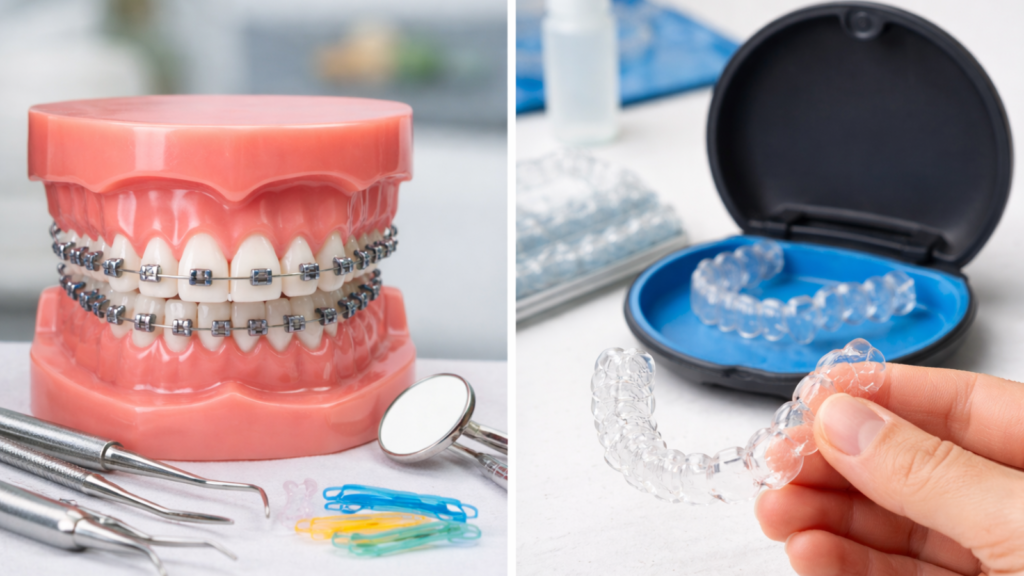
Braces and clear aligners are two fundamentally different approaches to straightening teeth, each with distinct mechanisms, materials, and clinical applications. Braces use fixed metal or ceramic brackets bonded to your teeth with wires that apply constant force 24 hours a day, while clear aligners (including branded systems like Invisalign and generic alternatives) use removable plastic trays that you change every 1 to 2 weeks.
Invisalign vs “clear aligners”: brand vs generic systems (and why it matters for cost)
Invisalign is a branded clear aligner system manufactured by Align Technology, while “clear aligners” refers to any removable plastic tray system used to move teeth. Invisalign uses proprietary software (ClinCheck) to plan tooth movements and manufactures aligners in the United States. Other clear aligner brands (such as ClearCorrect, Spark, or local systems) use similar principles but different materials, planning software, and manufacturing locations.
The difference matters for cost in 3 ways. Firstly, Invisalign typically costs more in Kathmandu (NPR 150,000 to NPR 400,000+) due to brand premiums, import duties, and the requirement that dentists complete Invisalign-specific training. Secondly, generic or locally-made clear aligners often range from NPR 80,000 to NPR 200,000 because they use simpler workflows and local labs. Thirdly, the number of refinement trays (extra trays if your teeth do not track as planned) is often unlimited with Invisalign packages but may be limited or cost extra with generic systems.
Quality and predictability can also vary. Invisalign has the largest clinical database and longest track record, which can matter for complex cases. Generic systems can deliver excellent results for mild to moderate cases but may require more dentist skill to plan movements manually.
Types of braces in Kathmandu: metal, ceramic, self-ligating, lingual
Braces are fixed orthodontic appliances bonded to your teeth. You cannot remove them until your orthodontist takes them off at the end of treatment. There are 4 main types available in Kathmandu.
- Metal braces are the most common and affordable option (NPR 60,000 to NPR 120,000 for full treatment). They use stainless steel brackets and wires. Modern metal braces are smaller and more comfortable than older versions, but they are still visible when you smile.
- Ceramic (tooth-colored) braces use clear or tooth-colored brackets that blend with your teeth (NPR 80,000 to NPR 150,000). The wires are still metal, so there is some visibility, but they are much more discreet than metal. Ceramic brackets can stain if you drink a lot of tea or coffee and are slightly more fragile than metal.
- Self-ligating braces (metal or ceramic) use a built-in clip instead of elastic bands to hold the wire (NPR 100,000 to NPR 180,000). They create less friction, which can mean fewer appointments and slightly faster treatment in some cases. The brackets are bulkier than traditional braces.
- Lingual braces are bonded to the back (tongue-side) of your teeth, making them invisible from the front (NPR 200,000 to NPR 350,000+). They are the most expensive and hardest to clean, and they can affect your speech for the first few weeks. Very few clinics in Kathmandu offer lingual braces because they require specialized training.
How braces vs aligners move teeth (fixed force vs removable trays)
Braces and aligners both move teeth by applying controlled pressure, but the mechanics are different.
Braces apply constant force 24 hours a day. The wire running through the brackets is pre-shaped to the ideal position of your teeth. Your orthodontist tightens or changes the wire at each visit (usually every 4 to 6 weeks), gradually increasing the force. Braces can also use elastics (rubber bands) between your upper and lower teeth to correct bite problems. The fixed nature means your teeth are always under pressure, which is why braces can handle very complex movements like rotating molars, intruding teeth, or fixing severe overbites.
Clear aligners apply force only when you wear them (ideally 20 to 22 hours per day). Each aligner is slightly different from the previous one. You wear each tray for 1 to 2 weeks, then switch to the next tray in the series. The plastic pushes your teeth into the new position over that period. Aligners rely on attachments (small tooth-colored bumps bonded to your teeth) and sometimes elastics to achieve certain movements. The removable design means there are periods (during meals, brushing) when no force is applied, which is why wear-time compliance is critical.
What they can fix: crowding, spacing, rotations, bite issues (realistic outcomes)
Both braces and aligners can correct crowding (overlapping teeth), spacing (gaps), rotations (twisted teeth), and many bite problems (overbite, underbite, crossbite, open bite). The difference is in how effectively and predictably they handle complex cases.
- Braces excel at: severe crowding that requires tooth extraction, rotating back teeth (molars), closing large gaps (more than 3 to 4 millimeters), moving tooth roots (not just crowns), correcting severe overbites or underbites, and cases where elastics are needed to shift your jaw position. Braces are also better when you need to bring down impacted teeth (teeth stuck in the gum) because the orthodontist can bond a bracket directly to the tooth and pull it into place.
- Clear aligners work best for: mild to moderate crowding (up to 4 to 5 millimeters per arch), spacing, rotating front teeth, mild overbite or crossbite, and cases where no extractions are needed. Aligners struggle with vertical movements (bringing teeth up or down), large rotations of back teeth, and cases that require significant bite correction. Some movements (like rotating cylindrical premolars or tipping roots) are simply harder for plastic trays to achieve compared to a wire bonded directly to the tooth.
In Kathmandu, orthodontists will often suggest braces if your case is complex, even if you prefer aligners. You can request a second opinion, but trust the clinical recommendation, starting with aligners on a case that needs braces usually means longer treatment, more refinements, and frustration.
Cost in Kathmandu (NPR): braces vs Invisalign / clear aligners
Orthodontic treatment costs in Kathmandu range from NPR 60,000 for basic metal braces to NPR 400,000+ for comprehensive Invisalign packages, with the final price determined by appliance type, case complexity, and clinic reputation.
Kathmandu price snapshot: braces types vs aligners (example ranges and why they vary)
Orthodontic costs in Kathmandu vary widely based on the type of appliance, the complexity of your case, and the clinic you choose. For a side-by-side breakdown of every bracket type and aligner system, see our detailed guide on the cost of braces in Kathmandu. Here are typical all-inclusive price ranges as of January 2026.
- Metal braces: NPR 60,000 to NPR 120,000 (full treatment, both arches). Premium orthodontic clinics may charge NPR 100,000 to NPR 120,000, while smaller practices or dental colleges may offer NPR 60,000 to NPR 80,000.
- Ceramic braces: NPR 80,000 to NPR 150,000. The upper end applies when you use ceramic on both upper and lower arches.
- Self-ligating braces (metal): NPR 100,000 to NPR 150,000. Ceramic self-ligating systems cost NPR 120,000 to NPR 180,000.
- Lingual braces: NPR 200,000 to NPR 350,000+. Few clinics offer this, and you may need to travel to specialized orthodontic centers.
- Clear aligners (generic / local brands): NPR 80,000 to NPR 200,000 depending on tray count (mild cases may need 15 to 20 trays; moderate cases 25 to 35 trays).
- Invisalign: NPR 150,000 to NPR 400,000+. Invisalign Lite (up to 14 trays, mild cases) is often NPR 150,000 to NPR 200,000. Comprehensive packages (unlimited trays within 2 to 3 years) run NPR 250,000 to NPR 400,000.
Prices vary for 3 main reasons.
- Firstly, clinic location and reputation (Thamel, Durbar Marg, and Lazimpat clinics often charge 20 to 30 percent more than Putalisadak or Chabahil).
- Secondly, orthodontist experience (specialists with 10+ years and international training command higher fees).
- Thirdly, case complexity (severe crowding or bite problems require longer treatment, more appointments, and more materials, which increases the total cost).
Clear aligner price by tray count and duration
Clear aligner pricing in Kathmandu is often structured by the number of trays you need, which directly correlates with your case complexity and treatment duration.
- Mild cases (10 to 20 trays, 5 to 10 months): NPR 80,000 to NPR 150,000. Examples include minor crowding, small gaps, or slight rotations. You change trays every 1 to 2 weeks.
- Moderate cases (20 to 35 trays, 10 to 18 months): NPR 150,000 to NPR 250,000. Examples include moderate crowding, multiple rotations, or mild bite issues. This range is where most adult patients fall.
- Complex cases (35+ trays, 18 to 24+ months): NPR 200,000 to NPR 400,000. These cases may require tooth extractions, significant bite correction, or multiple refinement rounds. Some clinics will recommend braces instead because aligners become less predictable and more expensive at this complexity level.
Generic aligner systems may cap refinements at 1 or 2 rounds, after which each additional set costs NPR 15,000 to NPR 30,000. Invisalign packages often include unlimited refinements within the contract period (typically 2 to 3 years), which can save money if your teeth do not track perfectly.
What’s included vs add-on costs: scans/X-rays, attachments, IPR, extractions, refinements, retainers
The quoted price for braces or aligners may or may not include all the costs you will face during treatment. If you want a broader picture of what dental procedures cost in Nepal, our guide on how much dental treatment costs in Kathmandu covers the full range. Always ask for a written breakdown at your consultation.
- Typically included in the base price: initial consultation and exam, X-rays (panoramic and cephalometric), 3D scan or impressions, treatment planning, the braces or aligner trays themselves, attachments (for aligners) or brackets and wires (for braces), and routine adjustment appointments every 4 to 6 weeks.
- Often charged separately: extractions (if needed, NPR 3,000 to NPR 6,000 per tooth), interproximal reduction (IPR or “tooth shaving” to create space, sometimes NPR 2,000 to NPR 5,000), refinement trays beyond what your package includes (NPR 15,000 to NPR 30,000 per round for generic aligners), retainers at the end of treatment (fixed wire retainers NPR 8,000 to NPR 15,000 per arch; removable retainers NPR 6,000 to NPR 12,000 per set), and replacement aligners if you lose or break a tray (NPR 5,000 to NPR 8,000 per tray).
Some clinics include 1 set of retainers in the total cost, others do not. Clarify this upfront because retainers are not optional, you need them to prevent your teeth from shifting back after treatment.
Payment options and installment structures clinics commonly offer
Most orthodontic clinics in Kathmandu understand that NPR 100,000 to NPR 300,000+ is a large upfront cost. Payment plans are common and negotiable.
- Typical structures include: an initial deposit of NPR 20,000 to NPR 50,000 (covers records, scans, and first appliance placement), followed by monthly installments of NPR 5,000 to NPR 15,000 over the treatment duration (12 to 24 months). Some clinics require full payment within 12 months regardless of treatment length, while others let you pay until completion.
- No-interest installments are standard in most practices. Clinics rarely charge interest because they want to keep treatment accessible. However, you may forfeit remaining discounts if you stop treatment early or miss payments.
- Discounts for upfront payment: Some clinics offer 5 to 10 percent off if you pay the full amount at the start. This can save NPR 6,000 to NPR 30,000 depending on the total cost.
- Accepted payment methods: Cash, bank transfer, eSewa, Khalti, and credit/debit cards are all common. Mobile wallets (eSewa, Khalti) sometimes offer cashback or reward points, so ask if the clinic accepts them.
Always get your payment schedule in writing, including the total cost, deposit, monthly amount, and what happens if you need refinements or miss an appointment.
Duration: how long braces vs aligners take (and what changes the timeline)
Braces typically take 12 to 24 months for most cases, while clear aligners take 6 to 18 months for the initial phase, though refinements can add 3 to 6 months to the aligner timeline. The two biggest factors that determine your treatment duration are case complexity (how far your teeth need to move and what type of movements are required) and your individual biology (how fast your bone remodels in response to orthodontic force, which varies by age, genetics, and overall health).
Typical duration ranges and the biggest drivers (complexity and biology)
Braces typically take 12 to 24 months for most cases. Mild crowding or spacing may finish in 10 to 12 months. Moderate crowding, rotations, or bite issues take 15 to 20 months. Severe cases (extractions, jaw discrepancies, impacted teeth) can take 24 to 30+ months.
Clear aligners typically take 6 to 18 months for the initial phase, but refinements can add 3 to 6 months. Mild cases (small gaps, minor crowding) finish in 6 to 10 months. Moderate cases take 12 to 15 months. Complex cases can stretch to 18 to 24 months, especially if multiple refinement rounds are needed.
The 2 biggest factors that determine your timeline are complexity and biology. Complexity means how far your teeth need to move and what type of movements are required (simple tipping is faster than root movement or rotation). Biology means how fast your bone remodels in response to orthodontic force, this varies by age (teens often move faster than adults over 40), genetics, and overall health. Smoking, poor oral hygiene, and untreated gum disease all slow treatment down.
Invisalign plan types (Lite/Moderate/etc): how “package level” affects time and trays
Invisalign offers tiered packages based on the number of trays and treatment scope. Understanding these helps you estimate both cost and duration.
- Invisalign Lite (up to 14 trays, mild cases): Designed for minor crowding, small gaps, or relapse after previous braces. Treatment usually takes 7 to 10 months (changing trays every 1 to 2 weeks). This package costs NPR 150,000 to NPR 200,000 in Kathmandu and includes 1 round of refinements (usually 5 to 7 extra trays). If your case needs more trays after refinements, you may need to upgrade to a higher package.
- Invisalign Moderate (up to 26 trays): Covers most adult cases with moderate crowding or bite issues. Treatment runs 13 to 18 months. Costs NPR 200,000 to NPR 280,000. Includes 1 to 2 refinement rounds.
- Invisalign Comprehensive (unlimited trays for 2 to 3 years): For complex cases or patients who want flexibility for refinements. Costs NPR 250,000 to NPR 400,000. You can revise your treatment plan and order new trays as many times as needed within the contract period, which is ideal if your teeth do not track well or if you have compliance issues.
Generic clear aligner systems may not offer tiered packages, you simply pay based on the number of trays your dentist orders (NPR 3,000 to NPR 5,000 per tray in some clinics). If you need refinements, you pay for those separately.
Wear-time compliance (20–22 hrs/day), tray change schedule, and why aligners can run long
Clear aligners only work if you wear them 20 to 22 hours per day. You remove them to eat, drink anything other than water, and brush your teeth. The rest of the time, they must be in your mouth.
Poor compliance is the number one reason aligner treatment takes longer than planned. Your teeth need consistent force to move. If you wear your aligners only 12 to 14 hours per day (common among people who remove them at work or during social events), your teeth will not track with the plan. Each tray may take 2 to 3 weeks instead of 1 to 2 weeks, doubling your treatment time.
Your dentist will give you a tray change schedule (usually every 7 to 14 days). Some orthodontists use “acceleration protocols” where you change trays every 5 to 7 days if your teeth are tracking well, which can shorten treatment by 20 to 30 percent. Others are more conservative and stick to 14-day changes, especially if you have complex rotations or bite corrections.
Aligners can also run long if your teeth do not move as planned. Orthodontic software predicts movements based on averages, but your teeth may not respond exactly as expected (especially molars, roots, and teeth that need vertical movement). When this happens, you need refinements, your dentist rescans your teeth, creates a new plan, and orders a new set of trays. Refinements add 2 to 6 months depending on how many trays you need.
Delays you should expect: refinements, lost trays, broken brackets, missed appointments
Even with perfect compliance, delays happen. Here are the most common ones and how they affect your timeline.
- Refinements (aligners): At least 30 to 40 percent of clear aligner patients need at least 1 refinement round. Scanning, ordering, and receiving new trays adds 3 to 6 weeks before you can continue treatment, plus the time to wear the new trays (usually 2 to 4 months).
- Lost or broken trays (aligners): If you lose a tray or crack it by removing it incorrectly, you may need to wear your previous tray or skip ahead to the next one (if your teeth fit). Ordering a replacement tray can take 2 to 4 weeks, which stalls progress.
- Broken brackets or loose wires (braces): Brackets can pop off if you eat hard or sticky foods. A loose wire can poke your cheek and needs emergency trimming. Each repair visit may delay your next scheduled adjustment by 1 to 2 weeks.
- Missed appointments: Skipping or postponing an adjustment can add 4 to 6 weeks to your treatment because your teeth stop moving once the wire or tray stops applying force. Orthodontic appointments are scheduled every 4 to 6 weeks for a reason, missing 2 appointments means 2 to 3 months of lost progress.
- Poor oral hygiene (braces or aligners): If you develop cavities or gum inflammation during treatment, your orthodontist may pause treatment until the issue is resolved. Treating a cavity can take 1 to 2 weeks; treating gum disease can take 4 to 8 weeks. Both delay your finish date.
The best way to stay on track is to wear your aligners as prescribed, avoid hard/sticky foods with braces, keep all appointments, and maintain excellent brushing and flossing habits.
Which is better for you? Results, comfort, and lifestyle fit
Clear aligners work best for mild to moderate cases (crowding up to 4 to 5 millimeters, spacing, minor rotations, mild bite issues) in motivated adults who can commit to wearing trays 20 to 22 hours per day, while braces remain the gold standard for complex cases involving extractions, severe crowding, significant bite correction, or patients who struggle with self-discipline.
When clear aligners are a great fit (mild–moderate cases and motivated wearers)
Clear aligners deliver excellent results when used on the right cases and worn by motivated patients.
- Aligners are ideal if you have: mild to moderate crowding (up to 4 to 5 millimeters per arch), spacing or gaps, minor rotations (especially front teeth), a mild overbite or open bite, or relapse after previous orthodontic treatment. If you are still exploring your overall dental health goals, dental in Kathmandu gives you a full overview of available services and clinics.
- You are a good aligner candidate if you: can commit to wearing trays 20 to 22 hours per day, are responsible enough not to lose trays frequently, value aesthetics and want nearly invisible treatment, have a job or lifestyle where removing braces is impractical (public speaking, customer-facing roles, media work), or are an adult who wants the flexibility to remove the appliance for important events (weddings, interviews, photos).
Adults in their 20s to 40s with professional careers often prefer aligners because they are discreet and removable. However, you must have the discipline to put them back in after every meal. If you are the type of person who forgets to take vitamins or struggles with routines, aligners may not be the best choice.
When braces are the better (or faster) choice (complex bite changes, tough movements)
- Braces are the better option if you have: severe crowding that requires tooth extraction, significant rotations (especially back teeth), large gaps (more than 4 to 5 millimeters), a severe overbite, underbite, or crossbite, impacted or blocked-out teeth, or a case that requires elastics (rubber bands) to shift your jaw position.
- Braces are also the right choice if you: struggle with self-discipline (fixed appliances remove the compliance variable), are a teenager (many teens lose or forget aligners), want the fastest possible treatment for complex cases, or cannot afford aligner refinements (braces cost is fixed, refinements with aligners may cost extra).
In Kathmandu, orthodontists will often recommend braces for patients under 18 because compliance is more predictable. They will also recommend braces for extraction cases because moving teeth into extraction spaces is faster and more controlled with wires than with plastic trays.
Braces are not “old-fashioned” or inferior, they remain the gold standard for complex orthodontics. If your orthodontist suggests braces even though you want aligners, trust the recommendation. Starting with aligners on a case that truly needs braces will cost you more money and time in the long run.
Comfort, eating, and daily life: food restrictions with braces vs removability of aligners
Braces require you to avoid hard, sticky, and chewy foods for the entire treatment period. Hard foods (nuts, hard candy, ice) can break brackets. Sticky foods (caramel, chewing gum, momo dough that sticks) can pull brackets off or get stuck in wires. Chewy foods (bagels, tough meat) put stress on brackets. You also need to cut apples, carrots, and corn off the cob into small pieces. Most people adapt within a few weeks, but it is a lifestyle change.
Clear aligners let you eat anything because you remove them before meals. You brush your teeth, put the aligners back in, and continue your day. The downside is that you need to brush after every meal or snack, which can be inconvenient if you eat out frequently or snack throughout the day. Drinking coffee or tea with aligners in can stain the trays, so most people remove them for all beverages except water.
- Comfort during the first few days: Both braces and aligners cause soreness when you first start or when you change wires/trays. Braces can cause cheek and lip irritation until your mouth toughens up (wax helps). Aligners do not cut your cheeks, but they can make your teeth sore for 2 to 3 days after each tray change. Over-the-counter pain relievers (paracetamol) help in both cases.
- Daily oral hygiene: Braces require more effort, you need to brush around brackets, use a interdental brush or water flosser to clean under wires, and avoid cavities. Aligners are easier because you remove them to brush and floss normally, but you must also clean the trays daily with a soft toothbrush and mild soap (not toothpaste, which can scratch the plastic).
Teens vs adults: responsibility, school/work practicality, and compliance risk
Teenagers often do better with braces in Kathmandu for 3 reasons. Firstly, teens are more likely to lose or forget aligners, especially during school lunch or sports. Secondly, peer pressure is less of an issue than it used to be, many teens in Kathmandu see braces as normal or even trendy. Thirdly, braces eliminate the compliance risk entirely, so parents do not need to monitor wear time.
That said, some highly motivated teens succeed with aligners (for example, athletes who play contact sports and want to avoid mouth injuries from braces). If you choose aligners for your teenager, make sure they understand the 20 to 22 hour rule and check in regularly.
Adults often prefer aligners because they value discretion at work or in social settings. Professionals in customer-facing roles (hospitality, sales, media) or those who give presentations frequently find aligners more practical. However, adults also need to be honest about their lifestyle, if you travel frequently for work, eat out often, or have irregular meal schedules, keeping up with aligner hygiene and wear time can be challenging.
Work and school practicality: Aligners let you attend important events without visible orthodontics. If a specific event like a wedding is your main motivation for starting treatment, our guide on smile makeovers for weddings and special events covers what is realistically achievable within a given timeframe. Braces are visible but modern systems are smaller and less noticeable than they were 10 years ago. Ceramic braces are a middle ground, more discreet than metal, but you do not need to worry about compliance.
Step-by-step treatment journey in Kathmandu: what happens from consult to retainer
Your orthodontic journey begins with a consultation and records appointment (1 to 1.5 hours) where the orthodontist takes clinical photos, X-rays (panoramic and cephalometric), and a 3D intraoral scan to create a written treatment plan with cost breakdown, estimated duration, and payment options.
1. Consultation and records: photos, X-rays, 3D scan, and a written treatment plan
Your first visit is a consultation and records appointment (usually 1 to 1.5 hours). The orthodontist will examine your teeth, take clinical photos (front, side, and intraoral views), and order X-rays (panoramic to see all teeth and roots; cephalometric to analyze your jaw and bite). Most modern clinics in Kathmandu now use 3D intraoral scanners instead of traditional putty impressions, which are faster and more comfortable.
The orthodontist uses these records to diagnose your case, plan tooth movements, and estimate treatment duration. You should receive a written treatment plan that includes: the type of appliance recommended (braces or aligners), estimated treatment time (in months), total cost breakdown (including any add-ons like extractions or refinements), and payment options.
This is your opportunity to ask questions. Specifically, ask: what movements are planned (are any teeth being extracted?), what happens if I need refinements (are they included in the cost?), how often will I need to come for appointments, what is included in the retainer cost, and what is the refund policy if I need to stop treatment early. You can also use your first visit to understand what a dental checkup costs in Kathmandu and what the records appointment typically includes.
Do not feel pressured to start treatment the same day. Take the plan home, compare it with quotes from other clinics if needed, and make an informed decision.
2. Starting day: bonding braces vs aligner delivery (attachments, elastics, bite ramps)
When you choose braces: Your bonding appointment takes 1.5 to 2 hours. The orthodontist cleans and etches your teeth, bonds brackets to each tooth, and threads the initial wire through the brackets. The wire is held in place with elastic ligatures (tiny rubber bands) or metal clips (self-ligating braces). You may also receive elastics (rubber bands) to wear between upper and lower teeth if your bite needs correction. Your teeth will feel tight and sore for 2 to 3 days after bonding.
When you choose aligners: You receive your first set of trays (usually 3 to 5 trays to start). The orthodontist bonds small tooth-colored attachments (bumps) to certain teeth to help the aligners grip and apply force. These attachments are essential for rotating teeth or correcting bite issues. You may also receive elastics, bite ramps (plastic bumps on the inside of your front teeth to prevent you from biting down fully), or buttons (small metal hooks for elastics). The orthodontist will show you how to remove and insert trays correctly to avoid cracking them.
You leave with instructions on wear time (20 to 22 hours per day), tray change schedule (every 7 to 14 days), and care instructions (clean trays daily, store them in a case when removed).
3. Follow-ups: appointment frequency, progress checks, hygiene routine, soreness management
- Braces appointments: You return every 4 to 6 weeks for wire changes and progress checks (15 to 30 minutes per visit). The orthodontist checks how your teeth are moving, replaces the wire with a thicker or differently shaped one, and may adjust elastics. If a bracket breaks, you need an emergency visit to rebond it.
- Aligner appointments: You return every 6 to 10 weeks for progress checks (10 to 20 minutes per visit). The orthodontist verifies that your teeth are tracking with the plan, checks attachments, and hands you your next batch of trays (usually 3 to 5 trays at a time). If your teeth are not tracking, they may rescan you for refinements.
- Hygiene routine during treatment: Brush after every meal (or at least twice a day). Use a soft-bristled toothbrush and fluoride toothpaste. With braces, brush around each bracket and use an interdental brush or water flosser to clean under wires. With aligners, brush your teeth and clean the trays with a soft brush and mild soap before putting them back in. Avoid mouthwash with strong dyes (it can stain aligners).
- Managing soreness: Your teeth will be sore for 2 to 3 days after each wire change (braces) or tray change (aligners). Over-the-counter pain relievers (paracetamol 500 milligrams every 6 hours) help. Eat soft foods (dal bhat with soft vegetables, yogurt, bananas, soup) during sore periods. With braces, wax can cover sharp wires or brackets that irritate your cheeks.
Missing appointments or poor hygiene can extend your treatment by months. Stay on schedule and keep your teeth clean.
4. Finishing and retention: detailing, retainer types, and typical retainer costs in Kathmandu
When your teeth reach their final positions, your orthodontist will remove your braces or tell you to stop wearing aligners. The final appointment includes detailing (small adjustments to ensure your bite is perfect) and retainer delivery.
Retainers are not optional. Your teeth will shift back toward their original positions if you do not wear retainers. There are 2 main types.
- Fixed retainers (bonded wire): A thin wire is bonded to the back of your front teeth (usually lower incisors, sometimes upper as well). Fixed retainers are permanent and prevent shifting without requiring daily compliance. They cost NPR 8,000 to NPR 15,000 per arch in Kathmandu. The downside is that flossing becomes harder (you need a floss threader or water flosser), and the wire can break if you bite hard foods.
- Removable retainers (clear plastic or Hawley): Clear retainers look like thin aligners and are nearly invisible. Hawley retainers are made of acrylic and wire and are more durable but visible. Both types must be worn full-time (22 hours per day) for the first 3 to 6 months, then only at night long-term. Removable retainers cost NPR 6,000 to NPR 12,000 per set. They can crack or warp if you chew on them or wash them in hot water, so you may need replacements every 1 to 2 years (NPR 5,000 to NPR 8,000 per replacement).
Most orthodontists in Kathmandu recommend a combination approach: a fixed retainer on the lower front teeth (the most likely to shift) and a removable retainer on the upper arch. This provides long-term stability with minimal daily effort.
Retention timeline: Wear your removable retainers 22 hours per day for the first 3 to 6 months. After that, wear them nightly indefinitely. Many orthodontists recommend lifelong nighttime wear (even 5 to 10 years after treatment) to prevent any shifting. If you stop wearing retainers and notice your teeth moving, contact your orthodontist immediately, early intervention (wearing retainers full-time again for a few weeks) can often correct small shifts without needing full retreatment.
Is Invisalign the same as “clear aligners”?
Invisalign is a brand of clear aligners, but not all clear aligners are Invisalign. “Clear aligners” refers to various brands using similar tray-based systems. Differences include software, materials, and treatment processes. In Kathmandu, multiple systems are available, so always confirm which brand a clinic uses.
What makes braces cheaper or more expensive in Kathmandu?
Braces in Kathmandu cost more or less based on the type (metal, ceramic, lingual) and the complexity of the case. Added steps like extractions or long treatments raise fees. Some clinics bundle X-rays and retainers, while others charge separately. Always ask for a written cost breakdown for fair comparison.
What makes Invisalign / clear aligners cost more or less?
Clear aligner cost depends on the number of trays, case complexity, and refinements needed. More difficult movements require more trays and planning. Extras like attachments or IPR can raise costs. A 3D scan and detailed treatment plan give the most accurate price.
How long do braces vs aligners typically take?
Braces and aligners take between several months to a few years depending on case severity. Braces are more consistent for complex bite issues, while aligners depend on patient wear time. Your orthodontist should give a duration estimate and key reasons your treatment may take longer.
Is Invisalign (aligners) usually faster than braces?
Invisalign is sometimes faster than braces, especially for mild cases. However, braces may work better for complex movements. Treatment speed depends more on case type and compliance than the tool used. A customized plan shows which method works faster for your situation.
Do braces hurt more than clear aligners?
Both braces and clear aligners can cause soreness, especially during the first week. Braces may cause more irritation due to wires and brackets. Aligners can feel tight during tray changes. Most pain fades as your mouth adjusts, but sharp or lasting pain should be checked by a dentist.
What happens if I lose an aligner tray or break a bracket?
Losing a tray or breaking a bracket can delay treatment and may lead to extra fees. Dentists may advise wearing the previous or next tray depending on progress. Broken brackets need quick fixes to prevent unwanted tooth movement. Always notify your clinic immediately to minimize delays.
Can I switch from braces to aligners (or aligners to braces) mid-treatment?
Switching between braces and aligners during treatment is possible, but may require new scans and devices. It can increase both time and cost, so review braces vs clear aligners cost in Kathmandu (metal, ceramic, Damon, and aligners) before deciding. Some plans begin with braces and end with aligners for better results. Confirm total cost and treatment time before changing systems.
Will my teeth move back after treatment, and do I need retainers?
Teeth often shift back after treatment, so wearing retainers is essential. Retainers help preserve alignment and prevent relapse. Types include clear, fixed, or both. Most relapses happen when retainers aren’t worn. A good plan includes replacement options and a long-term schedule.
Are clear aligners okay for teens in Kathmandu?
Clear aligners can work well for teens in Kathmandu if worn consistently. The biggest risk is poor compliance, which extends treatment. Braces may be better for less disciplined teens. A clinic should assess lifestyle, growth, and bite issues before recommending a system.
Ready to start your orthodontic journey?
Choosing between braces and clear aligners comes down to your specific case complexity, budget, lifestyle, and willingness to comply with wear-time requirements. Both options deliver excellent results when used correctly and matched to the right cases.
At BrightSmile Dental Clinic in Putalisadak, Kathmandu, we offer transparent pricing, flexible payment plans, and personalized treatment planning for both braces and clear aligner systems. Our team will walk you through your options, show you exactly what your treatment will involve, and help you make the best decision for your smile and budget.
Contact us for a consultation: Call or WhatsApp +977-9748343015, email brightsmileclinic33@gmail.com, or visit us at Putalisadak, Kathmandu. We will take your records, create a custom treatment plan, and provide a written cost breakdown with no hidden fees.