
Choosing between veneers, crowns, and composite bonding represents one of the most important decisions you make for your smile and oral health. Each treatment serves different purposes: veneers transform the appearance of healthy teeth with minimal alteration, crowns rebuild and protect damaged or weakened teeth, and composite bonding offers a reversible solution for minor cosmetic concerns. Understanding these differences helps you avoid unnecessary treatments, preserve maximum tooth structure, and invest wisely in long-term dental health.
This comprehensive guide walks you through every aspect of these three popular treatments, from how dentists determine the right option for your specific situation to detailed cost breakdowns in Kathmandu. You will learn the complete treatment process for each option, understand material choices and their impact on durability, discover real-world limitations and risks, and gain the knowledge needed to select a qualified dentist who delivers results matching your expectations. The information presented combines clinical expertise with practical considerations relevant specifically to dental patients in Nepal.
Understanding Your Smile Restoration Options
Dental veneers, crowns, and composite bonding each serve distinct purposes in restoring your smile. Veneers address cosmetic concerns on healthy teeth with minimal tooth removal, crowns provide comprehensive protection for damaged or weakened teeth, and bonding offers reversible solutions for minor imperfections. Understanding these fundamental differences helps you make informed decisions about which treatment aligns with your dental needs and aesthetic goals.
What are dental veneers and what problems do they solve?
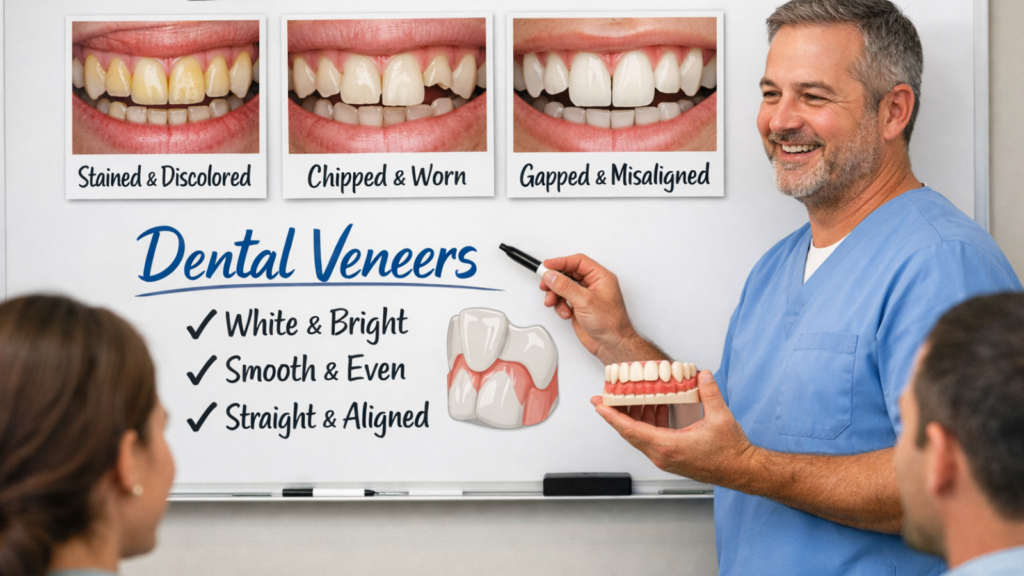
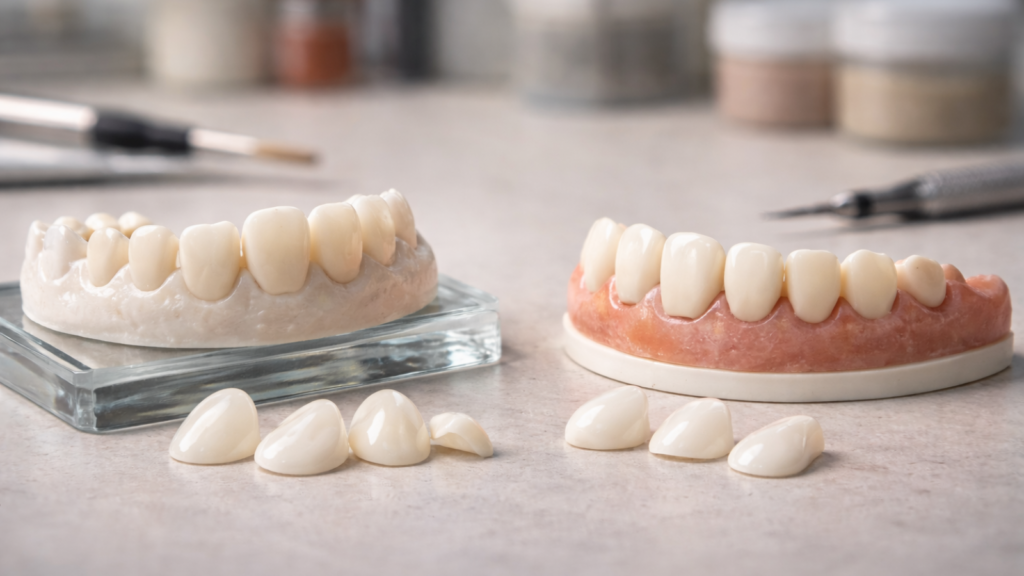
A dental veneer is a thin shell of porcelain or composite material bonded to the front surface of your tooth. Dentists use veneers primarily to correct cosmetic concerns rather than structural damage.
Veneers solve specific aesthetic problems that other treatments cannot address as effectively. Discolored teeth that resist whitening treatments, from tetracycline staining, fluorosis, or root canal procedures, transform completely with veneers. Teeth with chips, cracks, or worn edges gain a smooth, uniform appearance. Gaps between teeth close without orthodontics. Minor rotations or misalignments improve without braces.
The treatment works best for patients with healthy tooth structure who want dramatic cosmetic improvement. Veneers require minimal tooth reduction (typically 0.5 to 0.7 millimeters), preserving most of your natural enamel. This conservative approach makes veneers ideal for front teeth visible when you smile.
What is a dental crown and when is it medically necessary?
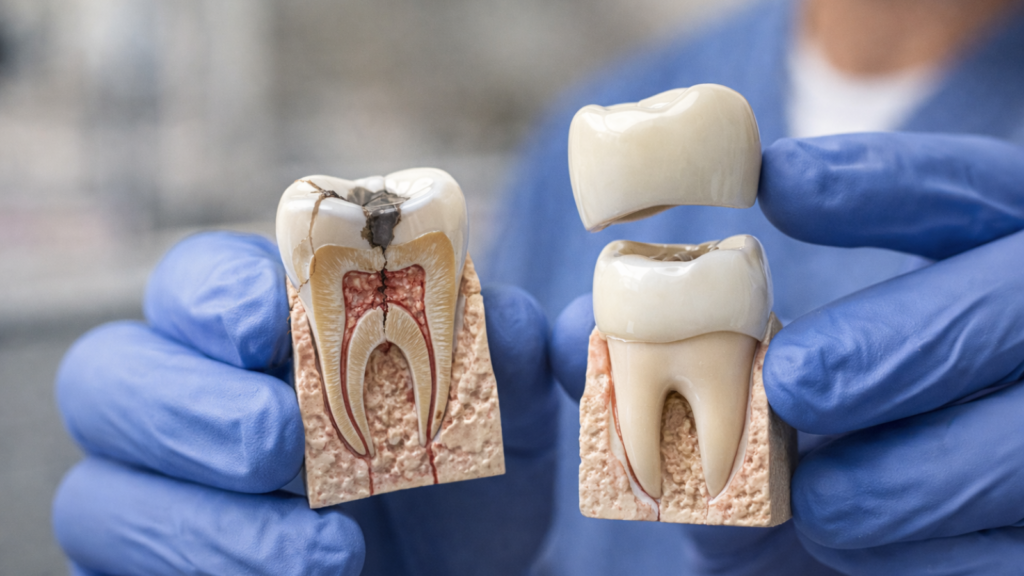
A dental crown is a full-coverage restoration that encases your entire tooth from the gum line upward. Unlike veneers that cover only the front surface, crowns protect all sides of your tooth.
Dentists recommend crowns when teeth have significant structural damage or weakness. A tooth with a large filling, occupying more than 50% of the tooth structure, needs a crown to prevent fracture. Root canal treated teeth require crowns because they become brittle without their blood supply. Severely decayed teeth with multiple failing fillings benefit from the complete protection crowns provide. Cracked teeth that extend below the gum line need crowns to hold the remaining structure together.
Medical necessity drives crown recommendations. Your tooth lacks sufficient structure to support a filling or veneer. Crowns restore both function and appearance, letting you chew normally without risking further damage. The procedure requires more tooth reduction than veneers, typically 1.5 to 2 millimeters (1500 to 2000 micrometers) from all surfaces, but this reduction enables the crown to fit properly and provide adequate strength.
What is composite bonding and why is it considered minimally invasive?
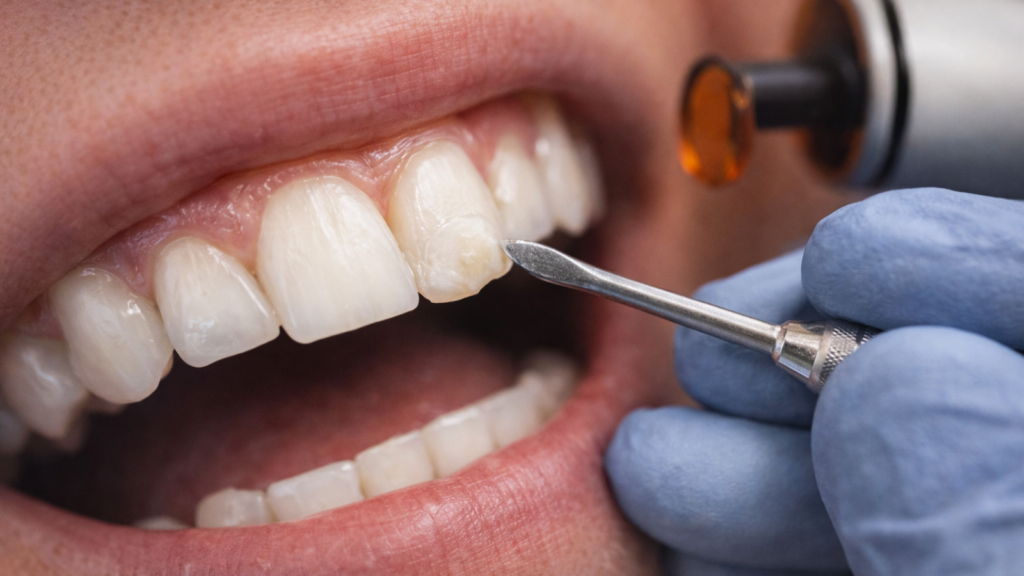
Composite bonding is a tooth-colored resin material sculpted directly onto your tooth surface during a single appointment. A dentist applies the resin, shapes it to match your natural tooth contour, and hardens it with a special light.
Bonding earns the minimally invasive designation because it preserves maximum tooth structure. Most bonding procedures require zero tooth reduction. Your dentist roughens the enamel surface slightly, applies bonding agent, then builds up the composite layer by layer. This additive approach contrasts sharply with veneers and crowns, which require removing tooth structure before placement.
The treatment excels at repairing small chips, closing minor gaps, and covering isolated discoloration spots. Bonding works particularly well for young patients whose teeth are still developing. Parents appreciate that bonding can be revised or replaced as their child grows without permanently altering tooth structure. Adults use bonding as a conservative first treatment before committing to more permanent options.
Bonding limitations become apparent with extensive cosmetic concerns. The material stains more easily than porcelain, lasts fewer years, and cannot withstand the same chewing forces as crowns. Still, the reversibility and low cost make bonding an excellent starting point for many patients.
Veneers vs crowns vs composite bonding: key differences at a glance (comparison table)
| Feature | Veneers | Crowns | Composite Bonding |
| Coverage Area | Front surface only | Entire tooth (360°) | Targeted spots or front surface |
| Tooth Reduction | 0.5 to 0.7 mm | 1.5 to 2 mm | Usually none (0 mm) |
| Primary Purpose | Cosmetic improvement | Structural restoration + aesthetics | Minor repairs + cosmetic touch-ups |
| Best For | Healthy teeth with aesthetic concerns | Damaged, weakened, or heavily filled teeth | Small chips, gaps, minor discoloration |
| Material Options | Porcelain, composite | Zirconia, porcelain, metal, PFM | Composite resin only |
| Appointments Needed | 2 to 3 visits | 2 to 3 visits | 1 visit (same day) |
| Lab Fabrication | Yes (porcelain veneers) | Yes | No (done chairside) |
| Reversibility | No (enamel removed) | No (significant tooth reduction) | Yes (can be removed/replaced easily) |
| Average Lifespan | 10 to 15 years | 15 to 25 years | 5 to 7 years |
| Stain Resistance | Excellent (porcelain) | Excellent (porcelain/zirconia) | Moderate (stains with coffee, tea, wine) |
| Typical Cost (Kathmandu) | NPR 25,000 to 45,000 per tooth | NPR 15,000 to 50,000 per tooth | NPR 3,000 to 8,000 per tooth |
This table clarifies the fundamental trade-offs. Veneers prioritize aesthetics with minimal tooth removal. Crowns prioritize strength and comprehensive protection. Bonding prioritizes preservation and reversibility. Your specific dental condition determines which trade-off serves you best.
Common myths and misconceptions about cosmetic dental treatments
Myth 1: Veneers damage your natural teeth
Your natural teeth remain healthy under properly placed veneers. The minimal enamel removal (0.5 to 0.7 millimeters) occurs in the outermost layer only. Enamel thickness on front teeth ranges from 1 to 2.5 millimeters, leaving substantial natural structure intact. Problems arise from improper placement or excessive reduction by inexperienced dentists, not from veneers themselves.
Myth 2: Crowns are only for old people
Age does not determine crown necessity, tooth condition does. Young adults who grind their teeth heavily often crack molars by age 25, requiring crowns. Athletes experience dental trauma regardless of age. Children with severe decay or developmental defects receive stainless steel crowns routinely. The oldest patients with excellent oral hygiene may never need a crown.
Myth 3: Composite bonding looks fake and obvious
Modern composite materials match natural tooth color with remarkable accuracy when applied by skilled dentists. Poorly done bonding appears opaque and unnaturally white because the dentist failed to layer different shades or polish the surface properly. High-quality bonding blends seamlessly with your natural teeth. The limitation is staining over time, not initial appearance.
Myth 4: You need to replace all your front teeth together
Matching veneers or crowns to existing teeth requires expertise but remains entirely possible. Dentists take shade photographs, select custom colors, and communicate with dental labs to match neighboring teeth precisely. Replacing only 2 front teeth while leaving adjacent teeth natural works well. The exception occurs when existing teeth have significant discoloration that veneers cannot match.
Myth 5: Dental work in Nepal lacks quality compared to India or Thailand
Kathmandu dental clinics use identical materials and technologies as facilities in India, Thailand, and Western countries. Dentists trained at leading universities worldwide practice in Nepal. The determining factor is the individual dentist and clinic, not the country. Research dentist credentials, view before-and-after photos, and read patient reviews exactly as you do elsewhere.
How Dentists Decide What’s Right for You (Clinical Decision Framework)

Your dentist evaluates multiple clinical factors before recommending veneers, crowns, or bonding for your specific situation. Remaining tooth structure, bite forces, grinding habits, gum health, and medical conditions all influence treatment selection significantly. This systematic evaluation ensures the chosen treatment not only improves your smile but also functions reliably for years based on your individual oral health profile.
How much natural tooth structure remains, and why it matters
Your dentist evaluates remaining tooth structure first because this single factor eliminates inappropriate treatment options immediately.
Teeth with greater than 70% healthy structure qualify for veneers or bonding. The enamel and dentin remain strong enough to support thin restorations. Patients asking for crowns in this scenario receive recommendations for less invasive options instead. Preserving tooth structure always takes priority over aggressive treatment.
Teeth with 40% to 70% remaining structure enter a decision zone. Small to moderate fillings may succeed with reinforcement, or crowns may provide better long-term protection. Your dentist considers crack patterns, filling locations, and how you use the tooth. Front teeth with 50% structure remaining often receive veneers successfully. Molars bearing heavy chewing forces typically need crowns at this threshold.
Teeth with less than 40% remaining structure require crowns or extraction. Fillings and bonding cannot withstand normal chewing forces without fracturing the weakened tooth. Dentists explain this limitation clearly: the tooth will break without crown protection. Some patients resist crowns due to cost concerns, then return months later with broken teeth requiring extraction, a more expensive outcome.
X-rays reveal internal damage invisible to the naked eye. Decay beneath old fillings, cracks extending toward the root, and thinned tooth walls all impact treatment selection. Your dentist reviews these images with you, pointing out exactly why certain treatments work while others fail for your specific tooth.
Bite forces, grinding (bruxism), and chewing habits: will bonding last?
Humans generate bite forces ranging from 70 to 150 pounds per square inch during normal chewing. Patients who grind their teeth at night, a condition called teeth grinding (bruxism), exert forces exceeding 250 pounds per square inch for hours at a time.
Composite bonding fails rapidly under grinding forces. The material chips away within months rather than years. Dentists explain this limitation honestly during consultation. Bonding works well for non-grinders but proves wasteful for patients who clench or grind. These patients need porcelain veneers or crowns, which withstand significantly higher forces.
Your dentist identifies grinding through specific tooth wear patterns. Flattened cusps on molars, thinned edges on front teeth, and exposed dentin indicate chronic grinding. Many patients grind unconsciously during sleep and deny the habit initially. Examination findings prove more reliable than patient history.
Chewing ice, opening packages with teeth, or biting fingernails increases failure risk for all restorations. Bonding chips immediately from ice chewing. Veneers crack eventually. Even crowns sustain damage from extreme misuse. Dentists ask about these habits specifically because modifying them extends treatment longevity significantly.
Night guard recommendations accompany veneer or bonding treatment for grinders. The custom night guard absorbs grinding forces that would otherwise damage your restorations. Patients who refuse night guards void some warranty coverage because premature failure becomes predictable.
Gum health, enamel quality, and oral hygiene considerations
Inflamed, bleeding gums contraindicate all elective cosmetic dentistry. Your dentist treats gum disease first, waits for healing, then proceeds with veneers or crowns. Placing restorations over infected gums guarantees failure. The inflammation spreads beneath the veneer, decay develops at margins, and the restoration loosens.
Periodontal treatment timeline varies by severity. Mild gingivitis resolves within 2 to 3 weeks of improved brushing and flossing. Moderate periodontitis requires deep cleaning and 2 to 3 months of healing. Advanced cases need surgical intervention and 6 months of healing before cosmetic dentistry becomes viable.
Enamel quality determines bonding success. Teeth with fluorosis or hypoplastic enamel bond unpredictably. The enamel structure contains defects that prevent adequate adhesion. Dentists perform test bonds on these teeth before committing to full treatment. Poor bonding strength shifts recommendations toward crowns, which rely on mechanical retention rather than adhesive bonding.
Patients with poor oral hygiene face difficult conversations with dentists. Placing expensive veneers on teeth you do not clean regularly wastes money. Decay develops at veneer margins within 2 to 3 years. Dentists refuse treatment until you demonstrate consistent hygiene through several cleaning appointments. This requirement protects both your health and your financial investment.
Age, lifestyle, and long-term expectations for smile makeovers
Young patients under 25 receive bonding recommendations more often than veneers, especially when considering a smile makeover for weddings and special events. Teeth continue subtle movement and eruption until approximately age 25. Permanent veneers placed too early may require replacement as teeth shift. Bonding provides excellent temporary aesthetics that can be adjusted easily as facial features mature.
The exception occurs with severe discoloration or damage where waiting causes significant psychological distress. Dentists discuss the likelihood of future replacements and ensure patients understand the long-term commitment.
Active lifestyles influence material selection. Athletes who play contact sports need extra protection. Full crowns on front teeth provide more durability than veneers for rugby players, martial artists, or hockey players. Custom sports guards become mandatory for veneer patients participating in contact sports.
Long-term expectations require realistic discussion. Patients expecting lifetime results from any single dental restoration face disappointment. All dental work requires eventual maintenance or replacement. Veneers last 10 to 15 years on average, crowns 15 to 25 years, and bonding 5 to 7 years. Budget planning should include future replacement costs divided across these timeframes.
Lifestyle factors like diet and oral habits accelerate or delay replacement needs. Patients who avoid staining foods and maintain excellent hygiene extend veneer lifespan significantly. Those who continue smoking, drinking heavy tea, or neglecting flossing require replacements sooner.
Medical conditions (diabetes, smoking, medications) that affect treatment choice
Diabetes affects healing and infection risk after dental procedures. Patients with well-controlled diabetes (HbA1c below 7%) proceed with standard treatment protocols. Those with uncontrolled diabetes (HbA1c above 9%) face delayed healing and higher infection rates. Dentists require diabetes management optimization before proceeding with elective procedures.
Glucose levels on the day of treatment matter too. Your dentist checks your recent glucose readings before crown preparation or veneer bonding. High blood sugar on treatment day increases bleeding and impairs the bonding process.
Smoking compromises blood flow to gums and teeth, reducing healing capacity and restoration longevity. Smokers experience veneer failure rates approximately 40% higher than non-smokers. The heat and chemicals damage the bonding interface over time. Dentists strongly encourage smoking cessation before cosmetic dentistry. Some refuse treatment for active smokers, while others require signed acknowledgment of increased failure risk.
Medications causing dry mouth, including antidepressants, antihistamines, and blood pressure medications, increase decay risk around dental restorations. Saliva protects teeth by neutralizing acids and washing away bacteria. Reduced saliva production leaves restoration margins vulnerable to decay. Patients on these medications require fluoride supplementation and more frequent dental cleanings.
Bisphosphonate medications for osteoporosis require special consideration before tooth extraction. These drugs impair bone healing and can cause jaw necrosis after invasive procedures. Your dentist reviews your complete medication list and coordinates with your physician when necessary.
Treatment Process, Timeline & What to Expect
Each restoration option follows a distinct procedural timeline with specific steps from consultation through final placement. Veneers and crowns typically require 2 to 3 appointments spanning 2 to 3 weeks including laboratory fabrication time, while composite bonding completes during a single visit. Understanding the detailed process for each treatment helps you prepare mentally, schedule appropriately, and know exactly what happens at every appointment.
Your first consultation: exams, X-rays, photos, and smile planning
The consultation appointment lasts 45 to 60 minutes and determines your entire treatment plan. Your dentist begins with a comprehensive oral examination, checking each tooth for decay, cracks, old fillings, and structural problems. Gum health assessment follows, measuring pocket depths and identifying inflammation.
X-rays reveal issues invisible during visual examination. Dentists take bitewing X-rays to detect decay between teeth and periapical X-rays to assess root and bone health. Panoramic X-rays show the entire jaw structure, helpful for identifying previous root canals, impacted teeth, or bone loss.
Digital photographs document your current smile from multiple angles. Dentists capture close-ups of individual teeth and full-face photos showing your smile in relation to your lips and facial features. These photos serve 3 purposes: firstly, they provide a baseline for comparing treatment results; secondly, they help communicate your goals to the dental laboratory; thirdly, they become part of your permanent treatment record.
Smile planning moves beyond clinical needs to aesthetic preferences. Your dentist asks about your ideal tooth shape, size, and color. Reference photos from magazines or online help communicate your vision. Discuss realistic outcomes openly. Dentists explain what your facial features support and what appears unnatural.
Treatment cost estimates include all necessary procedures. Your dentist itemizes each step, cleanings, fillings, crown preparations, lab fees, so you understand exactly what you pay for. Payment plans and financing options receive discussion during this appointment.
Veneers step-by-step: preparation, lab work, fitting, and healing timeline
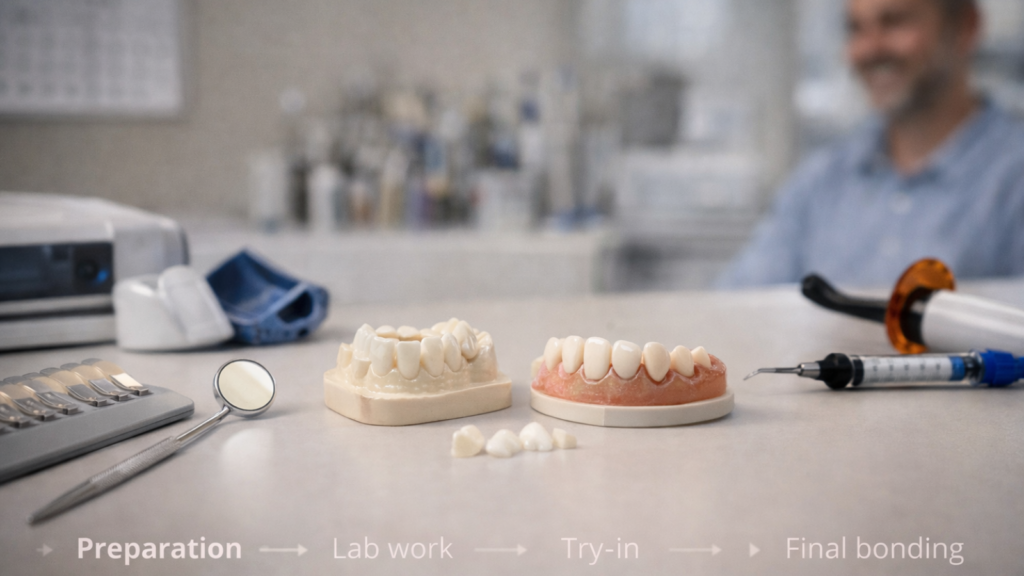
Appointment 1: Preparation (90 to 120 minutes)
Your dentist numbs the treatment area with local anesthesia. Tooth preparation removes 0.5 to 0.7 millimeters of enamel from the front surface, creating space for the veneer without making your tooth appear bulky. The preparation extends slightly beyond the visible front surface to hide veneer edges.
Preparation depth varies by case. Teeth with existing discoloration require slightly more removal to mask the underlying color. Perfectly white teeth need minimal reduction.
After preparation, your dentist takes impressions using putty material or digital scanning. These impressions capture exact tooth dimensions and bite relationships. Temporary veneers made from acrylic protect your prepared teeth while the lab fabricates your permanent veneers. Temporaries look acceptable but feel rough and require gentle eating.
Shade selection happens at this appointment. Your dentist uses a shade guide, a set of sample teeth in various colors, holding different shades next to your natural teeth in natural light. Photos of selected shades accompany your impressions to the laboratory.
Lab Work (10 to 14 days)
Dental technicians create your veneers from porcelain blocks, layering colors to mimic natural tooth translucency. High-quality labs build custom shading that looks different in various lighting conditions, exactly like natural teeth.
Appointment 2: Try-In (15 to 30 minutes)
Your dentist places veneers on your teeth without cement to verify fit and appearance. This try-in lets you see exactly how your new smile looks. Request modifications at this stage. Lab adjustments take another 3 to 5 days but ensure satisfaction.
Appointment 3: Final Bonding (60 to 90 minutes)
Your dentist cleans your prepared teeth thoroughly, then acid-etches the enamel to create microscopic roughness for bonding. Each veneer receives internal etching too, preparing the porcelain surface for adhesive.
Bonding cement fills the space between tooth and veneer. Your dentist removes excess cement, then hardens the bond with a special curing light. The process repeats for each tooth. Final polishing smooths all edges.
Bite adjustment follows bonding. Your dentist checks how your teeth meet when you close your mouth, grinding away any high spots that cause premature contact. This adjustment prevents chipping and discomfort.
Healing and Adjustment Period (2 to 4 weeks)
Sensitivity to cold temperatures occurs commonly for 1 to 2 weeks after veneer placement. This sensitivity resolves as your tooth adapts to the new restoration. Avoid extremely hot or cold foods initially.
Your teeth feel different, smoother, slightly thicker. This sensation normalizes within 1 week as your lips, tongue, and cheeks adapt. Some patients experience minor speech changes for 2 to 3 days, particularly with certain sounds like “s” or “f.”
Return for your follow-up appointment 2 weeks after bonding. Your dentist checks veneer adaptation, bite comfort, and gum health around the restorations.
Crowns step-by-step: tooth reduction, temporaries, and final placement
Appointment 1: Preparation (60 to 90 minutes per tooth)
Local anesthesia numbs your tooth completely. Your dentist removes decay and old fillings first, assessing remaining tooth structure. Crown preparation reduces the tooth from all sides, front, back, chewing surface, and between teeth. Total reduction measures 1.5 to 2 millimeters (1500 to 2000 micrometers), creating space for crown thickness.
The prepared tooth resembles a small peg with rounded edges. Sharp angles crack crowns, so your dentist smooths all transitions. An impression captures this preparation exactly.
Temporary crowns protect your prepared tooth while the laboratory fabricates your permanent crown. These temporaries are cemented with weak cement that allows easy removal at your next appointment. Temporaries break occasionally, call your dentist immediately for recementation.
Avoid sticky or hard foods with temporaries. The temporary crown lacks the strength of your permanent restoration. Chew on the opposite side when possible.
Lab Work (10 to 14 days)
Laboratory technicians build your crown layer by layer. Zirconia crowns are milled from solid blocks using computer-guided machines. Porcelain crowns are hand-layered by technicians matching your natural tooth color.
Appointment 2: Final Placement (45 to 60 minutes)
Your dentist removes the temporary crown and cleans all temporary cement from your tooth. The permanent crown is tried in to verify fit and appearance. Approve the color and shape before final cementation, changes after cementing are difficult.
Permanent cementation uses strong adhesive. Your dentist dries your tooth thoroughly, applies bonding agent, and fills the crown with cement. The crown seats firmly onto your prepared tooth. Excess cement is removed carefully from around the gum line. A curing light hardens the cement.
Bite adjustment ensures comfortable chewing. Your dentist uses thin paper to mark high spots when you bite down. These high spots are ground away until your bite feels natural.
Healing Period (1 to 2 weeks)
Sensitivity after crown placement usually indicates high bite or residual cement irritating your gums. Contact your dentist rather than waiting for it to resolve. Adjustments take minutes and eliminate discomfort immediately.
Gums may appear slightly inflamed around new crowns due to procedure irritation. This redness resolves within 1 week with normal brushing and flossing. Persistent inflammation beyond 2 weeks suggests cement remnants under the gum line requiring removal.
Composite bonding procedure: one-visit treatment and instant results
Single Appointment (30 to 60 minutes per tooth)
Anesthesia is unnecessary for most bonding procedures. Your dentist roughens your tooth surface slightly with a mild acid etch, creating microscopic irregularities for bonding. The etch remains on your tooth for 15 to 30 seconds, then rinses away.
Bonding liquid coats your prepared tooth, soaking into the etched surface. A curing light hardens this bonding layer. Now the adhesive surface is ready for composite application.
Your dentist applies tooth-colored composite in thin layers, sculpting the material to match your natural tooth contour. Each layer receives light curing for 20 to 40 seconds before adding the next layer. This layering technique prevents internal stress that causes bonding failure.
Shaping and polishing refine the bonded tooth. Your dentist uses special burs to smooth rough areas and create natural-looking texture. Polishing discs and paste bring the surface to a high shine matching your natural enamel.
Bite check ensures comfortable chewing. Your dentist adjusts any high spots while the composite is still accessible for modification.
Immediate Aftercare
Avoid staining foods and drinks for 48 hours after bonding. Composite continues hardening fully for 24 to 48 hours after your appointment. Coffee, tea, red wine, and curry penetrate the slightly porous material during this curing period.
Bonded teeth function normally immediately. Resume regular eating and drinking after the 48-hour staining window passes.
Aftercare, maintenance routines, and follow-up schedules for each option
Veneers Maintenance
Brush twice daily with soft-bristled toothbrush and non-abrasive toothpaste. Whitening toothpastes contain abrasives that scratch porcelain over time, dulling the surface.
Floss daily around veneer margins. Plaque accumulation at the tooth-veneer junction causes gum inflammation and decay. Slide floss gently down the side of each tooth rather than snapping it forcefully through contacts.
Avoid biting hard objects. Opening bottles, tearing packages, or biting fingernails concentrates force on veneer edges where chipping occurs. Use scissors and bottle openers instead.
Professional cleanings every 6 months maintain gum health around veneers. Hygienists use special instruments that avoid scratching porcelain surfaces.
Crowns Maintenance
Brush and floss identically to natural teeth. Crown margins where the crown meets your tooth are vulnerable to decay without proper hygiene. Food and plaque collect in this junction easily.
Water flossers supplement traditional floss for crown maintenance. The pulsating water cleans beneath gum margins around crowns where floss sometimes misses.
Monitor for cement washout. Crowns occasionally develop gaps between the crown and tooth as cement dissolves over years. You taste metallic flavor or notice food packing in the area. Contact your dentist immediately, recementation is simple before decay develops.
Night guards protect crowns from grinding damage. Replace your night guard every 2 to 3 years as the material wears thin and loses protective capacity.
Professional cleanings every 6 months detect early problems. X-rays every 12 to 24 months monitor bone levels and decay around crowned teeth.
Bonding Maintenance
Minimize staining exposure. Bonding absorbs stains more readily than porcelain or natural enamel. Rinse your mouth after coffee, tea, or red wine. Use a straw for dark beverages when possible.
Avoid biting with bonded edges. Bonding chips more easily than other materials. Use your back teeth for biting hard foods like apples or crusty bread.
Polishing maintains shine. Professional polishing during cleaning appointments restores surface smoothness and luster to bonded teeth. Request polishing specifically, some hygienists overlook it.
Expect replacement every 5 to 7 years. Bonding discolors and chips gradually. Replacement is simple and minimally invasive since no tooth structure was removed initially.
Follow-Up Schedules
New veneers: 2 weeks, 6 months, then annually New crowns: 2 weeks, 6 months, then annually New bonding: 6 months initially, then with regular cleanings
Materials, Durability & Cost Considerations (Practical & Localized)
Material selection significantly impacts the appearance, longevity, and cost of your dental restoration. Porcelain veneers offer superior aesthetics and stain resistance compared to composite options, zirconia crowns provide exceptional strength for heavy chewing forces, and composite bonding delivers affordable solutions with shorter lifespans. Understanding the full picture of dental treatment costs in Kathmandu, which range from NPR 3,000 for basic bonding to NPR 45,000 for premium porcelain veneers, makes value-per-year analysis essential for budget planning.
Types of veneers: porcelain vs composite veneers, pros and cons
Porcelain Veneers
Porcelain veneers are custom-fabricated in dental laboratories from ceramic materials. The fabrication process involves layering different porcelain shades to mimic the natural translucency and color variation of tooth enamel.
Porcelain offers superior stain resistance compared to all other materials. Coffee, tea, wine, and tobacco cause minimal discoloration over decades. The glazed porcelain surface remains smooth and lustrous with minimal maintenance.
Strength distinguishes quality porcelain veneers. Modern ceramics withstand normal chewing forces for 10 to 15 years reliably. Failure typically results from grinding habits or trauma rather than material weakness.
The appearance of porcelain veneers surpasses composite veneers significantly. Light passes through porcelain similarly to natural enamel, creating realistic depth and translucency. Composite blocks light completely, appearing flat and opaque in comparison.
Cost represents the primary disadvantage. Porcelain veneers in Kathmandu range from NPR 25,000 to 45,000 per tooth depending on laboratory quality and dentist expertise. Multiple-tooth cases require substantial investment.
Treatment time spans 2 to 3 weeks due to laboratory fabrication. Patients wear temporary veneers during this period, which some find inconvenient.
Composite Veneers
Composite veneers are fabricated from the same resin material used for dental bonding. Dentists either build composite directly on your teeth during one appointment or indirect composite veneers are fabricated in a laboratory and later bonded.
Direct composite veneers complete in a single appointment lasting 2 to 4 hours depending on the number of teeth treated. This immediate result appeals to patients wanting fast cosmetic improvement.
Cost advantage makes composite accessible. Composite veneers in Kathmandu cost NPR 8,000 to 15,000 per tooth, roughly half the price of porcelain. Budget-conscious patients achieve significant smile improvement at lower investment.
Repairability offers practical benefit. Chipped composite veneers are repaired directly in your mouth during a brief appointment. Chipped porcelain veneers require complete replacement.
Aesthetic limitations become apparent quickly. Composite lacks the translucency of porcelain, appearing slightly opaque and artificial in bright light. Color matching natural teeth proves more difficult with composite.
Staining occurs progressively. Composite absorbs pigments from coffee, tea, curry, and wine. Veneers noticeably darken within 3 to 5 years. Professional polishing lightens the surface temporarily but does not restore original color.
Longevity falls short of porcelain. Composite veneers last 5 to 7 years on average before requiring replacement. Porcelain veneers last 10 to 15 years. The price difference narrows significantly when comparing cost per year of service.
Types of crowns: zirconia, ceramic, metal, and PFM compared
Zirconia Crowns
Zirconia is a white crystalline material known for exceptional strength. Molar crowns subjected to heavy chewing forces perform excellently in zirconia. The material resists fracture under grinding and clenching stresses that crack porcelain.
Aesthetic quality improved dramatically in recent years. Early zirconia appeared chalky white and opaque. Modern layered zirconia incorporates color gradients and translucency approaching natural teeth. Front tooth crowns in zirconia now match porcelain appearance while offering superior durability.
Biocompatibility causes zero allergic reactions. Patients with metal sensitivities tolerate zirconia perfectly. Gum tissue responds favorably to zirconia margins, showing less inflammation than metal-based crowns.
Cost in Kathmandu ranges from NPR 18,000 to 35,000 per crown depending on quality grades. Premium translucent zirconia costs more but delivers better aesthetics for front teeth.
All-Ceramic (Porcelain) Crowns
All-ceramic crowns are fabricated entirely from porcelain without any metal substructure. These crowns offer the most natural appearance of any material, perfectly matching surrounding teeth in color, translucency, and light reflection.
Front tooth crowns benefit most from all-ceramic materials. The translucency mimics natural enamel exactly, creating seamless integration with your smile. Laboratory technicians customize shading to match adjacent teeth.
Strength limitations restrict all-ceramic crowns to low-force areas. Front teeth and premolars tolerate porcelain well. Molars experience higher forces that risk cracking all-ceramic crowns. Dentists recommend zirconia for molar crowns instead.
Cost ranges from NPR 20,000 to 40,000 per crown in Kathmandu. Premium Japanese or German porcelain costs more but delivers superior aesthetics and longevity.
Metal Crowns
Metal crowns are fabricated from gold alloys or base metal alloys. These crowns provide maximum strength and durability, lasting 20 to 30 years routinely.
Molar crowns in the back of your mouth perform excellently in metal. The material withstands extreme chewing forces without chipping or cracking. Minimal tooth reduction is required, metal crowns function well with thin walls.
Aesthetic limitations relegate metal crowns to back teeth. The silver or gold color shows when you smile widely. Most patients prefer tooth-colored crowns on visible teeth.
Cost in Kathmandu ranges from NPR 10,000 to 25,000 depending on metal type. Gold alloy costs more than base metal but offers superior biocompatibility.
Porcelain-Fused-to-Metal (PFM) Crowns
PFM crowns combine metal strength with porcelain aesthetics. A metal shell provides structural support while tooth-colored porcelain covers the visible surfaces.
Cost efficiency makes PFM crowns popular. Prices range from NPR 12,000 to 25,000 in Kathmandu, less expensive than all-ceramic while offering reasonable aesthetics.
Aesthetic limitations appear over time. Metal shows as a dark line at the gum margin as gums recede with age. The porcelain layer sometimes chips away from the metal base. Modern materials (zirconia, all-ceramic) supersede PFM for front teeth in most cases.
Dentists recommend PFM crowns primarily for molars where strength matters more than aesthetics. The metal substructure prevents fracture under heavy chewing forces.
Direct vs indirect composite bonding: durability and cost differences
Direct Composite Bonding
Direct bonding refers to composite applied and shaped directly on your teeth during a single appointment. Your dentist sculpts the material freehand, building layers until the desired shape emerges.
Single-appointment completion appeals to patients with busy schedules. Walk in with chipped front teeth, walk out 90 minutes later with restored smile.
Cost remains minimal. Direct bonding in Kathmandu costs NPR 3,000 to 8,000 per tooth depending on complexity. This accessibility makes bonding the entry point to cosmetic dentistry for many patients.
Durability suffers compared to indirect bonding. Direct bonding lasts 3 to 5 years on average before chipping or discoloration necessitates replacement. The material undergoes greater shrinkage stress during curing when built in thick layers directly on teeth.
Aesthetic control proves more limited. Dentists work within your mouth without optimal viewing angles or lighting. Fine details and precise shading remain challenging to achieve chairside.
Indirect Composite Bonding
Indirect bonding involves fabricating composite restorations in a dental laboratory, then bonding them to your teeth at a second appointment. The laboratory technician builds the composite outside your mouth under magnification and ideal lighting.
Appearance quality improves significantly. Laboratory fabrication allows meticulous layering of different composite shades, creating natural translucency and color variation. The technician polishes the restoration to a high gloss before bonding.
Strength increases through controlled curing. Laboratory-fabricated composite cures completely under high-intensity lights and pressure, eliminating internal stresses that cause premature failure. Indirect bonding lasts 5 to 7 years typically, 2 years longer than direct bonding.
Cost rises moderately. Indirect composite bonding in Kathmandu costs NPR 10,000 to 18,000 per tooth due to laboratory fees and additional appointment time. The longevity improvement justifies the cost difference for many patients.
Treatment time extends to 2 weeks. You wear temporary restorations while the laboratory fabricates your composite. This delay inconveniences some patients who prefer immediate results.
How long veneers, crowns, and bonding really last in real life
Published research reports average lifespans: veneers 10 to 15 years, crowns 15 to 25 years, bonding 5 to 7 years. Real-world longevity varies dramatically based on habits, maintenance, and individual factors.
What Makes Veneers Fail Early (3 to 7 years)
Grinding habits cause 40% of early veneer failures. Patients who refuse night guards crack veneers within 5 years typically. The porcelain fractures under repeated stress that natural enamel would tolerate.
Poor oral hygiene creates decay at veneer margins. Plaque accumulation where the veneer meets tooth causes cavities that undermine the entire restoration. Dentists remove failed veneers to treat decay, requiring new veneers afterward.
Trauma from accidents or sports injuries chips veneers regardless of age. Front tooth impacts occur unpredictably. Protective mouthguards during sports prevent most trauma-related failures.
What Makes Veneers Last Longer (15 to 20+ years)
Excellent oral hygiene extends veneer life significantly. Patients who brush twice daily, floss nightly, and maintain 6-month cleaning schedules avoid decay and gum problems that compromise veneers.
Night guard use eliminates grinding damage completely. Patients who wear their night guards consistently experience nearly zero grinding-related failures.
Avoiding hard foods and bad habits preserves veneer edges. Patients who stop ice chewing, nail biting, and package opening with teeth prevent chipping.
What Makes Crowns Fail Early (5 to 10 years)
Root canal failures beneath crowns cause early replacement. The root canal treated tooth develops new infection, requiring retreatment and new crown afterward. Root canal success rates hover around 85% to 90%, failures occur despite proper treatment.
Cement washout allows decay under crown margins. Bacteria enter the gap between crown and tooth, causing decay that spreads under the crown. The tooth requires decay removal and new crown fabrication.
Crown fracture from grinding affects porcelain and zirconia crowns differently. Porcelain crowns crack completely, requiring replacement. Zirconia crowns chip on edges but remain functional, these chips are polished smooth and the crown continues service.
What Makes Crowns Last Longer (20 to 30+ years)
High-quality materials extend crown life substantially. Zirconia crowns and properly fabricated porcelain crowns last decades. Metal crowns routinely exceed 30 years.
Excellent oral hygiene prevents decay around crown margins. Patients who maintain meticulous cleaning avoid the most common cause of crown failure.
Regular dental monitoring catches problems early. Annual X-rays detect decay or cement washout before catastrophic failure occurs. Early intervention salvages crowns that would otherwise require replacement.
What Makes Bonding Fail Early (2 to 4 years)
Staining forces replacement despite structural integrity. Bonding darkens noticeably from coffee, tea, and wine within 3 years for heavy consumers. Patients replace discolored bonding for aesthetic reasons even though the material remains functional.
Edge chipping occurs commonly. Bonding material lacks the strength of porcelain. Thin edges chip away from normal chewing forces, especially on front teeth.
Debonding happens occasionally. The adhesive bond between composite and tooth fails, causing the bonding to pop off entirely. Teeth with poor enamel quality or insufficient tooth preparation experience higher debonding rates.
What Makes Bonding Last Longer (7 to 10 years)
Minimizing staining exposure prolongs aesthetic acceptability. Patients who drink coffee through straws, rinse after meals, and avoid tobacco keep bonding looking acceptable longer.
Strategic placement protects bonding from heavy forces. Bonding applied to areas experiencing light chewing forces lasts longer than bonding on biting edges.
Professional maintenance extends bonding life. Regular polishing restores surface smoothness and removes surface stains. Dentists repair small chips before they progress to complete failure.
Cost comparison in Kathmandu, Nepal: what affects pricing and value
Veneers Pricing Breakdown
Porcelain veneers in Kathmandu range from NPR 25,000 to 45,000 per tooth. This wide range reflects significant quality differences.
Budget veneers (NPR 25,000 to 30,000) use standard porcelain and basic laboratory fabrication. Acceptable aesthetics for most patients, though color matching and translucency fall short of premium options.
Mid-range veneers (NPR 30,000 to 38,000) feature better porcelain quality and more detailed laboratory work. Custom shading and improved translucency create more natural appearance.
Premium veneers (NPR 38,000 to 45,000) use highest-grade porcelain with advanced layering techniques. These veneers match natural teeth perfectly and maintain appearance longest.
Crowns Pricing Breakdown
Metal crowns: NPR 10,000 to 25,000 (gold alloy costs more) PFM crowns: NPR 12,000 to 25,000 Zirconia crowns: NPR 18,000 to 35,000 All-ceramic crowns: NPR 20,000 to 40,000
Laboratory quality drives price variation within each category. Premium dental laboratories charge higher fees but deliver superior fit and aesthetics. Poorly fitting crowns from budget laboratories require adjustments and remakes, ultimately costing more through treatment time and frustration.
Composite Bonding Pricing Breakdown
Direct bonding: NPR 3,000 to 8,000 per tooth Indirect bonding: NPR 10,000 to 18,000 per tooth
Complexity affects direct bonding pricing. Simple chip repairs cost NPR 3,000 to 5,000. Extensive reshaping or multiple-surface bonding costs NPR 6,000 to 8,000.
What Actually Affects Your Cost
Number of teeth treated reduces per-tooth price through bulk discounts. Treating 6 to 8 front teeth together typically receives 10% to 15% discount compared to single-tooth pricing.
Preliminary work adds cost before cosmetic treatment begins. Cleaning, fillings, gum treatment, and root canals must occur first. These necessary procedures increase your total investment but ensure long-term success.
Dentist experience level influences pricing reasonably. Highly experienced cosmetic dentists charge premium fees but deliver superior results requiring fewer adjustments and replacements. Budget dentists sometimes produce acceptable work but risk higher failure rates.
Clinic location within Kathmandu creates minor price differences. Clinics in Durbarmarg or Lazimpat charge slightly more than clinics in residential areas. The difference rarely exceeds NPR 5,000 to 8,000 per tooth.
Materials sourcing affects quality and price. Clinics using imported materials from Japan, Germany, or USA charge more than those using Indian or Chinese materials. Quality differences appear in longevity and aesthetics.
Budgeting, financing, and value-per-year cost breakdown
Value-Per-Year Analysis
Comparing total cost against expected lifespan reveals true value differences.
Porcelain veneers: NPR 35,000 ÷ 12 years = NPR 2,917 per year Composite veneers: NPR 12,000 ÷ 5 years = NPR 2,400 per year Zirconia crowns: NPR 25,000 ÷ 20 years = NPR 1,250 per year Direct bonding: NPR 5,000 ÷ 4 years = NPR 1,250 per year
This analysis shows zirconia crowns offer best value despite higher upfront cost. Direct bonding matches crown value when longevity proves acceptable for your goals.
Composite veneers deliver reasonable value for patients needing shorter-term solutions. Young adults expecting tooth movement or older patients with limited life expectancy benefit from this option.
Budgeting Strategies
Phased treatment spreads costs across multiple years. Treat your most visible front teeth first (typically 6 to 8 teeth), then add lateral teeth later. Most patients benefit maximally from treating just the front 6 teeth visible when smiling.
Prioritize problem teeth over perfect symmetry. Fixing 2 severely damaged front teeth dramatically improves your smile. Adding perfect symmetry later provides diminishing returns.
Combine treatments strategically. Place crowns on heavily damaged teeth, veneers on healthy teeth with aesthetic concerns, and bonding on minor imperfections. This mixed approach optimizes both cost and longevity.
Financing Options in Kathmandu
Many dental clinics offer installment payment plans. Typical terms include 3 to 6 monthly payments with zero interest or minimal interest (2% to 3% monthly). Total treatment costs divide into equal monthly installments.
Credit cards with 3 to 6 month interest-free periods finance dental treatment effectively. Calculate your monthly payment capacity before committing to treatment.
Medical loans from banks cover dental treatment costs. Interest rates range from 12% to 18% annually. Loan terms extend up to 36 months for larger treatment plans.
Dental insurance rarely covers cosmetic procedures in Nepal. Crowns receive partial coverage when medically necessary (not cosmetic). Verify coverage specifics with your insurance provider before treatment.
Hidden Costs to Consider
Maintenance costs accumulate over time. Professional cleanings every 6 months cost NPR 1,500 to 3,000. Night guards cost NPR 8,000 to 15,000 and require replacement every 3 to 5 years.
Future replacement costs should factor into budgeting. Eventually all dental work requires replacement. Set aside funds annually for future dental expenses.
Travel costs for quality care matter outside Kathmandu. Patients from outside the valley add transportation and accommodation expenses to treatment costs.
Alternatives, Risks, and Real-World Limitations
Beyond veneers, crowns, and bonding, several alternative treatments and important limitations deserve consideration before proceeding. Inlays, onlays, and bridges serve specific situations where standard options prove inadequate, while common problems like sensitivity, chipping, and staining affect all restoration types differently. Understanding when treatments fail, how preservation philosophy guides modern dentistry, and how to avoid unsafe providers protects both your health and financial investment.
Other restoration options: inlays, onlays, bridges, when they are better
Dental Inlays and Onlays
An inlay is a custom-fabricated filling that fits within the cusps (rounded points) of your tooth. An onlay extends over one or more cusps, providing more coverage than an inlay but less than a crown.
Inlays and onlays preserve more tooth structure than crowns while providing better durability than standard fillings. Teeth with moderate damage, too extensive for fillings but insufficient to warrant crowns, benefit from this middle-ground option.
Molar teeth with large fillings covering 30% to 50% of the chewing surface are ideal candidates. The inlay or onlay reinforces weakened areas without requiring the extensive reduction crowns demand.
Material options include gold, porcelain, and composite. Gold inlays last 20 to 30 years but show visibly. Porcelain inlays match tooth color perfectly and last 10 to 15 years. Composite inlays cost less but last only 5 to 7 years.
Cost in Kathmandu ranges from NPR 8,000 to 18,000 depending on material and complexity. This positions inlays between fillings and crowns in both invasiveness and cost.
Dental Bridges
A dental bridge is a fixed restoration that replaces missing teeth by crowning adjacent teeth and suspending a false tooth between them. Bridges restore chewing function and prevent tooth movement after tooth loss.
Bridges work best for single-tooth gaps with healthy adjacent teeth. The neighboring teeth are prepared for crowns, which support the suspended replacement tooth. This three-unit structure (two crowns plus one false tooth) functions as a permanent, non-removable solution.
Limitations include sacrificing healthy tooth structure. Your adjacent teeth require crown preparation even when they have no damage. This trade-off makes implants preferable when bone quality supports them.
Cost for a three-unit bridge in Kathmandu ranges from NPR 45,000 to 90,000 depending on materials. This higher cost reflects the multiple crowns and specialized laboratory work required.
When Bridges Beat Other Options
Patients with insufficient bone for dental implants benefit from bridges. Bone grafting costs exceed bridge costs significantly, making bridges more economical.
Medical conditions preventing surgery make bridges the only fixed-tooth replacement option. Patients with uncontrolled diabetes, blood clotting disorders, or recent radiation therapy cannot undergo implant surgery safely.
Fast treatment timelines favor bridges. Implant treatment requires 4 to 6 months for bone healing. Bridges complete within 3 weeks.
Common problems: sensitivity, staining, chipping, debonding
Post-Treatment Sensitivity
Cold sensitivity affects 60% to 70% of patients after veneer or crown placement. Your tooth nerves react to temperature changes transmitted through the thin restoration. This sensitivity peaks within 3 to 5 days post-treatment, then gradually diminishes over 2 to 3 weeks.
Normal sensitivity responds to over-the-counter desensitizing toothpaste containing potassium nitrate or stannous fluoride. Apply the toothpaste directly to sensitive areas without rinsing for maximum effect. Use twice daily.
Abnormal sensitivity persists beyond 4 weeks or worsens over time. This pattern suggests high bite points concentrating force on the restoration or exposed margins allowing temperature penetration. Contact your dentist for evaluation, simple adjustments resolve most cases.
Severe sensitivity indicating nerve damage requires root canal treatment. Teeth with minimal remaining structure or deep decay near the nerve occasionally require root canal before or after crown placement. Your dentist explains this risk during treatment planning.
Staining Patterns and Prevention
Composite materials stain progressively from dietary pigments. Coffee, tea, red wine, curry, and soy sauce deposit color molecules that penetrate the slightly porous composite surface. Staining intensity correlates with consumption frequency.
Surface stains respond to professional polishing during cleaning appointments. Hygienists remove superficial discoloration using fine abrasive paste. This maintenance extends aesthetic acceptability by 2 to 3 years.
Internal staining occurs when pigments penetrate deeper into the composite matrix. Professional polishing cannot remove internal stains. Replacement becomes necessary when discoloration reaches unacceptable levels.
Porcelain and zirconia resist staining almost completely. The glazed surface repels pigments effectively. Stains that develop on porcelain are surface deposits removed easily during professional cleaning.
Margin staining appears as a dark line where restorations meet natural teeth. Plaque accumulation and microscopic gaps allow stains to penetrate. Improved oral hygiene prevents margin staining before it becomes visible.
Chipping Mechanisms and Repair
Edge chipping affects bonding and porcelain veneers differently. Bonded teeth chip when the thin composite edge fractures under biting forces. Porcelain veneers chip at margins where the porcelain thickness measures less than 0.5 millimeters (500 micrometers).
Minor chips (under 2 millimeters) are repaired with additional composite bonding. Your dentist roughens the chipped area, applies bonding agent, and builds new composite to restore contour. Repairs complete within 30 minutes.
Major chips (over 2 millimeters) compromise structural integrity. Porcelain veneers require complete replacement when large chips occur, repairs fail quickly under chewing forces. Composite bonding tolerates larger repairs successfully.
Crown chipping follows similar patterns. All-ceramic crowns chip more readily than zirconia crowns. Metal and PFM crowns rarely chip. Chipped crowns on molars may require replacement, while chipped anterior crowns are sometimes repaired depending on location and size.
Debonding Causes and Solutions
Debonding refers to separation between the restoration and tooth, causing the veneer or bonding to detach partially or completely. Multiple factors contribute to debonding.
Moisture contamination during bonding causes 30% to 40% of early debonding failures. Saliva or blood contacting the prepared tooth surface before bonding prevents proper adhesion. Meticulous isolation using rubber dams prevents contamination.
Insufficient enamel bonding area reduces adhesive strength. Teeth prepared too deeply into dentin lack adequate enamel for strong bonding. Conservative preparation preserving maximum enamel prevents this issue.
Poor-quality bonding materials fail prematurely. Budget dental practices using inferior adhesives experience higher debonding rates. Quality dental cements from reputable manufacturers (3M, Ivoclar) bond reliably.
Rebonding detached restorations succeeds when the restoration remains undamaged. Your dentist cleans the tooth and restoration thoroughly, reapplies bonding agent, and recements the restoration. Rebonding takes 30 to 45 minutes.
Replacement becomes necessary when restorations break during debonding. Porcelain veneers crack easily during removal. New veneers require fabrication following the standard process.
Repair vs replacement: what happens when a treatment fails
When Repair Works
Small composite bonding chips repair successfully during brief appointments. Your dentist adds new composite to the damaged area, blends the repair with existing bonding, and polishes the surface smooth. Repairs last 2 to 3 years typically before requiring revision.
Minor porcelain veneer chips at margins are polished smooth when the chip exposes no underlying tooth. This polishing prevents sharp edges from cutting your lip or tongue. Aesthetic impact remains minimal after polishing.
Recementation saves debonded restorations when both the tooth and restoration remain intact. This procedure restores full function at minimal cost and time investment.
Adjustment fixes most bite-related problems. High spots causing discomfort grind away in minutes. Patients leave feeling immediate relief.
When Replacement Becomes Necessary
Large veneer chips exposing significant tooth structure require replacement. The compromised veneer lacks adequate strength even after repair. Temporary repairs fail within months, wasting time and money.
Decay developing under crowns or veneers necessitates complete restoration removal. Your dentist removes decay, possibly places a filling, then refabricates the restoration. Original restorations cannot be reused after decay removal reshapes the tooth.
Fractures extending into the root indicate non-restorable teeth. Extraction followed by implant or bridge becomes your only option. Dentists evaluate fracture depth using X-rays and clinical examination.
Color mismatch after years of service justifies replacement for some patients. Adjacent natural teeth darken or yellow while porcelain maintains original color. The contrast becomes noticeable. Replacement with properly shaded restorations restores color harmony.
Cost Implications of Failure
Early failures within warranty periods (typically 1 to 2 years) receive free replacement at most clinics. Read warranty terms carefully before treatment. Some warranties cover materials only, not dentist fees.
Failures beyond warranty periods require full payment for replacements. Budget 100% of original treatment cost for replacement. Some clinics offer courtesy discounts for returning patients.
Cascade failures increase total costs dramatically. One failing crown might overload adjacent teeth, causing additional failures. Address problems promptly before they spread.
Minimally invasive vs full-coverage dentistry: preserving your tooth
The Preservation Philosophy
Modern dentistry prioritizes conserving natural tooth structure whenever possible. Each millimeter of enamel and dentin removed weakens your tooth permanently. Teeth tolerate limited reduction cycles before becoming non-restorable.
Minimally invasive dentistry removes only diseased or damaged tissue, preserving maximum healthy structure. This approach relies on early intervention, preventive care, and conservative materials.
Full-coverage dentistry removes substantial tooth structure to accommodate restorations providing comprehensive protection. This approach suits severely damaged teeth requiring extensive rehabilitation.
Preservation Benefits Over Time
Preserved teeth tolerate future treatments better. Teeth with minimal previous reduction maintain adequate structure for crown placement decades later. Heavily reduced teeth become extraction candidates earlier.
Nerve vitality remains higher with minimal reduction. Aggressive preparation generates heat and removes dentin protecting the nerve. Vital nerves respond to stimuli appropriately, while damaged nerves may die requiring root canal treatment.
Gum health stays optimal around conservative restorations. Crown margins placed slightly above the gum line (supragingival margins) allow easy cleaning and prevent chronic inflammation. Deep subgingival margins trap plaque and irritate gums constantly.
When Aggressive Treatment Proves Necessary
Severe decay eliminating most tooth structure requires comprehensive coverage. Attempting conservative treatment on extensively damaged teeth fails predictably. Crowns provide the structural reinforcement necessary for long-term survival.
Major fractures extending toward the root need full coverage. Partial restorations cannot stabilize these teeth adequately. Crowns bind fractured segments together, preventing complete tooth loss.
Multiple failing restorations indicate compromised tooth integrity. Teeth with 3 or more large fillings benefit from crown protection rather than additional fillings. The remaining tooth structure cannot withstand more removal cycles.
Making the Decision
Your dentist evaluates remaining tooth structure using X-rays and clinical examination. Measurements of wall thickness, decay extent, and crack patterns guide treatment recommendations.
Conservative dentists favor preservation when outcomes remain uncertain. Overly aggressive dentists recommend crowns too readily. Seek second opinions when recommendations seem excessive compared to your tooth condition.
Book Porcelain veneers consultation for a natural smile
Trust dentists who explain trade-offs honestly. Every treatment decision involves balancing preservation against protection. Dentists acknowledging uncertainty and presenting multiple options demonstrate integrity.
Avoiding unsafe cosmetic dentistry and unlicensed providers
Red Flags Indicating Unsafe Practices
Promises of impossibly fast treatment raise concerns. Claims like “perfect smile in one day” suggest rushed procedures and inadequate treatment planning. Quality cosmetic dentistry requires proper planning, multiple appointments, and careful execution.
Extremely low prices indicate compromised quality. Porcelain veneers advertised at NPR 15,000 when standard prices range from NPR 25,000 to 45,000 use inferior materials or untrained technicians. The cheap veneer fails within 2 to 3 years, requiring complete replacement at standard prices.
Unlicensed practitioners operating illegally pose serious health risks. Nepal Dental Council licenses legitimate dentists. Verify your dentist holds current registration before treatment. Unlicensed providers lack training, use substandard materials, and operate without oversight or accountability.
Excessive tooth reduction for veneers indicates poor training. Veneers require 0.5 to 0.7 millimeters of reduction maximum. Dentists removing more than 1 millimeter either lack veneer training or use thick, bulky materials. The result appears unnatural and risks nerve damage.
Verifying Dentist Credentials
Nepal Dental Council maintains public registries of licensed dentists. Visit their office in Kathmandu or check online databases (when available) to verify registration status. Legitimate dentists display registration certificates prominently in their clinics.
Dental school graduation from recognized universities indicates baseline competence. Graduates from Kathmandu University, Tribhuvan University, or accredited international programs receive standardized training. Verify graduation credentials before treatment.
Continuing education in cosmetic dentistry separates specialists from general dentists. Advanced training in veneer preparation, shade matching, and smile design improves outcomes significantly. Ask about specific courses or certifications in aesthetic dentistry.
Professional association memberships signal commitment to quality. Nepalese Dental Association members maintain professional standards and ethical guidelines. International associations (American Academy of Cosmetic Dentistry) indicate advanced training.
Questions to Ask Before Treatment
“How many similar cases have you completed?” Experience matters tremendously in cosmetic dentistry. Dentists with 50+ veneer cases produce predictably good results. Those with under 20 cases still refine their technique.
“Can I see before-and-after photos of your previous patients?” Quality cosmetic dentists maintain extensive photo documentation. Photos reveal the dentist’s aesthetic sense and technical skill. Be suspicious of dentists who cannot show their work.
“What laboratory fabricates your restorations?” Laboratory quality determines final results significantly. Dentists using reputable Kathmandu laboratories or international labs produce superior work. Unknown laboratories or in-house fabrication raises quality concerns.
“What happens if I’m not satisfied with the results?” Clear revision policies indicate professional confidence. Dentists willing to adjust or remake restorations demonstrate commitment to patient satisfaction.
“What are the specific risks for my case?” Individual anatomy, habits, and health conditions create unique risks. Dentists who acknowledge these risks and explain mitigation strategies inspire confidence.
Which is better: veneers, crowns, or composite bonding?
Choose the treatment based on tooth condition and goals. Veneers suit healthy teeth with cosmetic concerns, crowns restore damaged or heavily filled teeth, and bonding fixes minor chips or gaps. Dentists assess tooth structure, bite forces, and aesthetics to select the correct option.
How long do veneers, crowns, and bonding last?
Porcelain veneers last 10–15 years, crowns last 15–25 years, and composite bonding lasts 5–7 years. Night guards, good hygiene, and avoiding hard foods often extend lifespan by 5–10 years.
Does getting veneers or crowns hurt?
Veneer and crown procedures do not hurt because dentists use local anesthesia. Mild cold sensitivity may occur for 1–3 weeks and resolves with desensitizing toothpaste.
Can I eat normally with veneers, crowns, or bonding?
Resume normal eating after 1–2 weeks for veneers and crowns, and after 48 hours for bonding. Avoid ice, hard candy, and shells. Avoid staining foods for 48 hours after bonding.
What happens to my natural tooth under a veneer or crown?
The tooth remains alive and healthy. Veneers remove 0.5–0.7 mm of front enamel. Crowns remove 1.5–2 mm around the tooth but usually preserve the nerve and root.
Will people notice I have veneers or crowns?
Well-made porcelain restorations look natural. Correct shade matching, translucency, and gum-line fit determine realism. Poor aesthetics result from poor technique, not the treatment.
Can veneers or crowns fix crooked teeth?
Veneers correct minor rotations, gaps, and uneven lengths. Moderate or severe misalignment requires orthodontics. Crowns do not change alignment but can mask small shape issues.
How much does each treatment cost in Kathmandu?
Bonding costs NPR 3,000–8,000 per tooth. Veneers cost NPR 25,000–45,000 per tooth. Crowns range from NPR 10,000–40,000. Zirconia crowns cost NPR 18,000–35,000. Dental in Kathmandu offers reliable treatment.
Do I need to replace all my front teeth at once?
Treat individual teeth if needed. Dentists match restorations to natural teeth. Treating 6–8 front teeth together improves symmetry and color harmony.
What is the biggest mistake people make when choosing between these treatments?
Choosing based on cost instead of clinical need causes failure. Bonding fails on severely damaged teeth. Crowns unnecessarily remove healthy tooth structure when used for minor cosmetic issues.